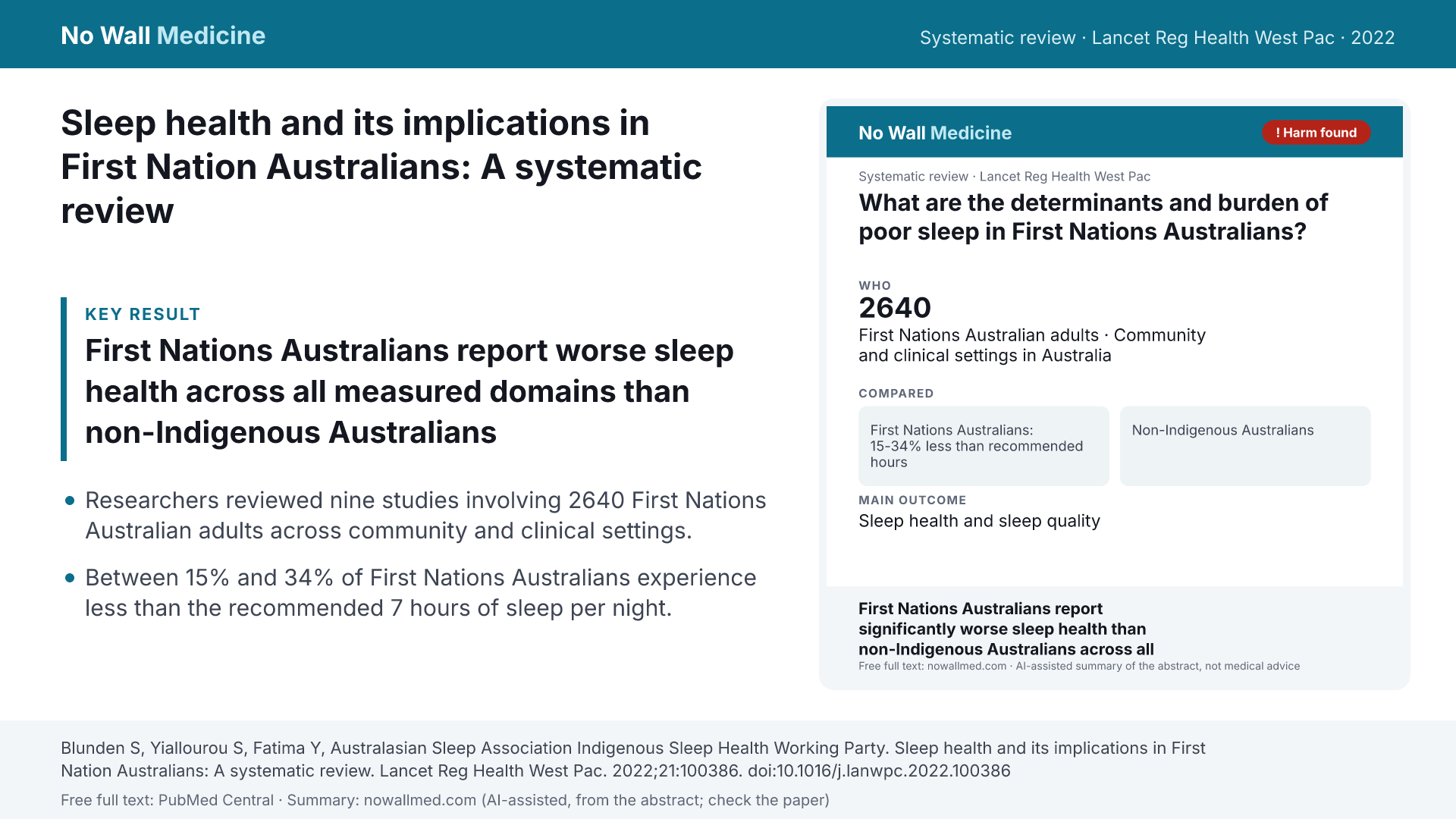
First Nations Australians report worse sleep health across all measured domains than non-Indigenous Australians
Sleep health and its implications in First Nation Australians: A systematic review
Systematic reviewHarm found
What are the determinants and burden of poor sleep in First Nations Australians?
Who
2640
First Nations Australian adults · Community and clinical settings in Australia
Compared
First Nations Australians: 15-34% less than recommended hours
Non-Indigenous Australians
Main outcome
Sleep health and sleep quality
Bottom line: First Nations Australians report significantly worse sleep health than non-Indigenous Australians across all measured domains.
Funded by: No external funding was provided
Lancet Reg Health West Pac · 2022-02-11Download image
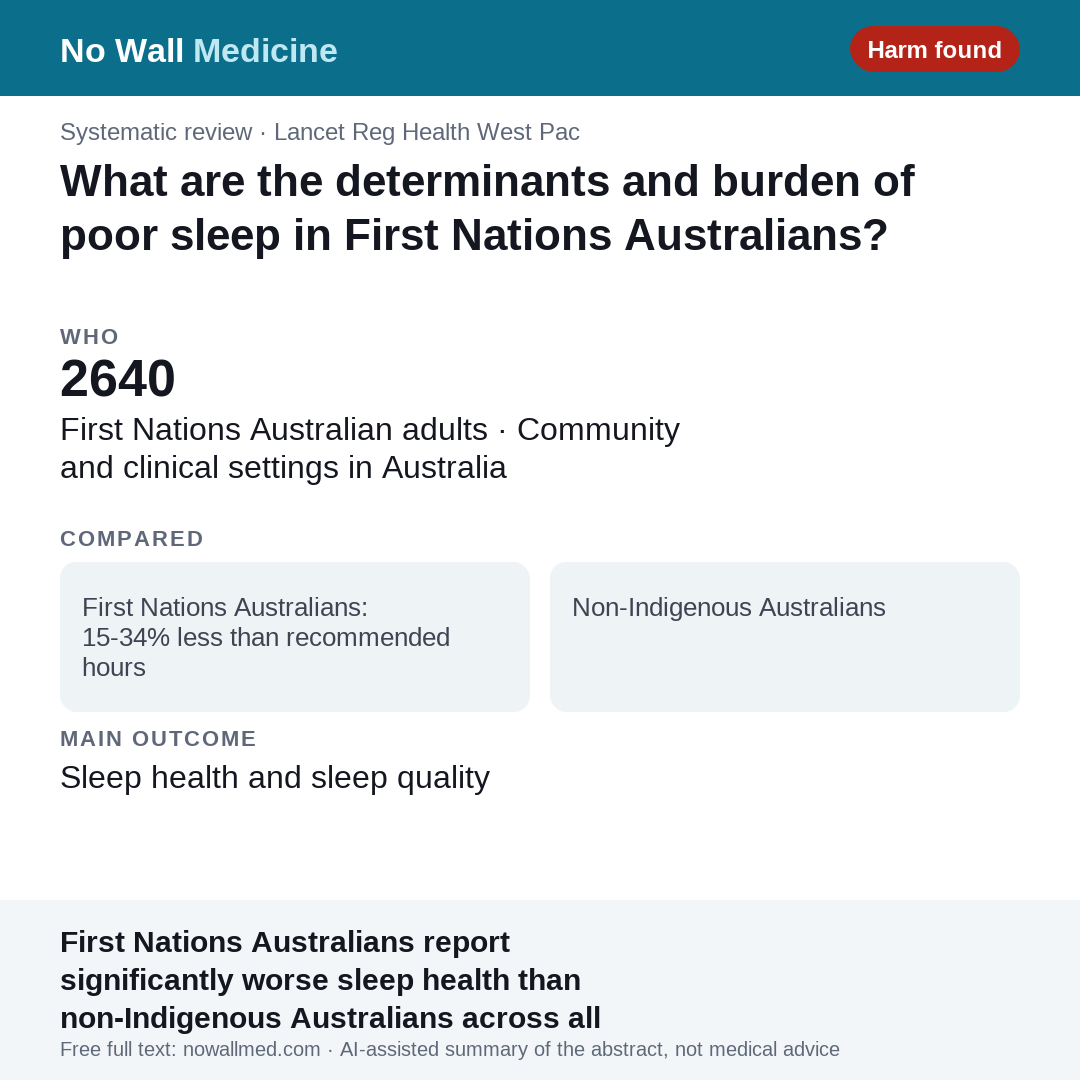
Clinical question: What are the determinants and burden of poor sleep in First Nations Australians?
Key points
- Researchers reviewed nine studies involving 2640 First Nations Australian adults across community and clinical settings.
- Between 15% and 34% of First Nations Australians experience less than the recommended 7 hours of sleep per night.
- Clinical populations showed a high prevalence of obstructive sleep apnea, which is a breathing disorder during sleep, at 39-46%.
Headline and key points written with AI from the paper’s abstract, with every number checked against it. Read the paper before relying on them.
Was this summary helpful?
Cite this article
Blunden S, Yiallourou S, Fatima Y, Australasian Sleep Association Indigenous Sleep Health Working Party. Sleep health and its implications in First Nation Australians: A systematic review. Lancet Reg Health West Pac. 2022. doi:10.1016/j.lanwpc.2022.100386
Spotted a mistake? Suggest a correction