Microneedle patches containing small interfering RNA resulted in smaller postoperative scar volumes than silicone sheets
Small interfering RNA microneedle patches versus silicone sheets in reducing postoperative scars: a randomized single-blinded intraindividually controlled clinical trial
Single-blinded intraindividually controlled randomized trialBenefit found
Do small interfering RNA microneedle patches reduce postoperative scar volume better than silicone sheets?
Who
Patients with 2-week-old postoperative wounds · Tertiary dermatological centre
Compared
small interfering RNA microneedle patches: 8.88 mm3
silicone sheets: 12.77 mm3
Main outcome
postoperative scar volume
Result: difference in mean percentage reduction of 9.7%
Bottom line: Small interfering RNA microneedle patches significantly reduce postoperative scar volume compared to silicone sheets.
Br J Dermatol · 2024-09-04Download image
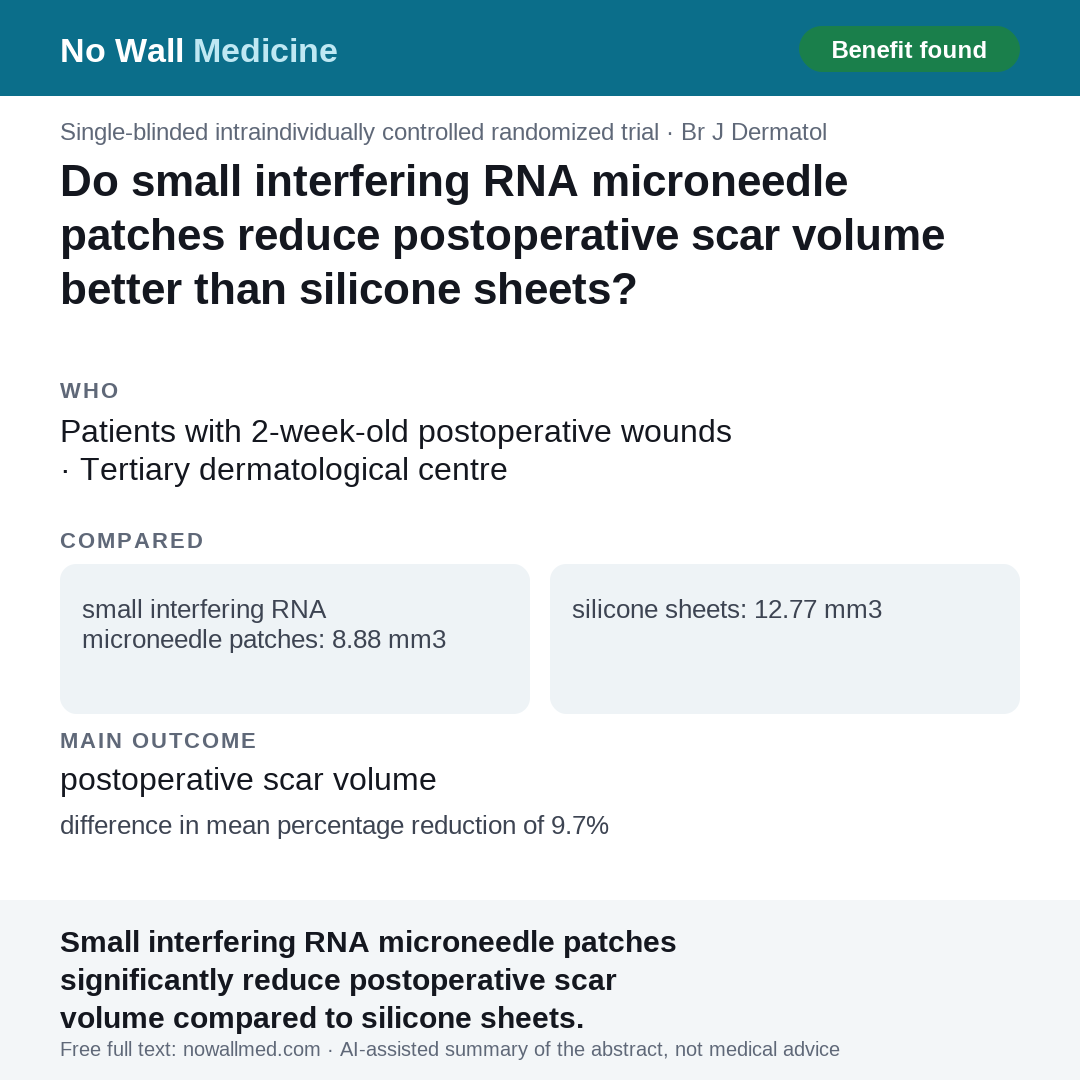
Clinical question: Do small interfering RNA microneedle patches reduce postoperative scar volume better than silicone sheets?
Why it matters: There are currently no treatments with good evidence for preventing the excessive production of fibrotic scar tissue like hypertrophic scars or keloids.
Key points
- In this randomized trial, patients with 2-week-old postoperative wounds had half of their scar treated with microneedle patches containing small interfering RNA and the other half with silicone sheets.
- At day 60, scars treated with microneedle patches had a lower volume of 8.88 mm3 compared to 12.77 mm3 for silicone sheets (P = 0.005).
- The mean percentage reduction in scar volume from baseline was 83.8% for the microneedle patches compared to 74.1% for the silicone sheets.
Headline and key points written with AI from the paper’s abstract, with every number checked against it. Read the paper before relying on them.
Topics
Cite this article
Lim DZJ, Chun YY, Tan FNSY, Monteiro AY, Cheng HM, Lee JY. Small interfering RNA microneedle patches versus silicone sheets in reducing postoperative scars: a randomized single-blinded intraindividually controlled clinical trial. Br J Dermatol. 2024. doi:10.1093/bjd/ljae347
Spotted a mistake? Suggest a correction
Top studies every Monday
The week’s key trials and guidelines in your specialties, by email. Free.
Get the weekly digest