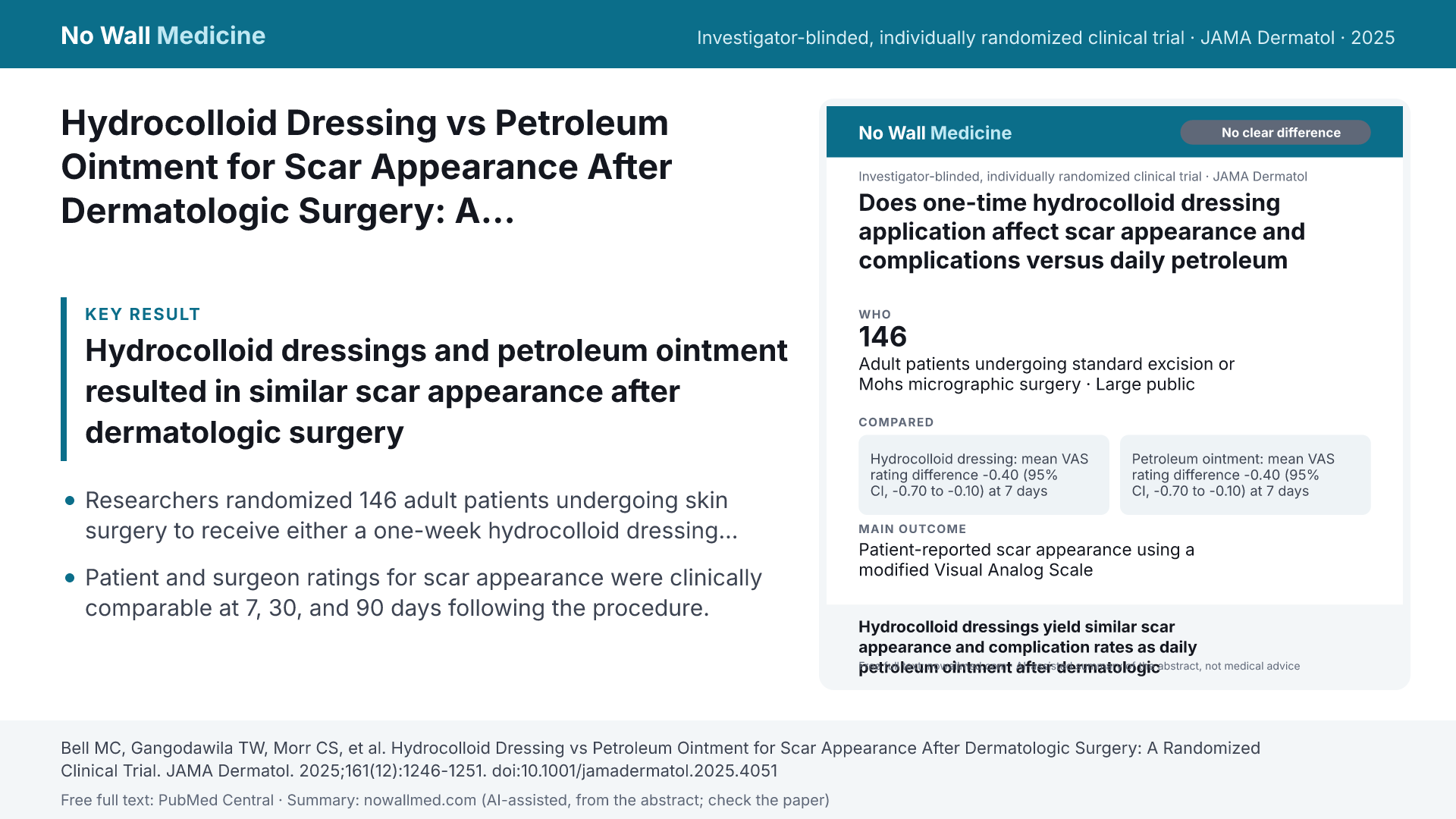
Hydrocolloid dressings and petroleum ointment resulted in similar scar appearance after dermatologic surgery
Hydrocolloid Dressing vs Petroleum Ointment for Scar Appearance After Dermatologic Surgery: A Randomized Clinical Trial
Investigator-blinded, individually randomized clinical trialNo clear difference
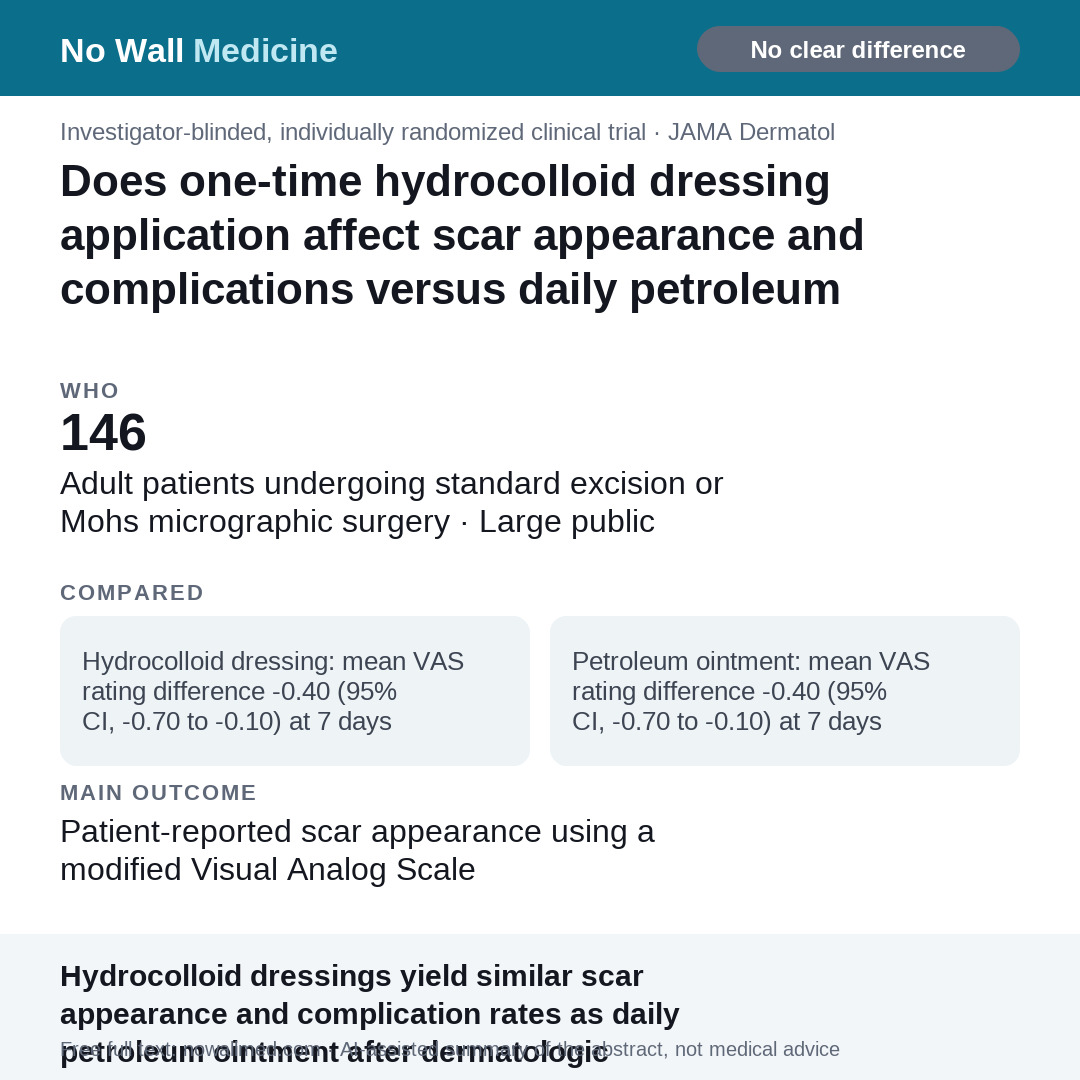
Does one-time hydrocolloid dressing application affect scar appearance and complications versus daily petroleum ointment?
Who
146
Adult patients undergoing standard excision or Mohs micrographic surgery · Large public university in Indiana
Compared
Hydrocolloid dressing: mean VAS rating difference -0.40 (95% CI, -0.70 to -0.10) at 7 days
Petroleum ointment: mean VAS rating difference -0.40 (95% CI, -0.70 to -0.10) at 7 days
Main outcome
Patient-reported scar appearance using a modified Visual Analog Scale
Result: -0.08 (95% CI, -0.38 to 0.23) at 30 days
Bottom line: Hydrocolloid dressings yield similar scar appearance and complication rates as daily petroleum ointment after dermatologic surgery.
Limitation: The hydrocolloid group had higher, but not statistically significant, rates of adverse events.
JAMA Dermatol · 2025-10-22Download image
Clinical question: Does one-time hydrocolloid dressing application affect scar appearance and complications versus daily petroleum ointment?
Why it matters: There are no randomized clinical trials comparing how hydrocolloid dressings affect scar appearance compared to daily petroleum ointment after excisional surgery.
Key points
- Researchers randomized 146 adult patients undergoing skin surgery to receive either a one-week hydrocolloid dressing or daily petroleum ointment.
- Patient and surgeon ratings for scar appearance were clinically comparable at 7, 30, and 90 days following the procedure.
- The hydrocolloid dressing group reported higher rates of postoperative bleeding, wound opening, and pain, though these differences were not statistically significant.
Headline and key points written with AI from the paper’s abstract, with every number checked against it. Read the paper before relying on them.
Was this summary helpful?
Subject terms
Cite this article
Bell MC, Gangodawila TW, Morr CS, Xue GR, Iqbal A, Merkel EA. Hydrocolloid Dressing vs Petroleum Ointment for Scar Appearance After Dermatologic Surgery: A Randomized Clinical Trial. JAMA Dermatol. 2025. doi:10.1001/jamadermatol.2025.4051
Spotted a mistake? Suggest a correction
Top studies every Monday
The week’s key trials and guidelines in your specialties, plus any topics you follow. By email, free.
Get the weekly digest