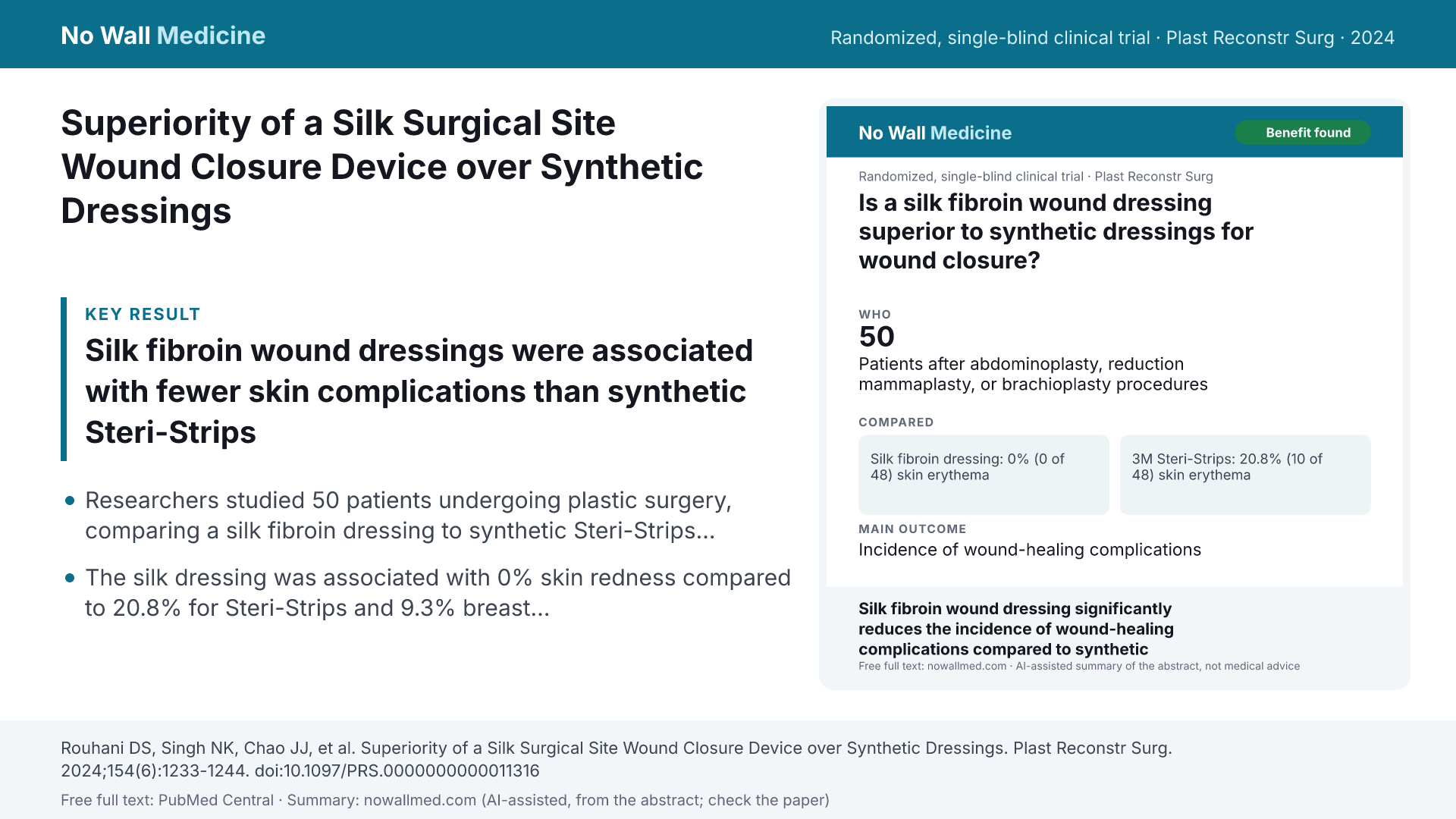
Silk fibroin wound dressings were associated with fewer skin complications than synthetic Steri-Strips
Superiority of a Silk Surgical Site Wound Closure Device over Synthetic Dressings
Randomized, single-blind clinical trialBenefit found
Is a silk fibroin wound dressing superior to synthetic dressings for wound closure?
Who
50
Patients after abdominoplasty, reduction mammaplasty, or brachioplasty procedures
Compared
Silk fibroin dressing: 0% (0 of 48) skin erythema
3M Steri-Strips: 20.8% (10 of 48) skin erythema
Main outcome
Incidence of wound-healing complications
Bottom line: Silk fibroin wound dressing significantly reduces the incidence of wound-healing complications compared to synthetic dressings.
Plast Reconstr Surg · 2024-02-07 · Save PNG
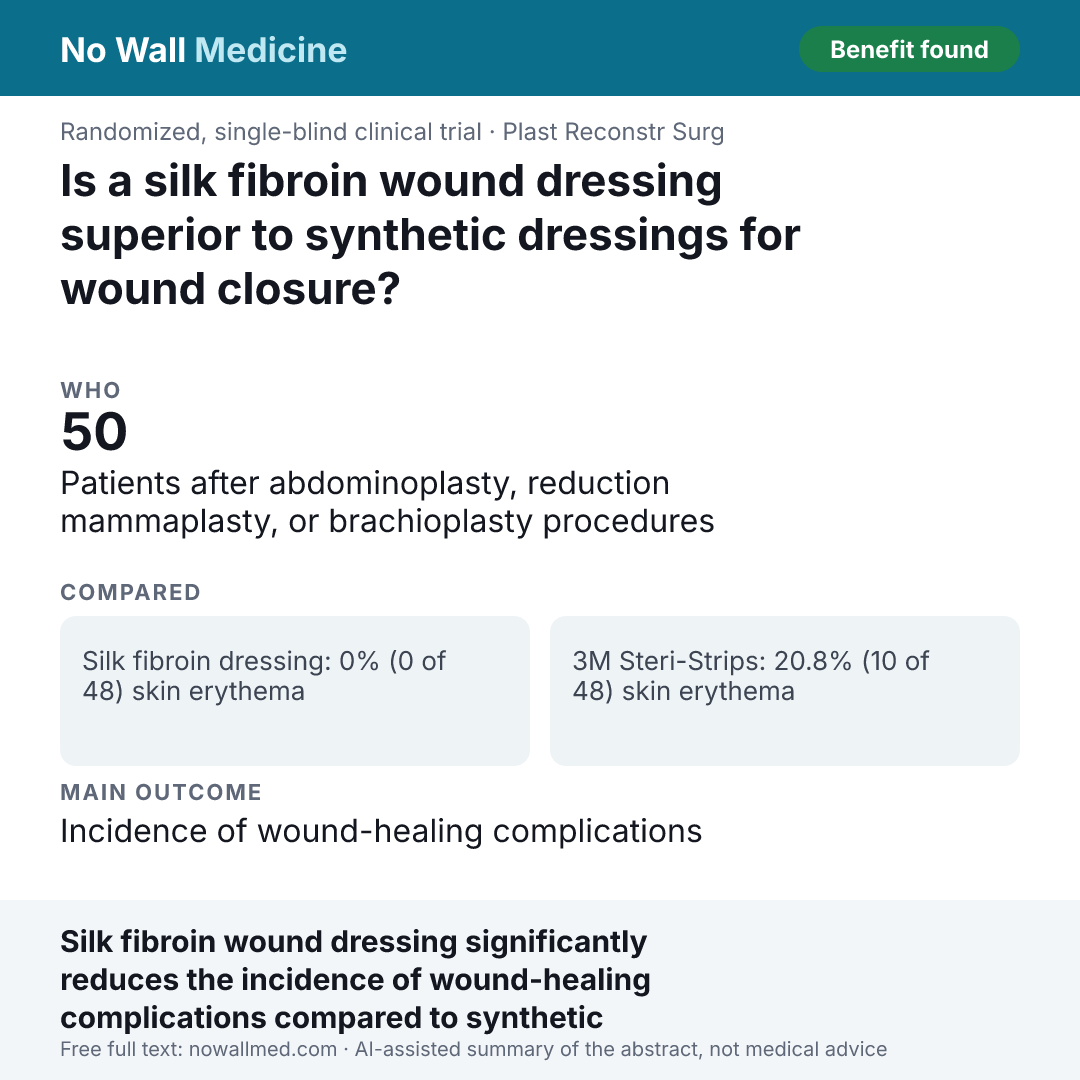
Clinical question: Is a silk fibroin wound dressing superior to synthetic dressings for wound closure?
Key points
- Researchers studied 50 patients undergoing plastic surgery, comparing a silk fibroin dressing to synthetic Steri-Strips on opposite sides of the body.
- The silk dressing was associated with 0% skin redness compared to 20.8% for Steri-Strips and 9.3% breast triple-point separation compared to 30.2% for Steri-Strips.
- Within the first 2 weeks, 75% of patients had partial or total detachment of Steri-Strips, while 0% had total detachment of the silk dressing.
Headline and key points written with AI from the paper’s abstract, with every number checked against it. Read the paper before relying on them.
Was this summary helpful?
Subject terms
Headline, design, result, key points, caveat and citation as plain text.
Cite this article
Rouhani DS, Singh NK, Chao JJ, et al. Superiority of a Silk Surgical Site Wound Closure Device over Synthetic Dressings. Plast Reconstr Surg. 2024;154(6):1233-1244. doi:10.1097/PRS.0000000000011316
Spotted a mistake? Suggest a correction