Smart Continence Care for People With Profound Intellectual and Multiple Disabilities Within Dutch Residential Care Facilities: Economic Evaluation Alongside a Cluster Randomized Trial
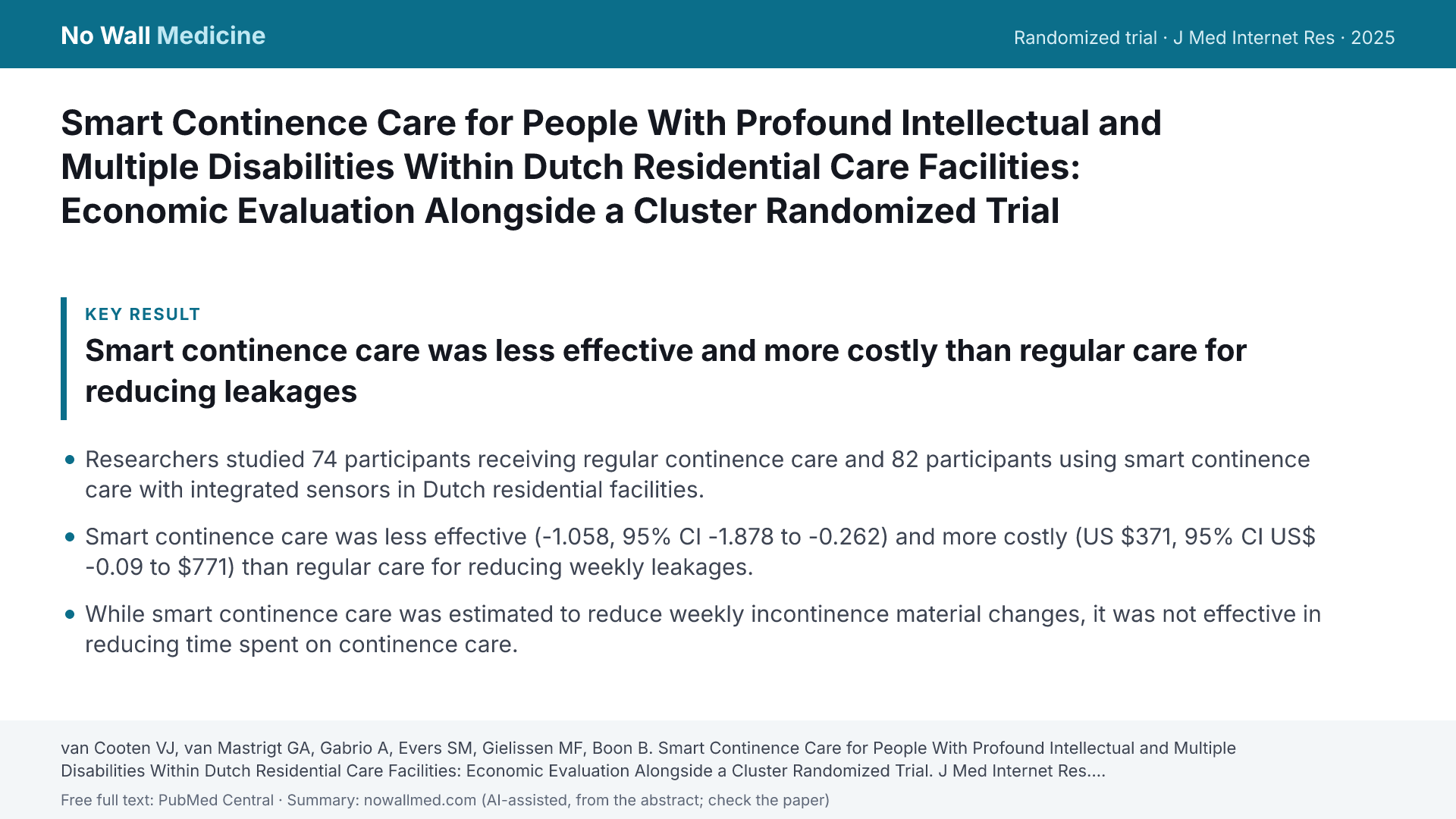
Key result: Smart continence care was less effective and more costly than regular care for reducing leakages
Key points
- Researchers studied 74 participants receiving regular continence care and 82 participants using smart continence care with integrated sensors in Dutch residential facilities.
- Smart continence care was less effective (-1.058, 95% CI -1.878 to -0.262) and more costly (US $371, 95% CI US$ -0.09 to $771) than regular care for reducing weekly leakages.
- While smart continence care was estimated to reduce weekly incontinence material changes, it was not effective in reducing time spent on continence care.
Why it matters: It is necessary to assess the cost-effectiveness and cost-utility of sensor-integrated incontinence materials as healthcare demand grows and the workforce decreases.
Limitation the authors note: The results are not conclusive because of the mixed outcomes and a limited 12-week timeframe.
Discussion prompts
- Would these patients look like yours? Who was left out?
- Is the main outcome one that matters to patients?
- Is the difference large enough to change what you do?
Cite: van Cooten VJ, van Mastrigt GA, Gabrio A, Evers SM, Gielissen MF, Boon B. Smart Continence Care for People With Profound Intellectual and Multiple Disabilities Within Dutch Residential Care Facilities: Economic Evaluation Alongside a Cluster Randomized Trial. J Med Internet Res. 2025;27:e72017. doi:10.2196/72017
Free full text: PubMed Central · Summary and visual abstract: nowallmed.com/a/smart-continence-care-for-people-with-profound-intellectual-and-vqyadw/ (AI-assisted from the abstract; check the paper before relying on it).