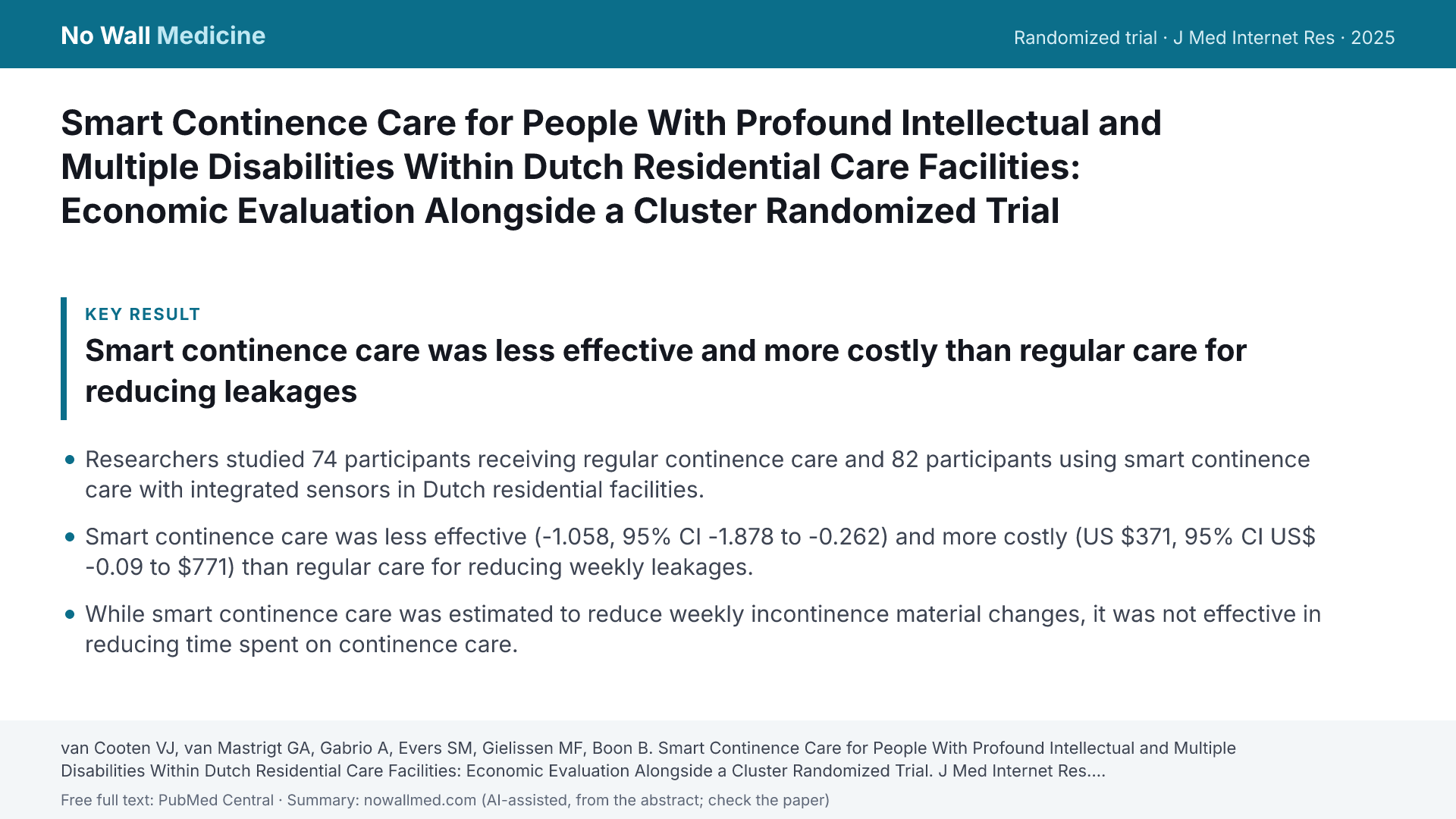
Smart continence care was less effective and more costly than regular care for reducing leakages
Smart Continence Care for People With Profound Intellectual and Multiple Disabilities Within Dutch Residential Care Facilities: Economic Evaluation Alongside a Cluster Randomized Trial
Why it matters: It is necessary to assess the cost-effectiveness and cost-utility of sensor-integrated incontinence materials as healthcare demand grows and the workforce decreases.
Key points
- Researchers studied 74 participants receiving regular continence care and 82 participants using smart continence care with integrated sensors in Dutch residential facilities.
- Smart continence care was less effective (-1.058, 95% CI -1.878 to -0.262) and more costly (US $371, 95% CI US$ -0.09 to $771) than regular care for reducing weekly leakages.
- While smart continence care was estimated to reduce weekly incontinence material changes, it was not effective in reducing time spent on continence care.
Limitation the authors note: The results are not conclusive because of the mixed outcomes and a limited 12-week timeframe.
Headline and key points written with AI from the paper’s abstract, with every number checked against it. Read the paper before relying on them.
Was this summary helpful?
Subject terms
Cite this article
van Cooten VJ, van Mastrigt GA, Gabrio A, Evers SM, Gielissen MF, Boon B. Smart Continence Care for People With Profound Intellectual and Multiple Disabilities Within Dutch Residential Care Facilities: Economic Evaluation Alongside a Cluster Randomized Trial. J Med Internet Res. 2025. doi:10.2196/72017
Spotted a mistake? Suggest a correction