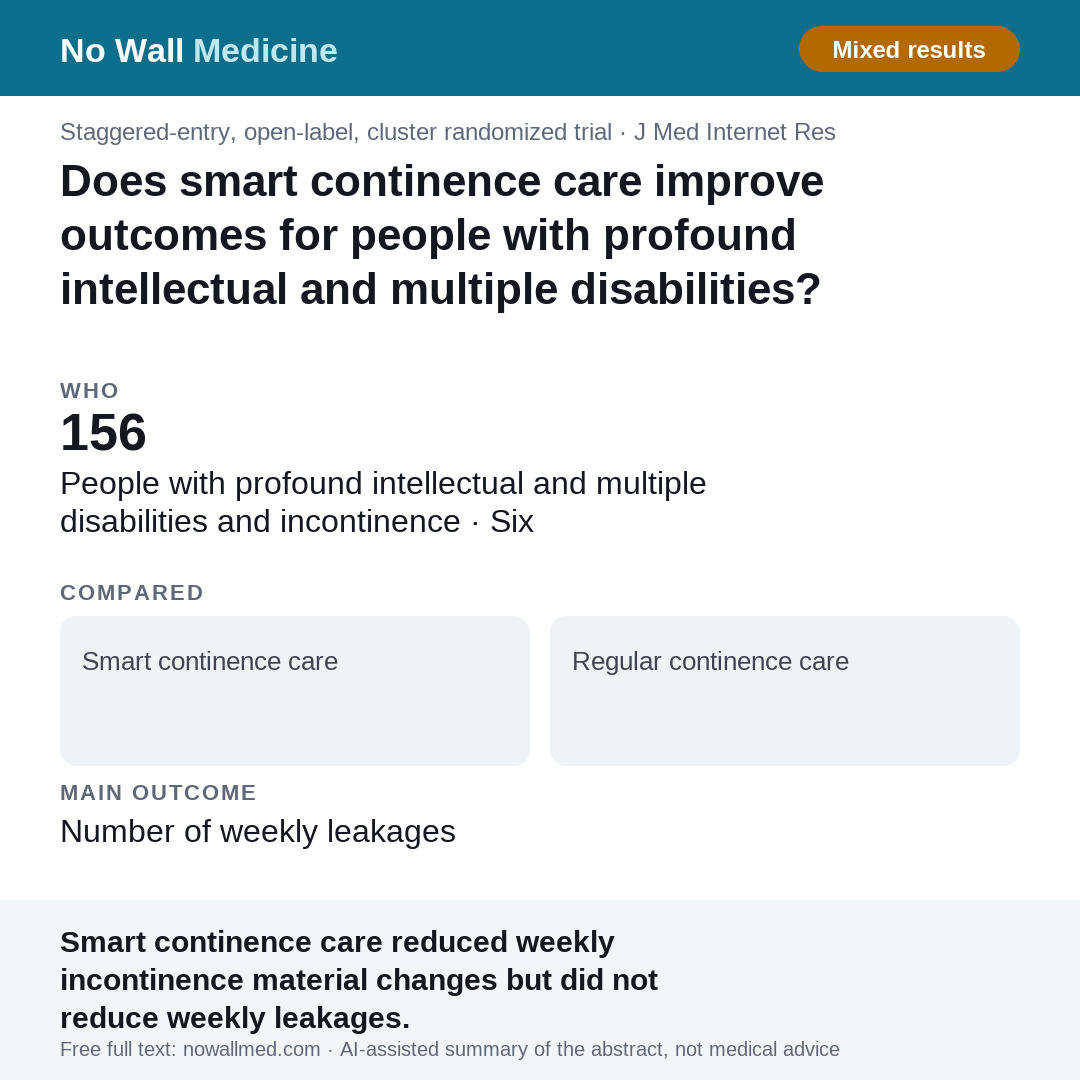
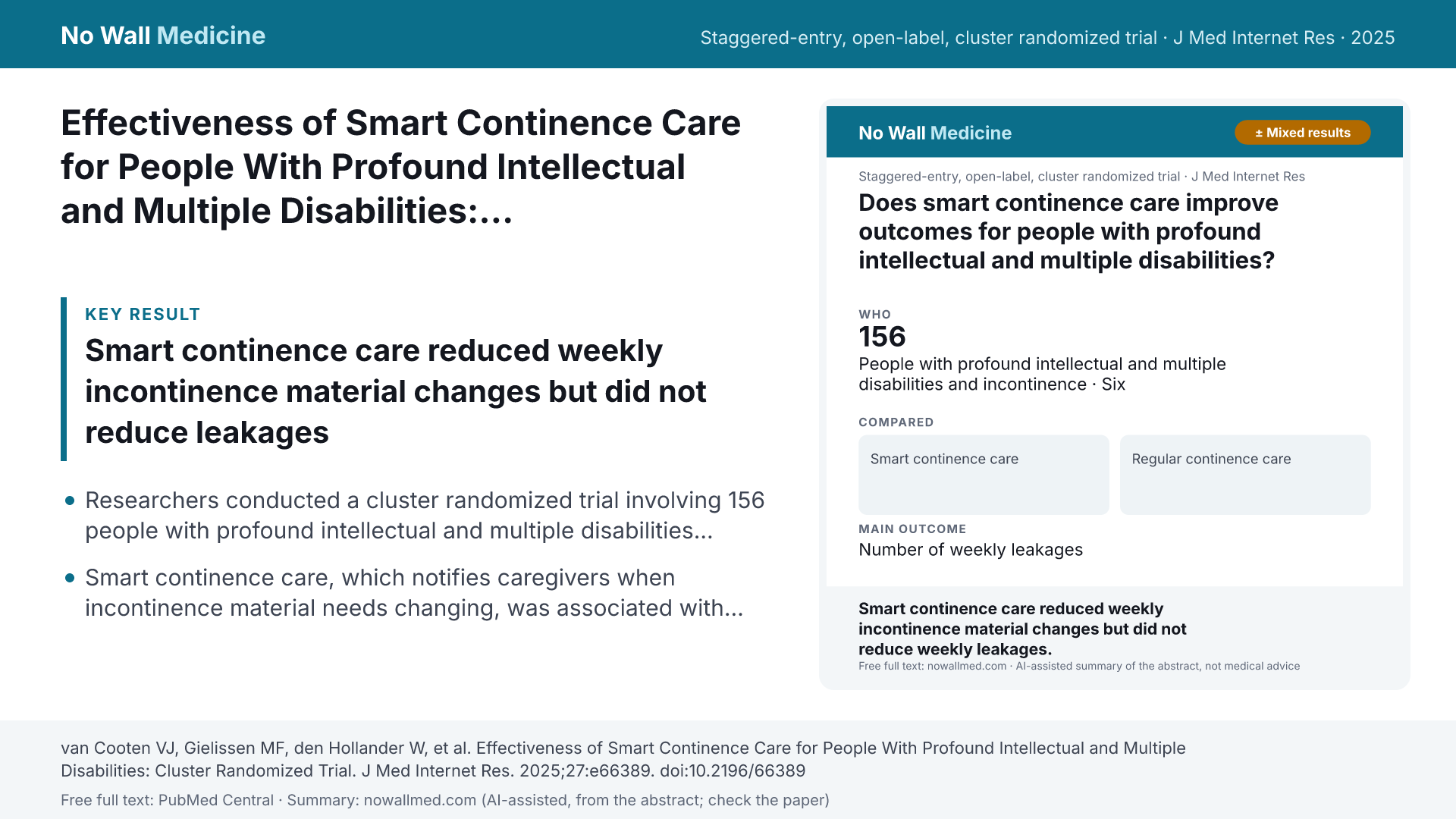
Smart continence care reduced weekly incontinence material changes but did not reduce leakages
Effectiveness of Smart Continence Care for People With Profound Intellectual and Multiple Disabilities: Cluster Randomized Trial
Staggered-entry, open-label, cluster randomized trialMixed results
Does smart continence care improve outcomes for people with profound intellectual and multiple disabilities?
Who
156
People with profound intellectual and multiple disabilities and incontinence · Six residential care facilities in the Netherlands
Compared
Smart continence care
Regular continence care
Main outcome
Number of weekly leakages
Result: β coefficient=1.013, 95% CI 0.217-1.808
Bottom line: Smart continence care reduced weekly incontinence material changes but did not reduce weekly leakages.
Limitation: An unexpected effect on leakage may be due to increased leakages at one residential care facility.
J Med Internet Res · 2025-07-31Download image
Clinical question: Does smart continence care improve outcomes for people with profound intellectual and multiple disabilities?
Why it matters: Scheduled continence care in residential facilities can lead to leakage or unnecessary changes of incontinence material, affecting individuals and caregivers.
Key points
- Researchers conducted a cluster randomized trial involving 156 people with profound intellectual and multiple disabilities in residential care facilities.
- Smart continence care, which notifies caregivers when incontinence material needs changing, was associated with fewer weekly material changes but no reduction in weekly leakages.
- The intervention did not significantly change the time spent on care, quality of life, or the physical burden on caregivers.
Limitation the authors note: The authors noted an unexpected reduction in leakages for the waiting-list group that may have been caused by increased leakages at one specific residential care facility.
Headline and key points written with AI from the paper’s abstract, with every number checked against it. Read the paper before relying on them.
Was this summary helpful?
Subject terms
Cite this article
van Cooten VJ, Gielissen MF, den Hollander W, et al. Effectiveness of Smart Continence Care for People With Profound Intellectual and Multiple Disabilities: Cluster Randomized Trial. J Med Internet Res. 2025. doi:10.2196/66389
Spotted a mistake? Suggest a correction