Smartphone-guided prone positioning did not show superiority over usual care for COVID-19 patients
Smartphone-Guided Self-prone Positioning vs Usual Care in Nonintubated Hospital Ward Patients With COVID-19: A Pragmatic Randomized Clinical Trial
Multicenter randomized clinical trialNo clear difference
Does smartphone-guided self-prone positioning reduce respiratory failure progression in nonintubated COVID-19 patients?
Who
293
Nonintubated adults with COVID-19 on less than 6 L/min supplemental oxygen
Compared
Smartphone-guided self-prone positioning intervention: 32 participants (posterior mean, 22.1%; 95% credible interval, 16.6-28.1)
Usual care: 31 participants (posterior mean, 24.7%; 95% credible interval, 18.6-31.4)
Main outcome
Respiratory deterioration or intensive care unit transfer
Result: posterior probability of superiority 72.1%
Bottom line: Smartphone-guided self-prone positioning did not show superiority over usual care for preventing respiratory deterioration.
Chest · 2022-05-18Download image
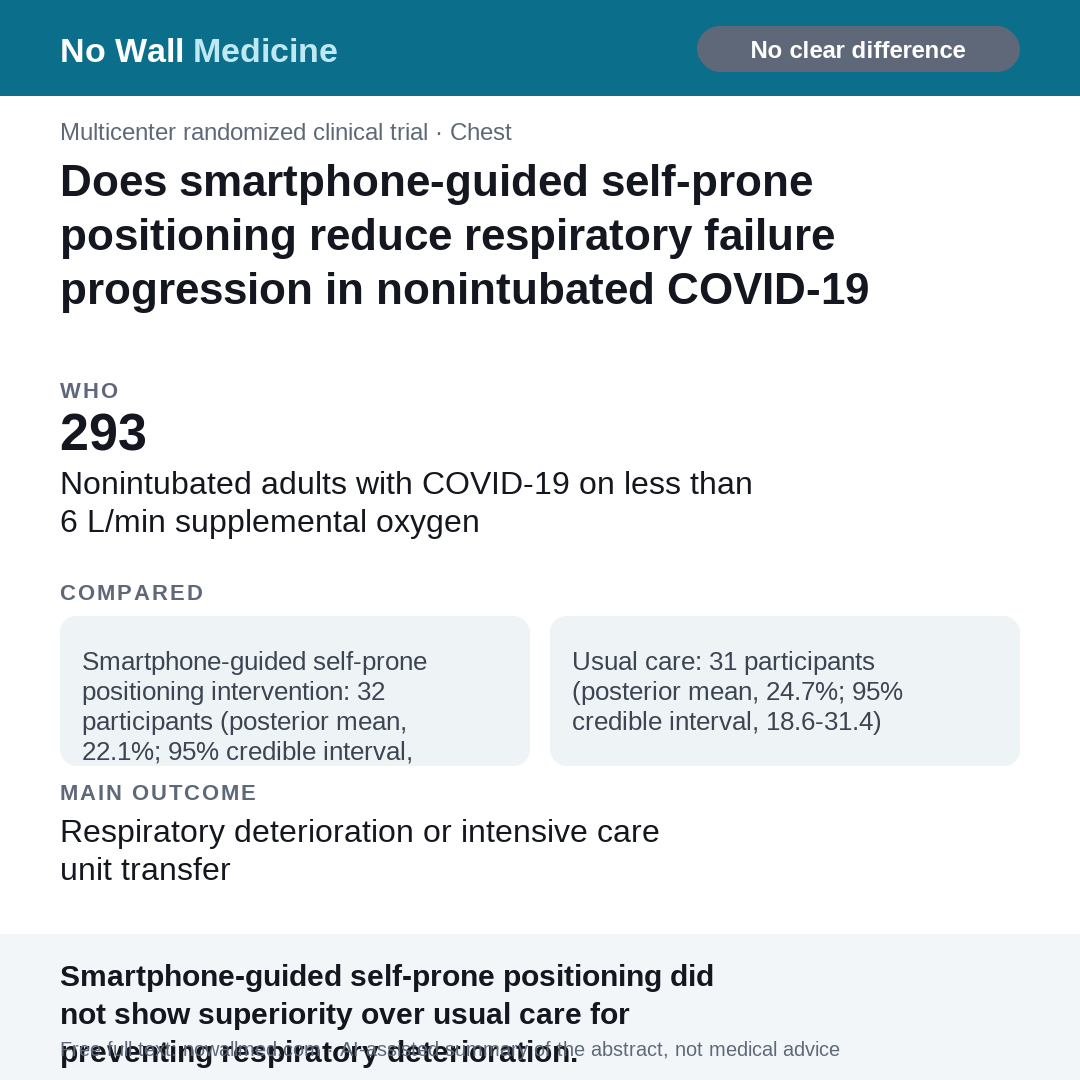
Clinical question: Does smartphone-guided self-prone positioning reduce respiratory failure progression in nonintubated COVID-19 patients?
Why it matters: It was unclear if smartphone-guided instructions for lying on the stomach could reduce the progression of respiratory failure in nonintubated patients with COVID-19.
Key points
- Researchers studied 293 nonintubated adults with COVID-19 receiving either smartphone-guided instructions for lying on their stomachs or usual care.
- The primary outcome of respiratory deterioration or intensive care unit transfer occurred in 22.1% of the intervention group and 24.7% of the usual care group.
- The posterior probability of superiority for the smartphone intervention was 72.1%, which was below the 95% threshold required for superiority.
Limitation the authors note: The trial was stopped early due to slow enrollment.
Headline and key points written with AI from the paper’s abstract, with every number checked against it. Read the paper before relying on them.
Was this summary helpful?
Subject terms
Cite this article
Rampon G, Jia S, Agrawal R, Arnold N, Martín-Quirόs A, Fischer EA. Smartphone-Guided Self-prone Positioning vs Usual Care in Nonintubated Hospital Ward Patients With COVID-19: A Pragmatic Randomized Clinical Trial. Chest. 2022. doi:10.1016/j.chest.2022.05.009
Spotted a mistake? Suggest a correction
Top studies every Monday
The week’s key trials and guidelines in your specialties, plus any topics you follow. By email, free.
Get the weekly digest