Brief coaching did not significantly increase long-term smoke-free home adoption among housing residents
Smoke-Free Home Intervention in Permanent Supportive Housing: A Cluster Randomized Clinical Trial
Cluster randomized clinical trialNo clear difference
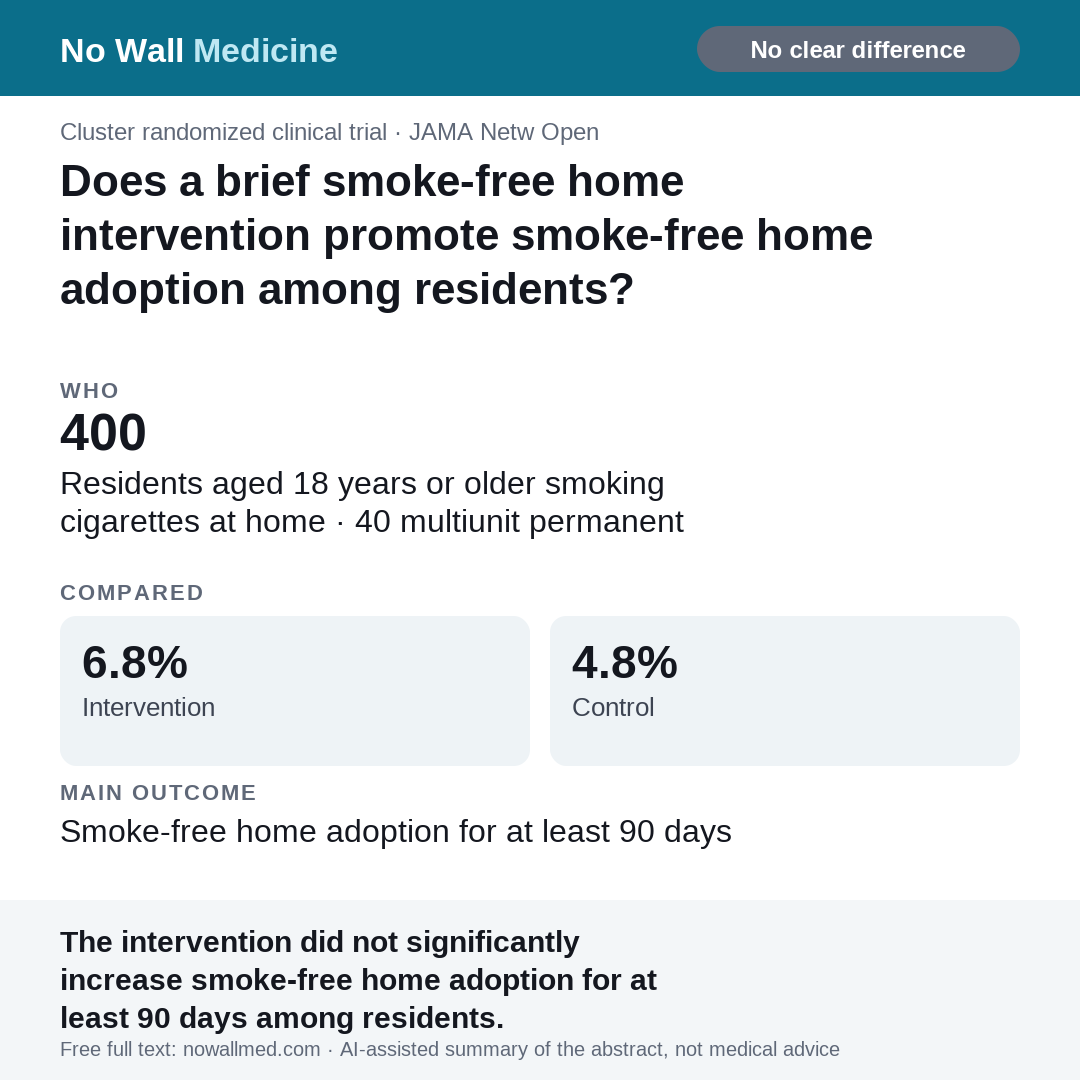
Does a brief smoke-free home intervention promote smoke-free home adoption among residents?
Who
400
Residents aged 18 years or older smoking cigarettes at home · 40 multiunit permanent supportive housing sites, San Francisco Bay area
Compared
6.8%Intervention
4.8%Control
Main outcome
Smoke-free home adoption for at least 90 days
Result: odds ratio 1.45 (95% CI, 0.69-3.07)
Bottom line: The intervention did not significantly increase smoke-free home adoption for at least 90 days among residents.
JAMA Netw Open · 2026-09-01Download image
Clinical question: Does a brief smoke-free home intervention promote smoke-free home adoption among residents?
Why it matters: Tobacco use and secondhand smoke exposure are leading causes of death among formerly homeless adults living in permanent supportive housing.
Key points
- Researchers studied 400 residents in 40 multiunit permanent supportive housing sites who were randomized to receive one-on-one coaching or a waiting list control.
- At 6 months, 6.8% of the intervention group and 4.8% of the control group adopted a smoke-free home for at least 90 days.
- Intervention residents had higher odds of adopting a smoke-free home for at least 1 day compared to the control group (63.4% vs 36.8%).
Headline and key points written with AI from the paper’s abstract, with every number checked against it. Read the paper before relying on them.
Topics
Cite this article
Hawes MR, Alway J, Chakravarty D, Xia F, Kushel M, Max W. Smoke-Free Home Intervention in Permanent Supportive Housing: A Cluster Randomized Clinical Trial. JAMA Netw Open. 2026. doi:10.1001/jamanetworkopen.2026.32697
Spotted a mistake? Suggest a correction