Somatosensory training improves tactile discrimination in healthy individuals but lacks data for stroke patients
Somatosensory training: a systematic review and meta-analysis with methodological considerations and clinical insights
Systematic review and meta-analysisBenefit found
Is somatosensory training effective in healthy individuals and stroke patients?
Who
Healthy individuals and stroke patients
Compared
Somatosensory training: 61.2% datasets improved performance
Non-stimulated site: no significant changes
Main outcome
Somatosensory performance and tactile two-point discrimination
Bottom line: Somatosensory training improves performance and tactile discrimination in healthy individuals at the stimulated site.
Limitation: Methodological concerns including randomization, control conditions, blinding, and missing data.
J Neuroeng Rehabil · 2025-03-03Download image
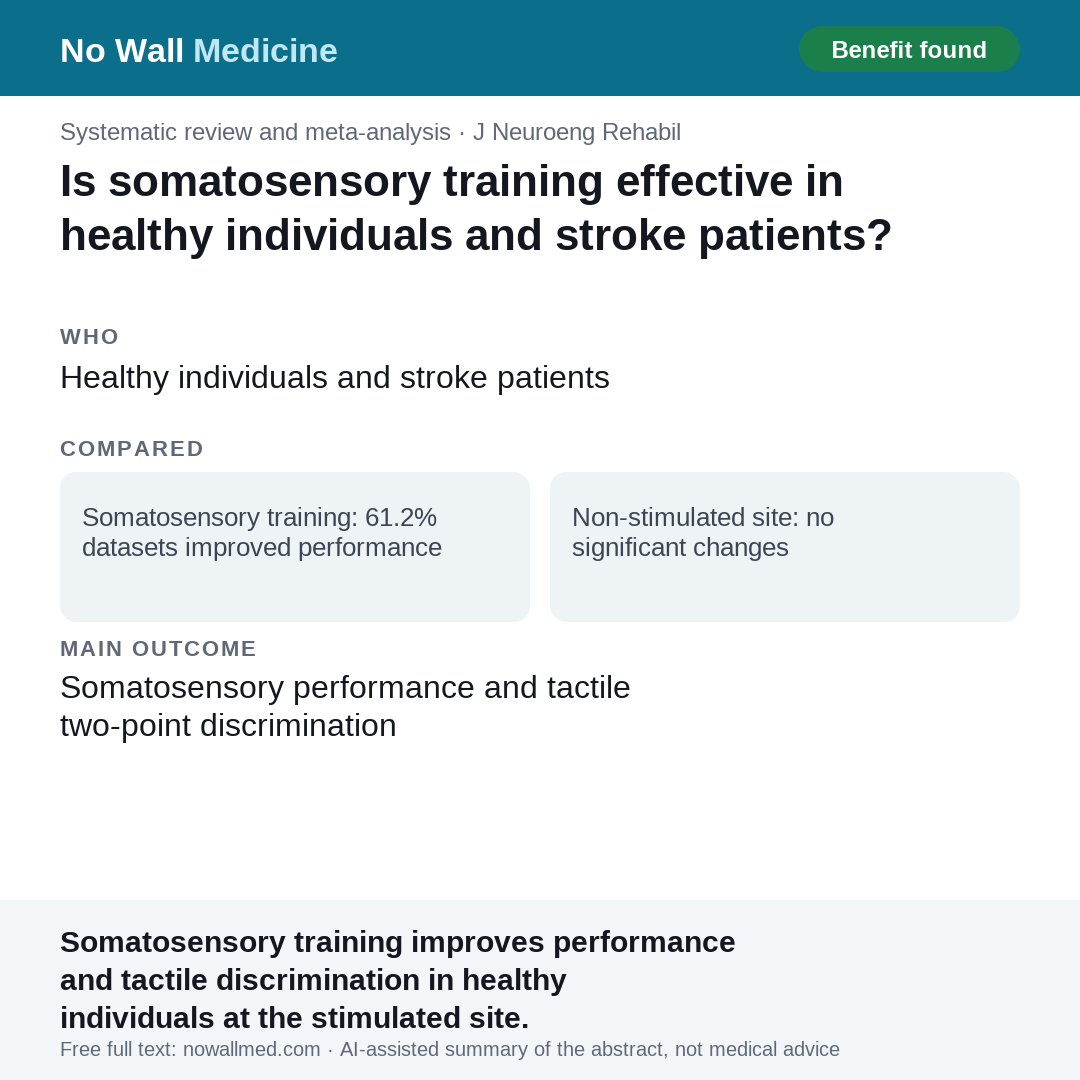
Clinical question: Is somatosensory training effective in healthy individuals and stroke patients?
Why it matters: It was unknown if somatosensory training is effective for improving sensory performance in healthy individuals and stroke patients.
Key points
- Researchers conducted a systematic review and meta-analysis of somatosensory training, which uses repetitive stimulation to improve sensory performance, but found no eligible data for stroke patients.
- In healthy participants, training improved performance in 61.2% of datasets and increased early somatosensory-evoked potential amplitudes in 76.9% of datasets at the stimulated site.
- Training was associated with a marked reduction in tactile two-point discrimination thresholds at the stimulated finger, though no significant changes occurred at non-stimulated fingers.
Limitation the authors note: The assessment revealed methodological concerns including the randomization process, proper control conditions, blinding information, and missing data.
Headline and key points written with AI from the paper’s abstract, with every number checked against it. Read the paper before relying on them.
Topics
Cite this article
Sasaki R, Kojima S, Saito K, Onishi H. Somatosensory training: a systematic review and meta-analysis with methodological considerations and clinical insights. J Neuroeng Rehabil. 2025. doi:10.1186/s12984-025-01579-y
Spotted a mistake? Suggest a correction
Top studies every Monday
The week’s key trials and guidelines in your specialties, plus any topics you follow. By email, free.
Get the weekly digest