Specialist physiotherapy did not improve physical functioning for people with functional motor disorder
Specialist physiotherapy for functional motor disorder in England and Scotland (Physio4FMD): a pragmatic, multicentre, phase 3 randomised controlled trial
Pragmatic, multicentre, phase 3 randomised controlled trialNo clear difference
Is specialist physiotherapy effective for functional motor disorder compared to treatment as usual?
Who
355
Adults with a clinically definite diagnosis of functional motor disorder · 11 hospitals in England and Scotland
Compared
Specialist physiotherapy
Treatment as usual
Main outcome
Physical functioning domain of the 36-item short form health questionnaire
Result: adjusted mean difference 3·5, 95% CI -2·3 to 9·3
Bottom line: Specialist physiotherapy did not result in better self-reported physical functioning at 12 months compared to treatment as usual.
Funded by: National Institute for Health and Care Research and Health Technology Assessment Programme
Lancet Neurol · 2024-05-17Download image
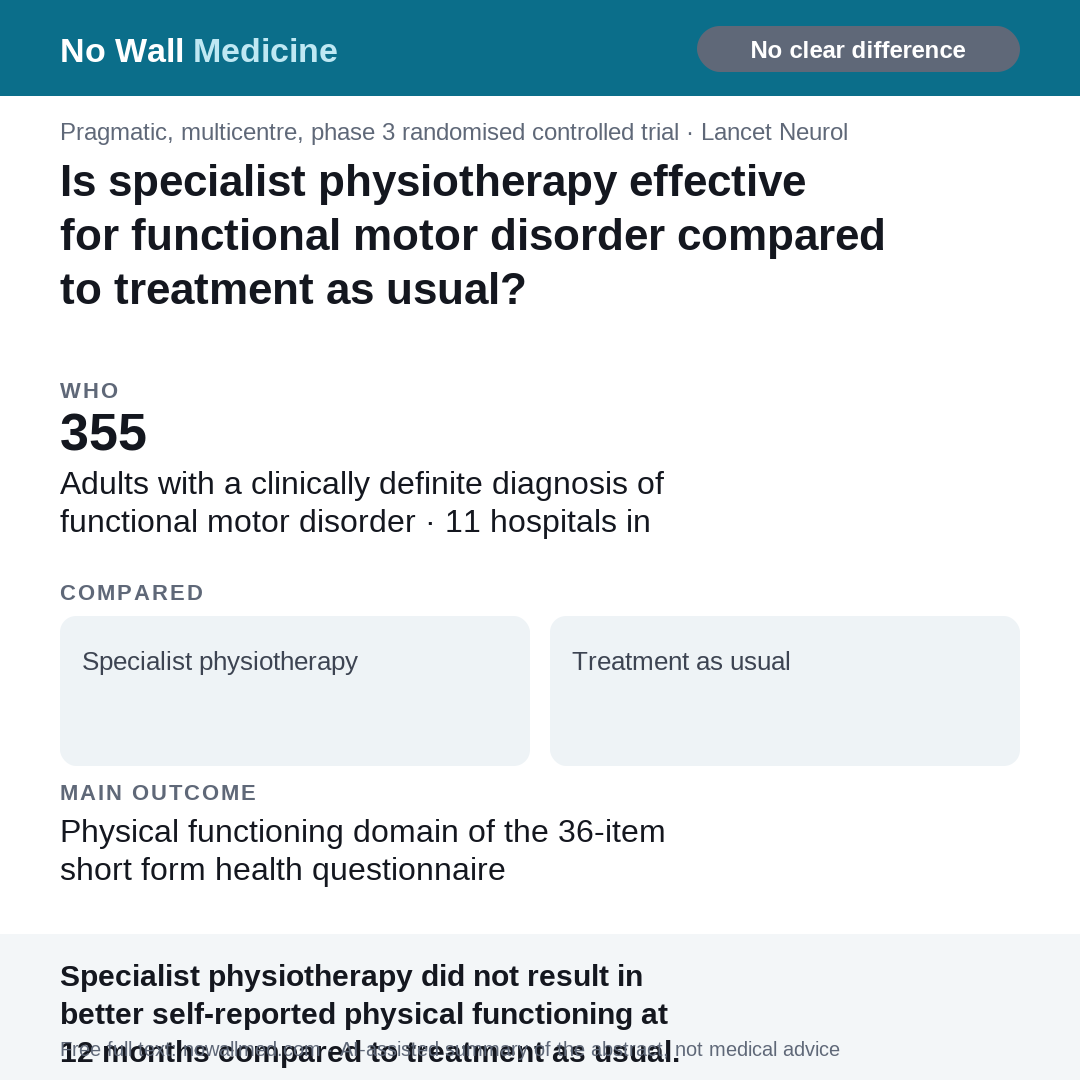
Clinical question: Is specialist physiotherapy effective for functional motor disorder compared to treatment as usual?
Why it matters: Large randomized controlled trials were absent regarding whether specialist physiotherapy is effective for functional motor disorder.
Key points
- Researchers conducted a trial with 355 adults with functional motor disorder, comparing specialist physiotherapy to usual community neurological physiotherapy.
- At 12 months, physical functioning scores did not differ significantly between the specialist physiotherapy group and the usual treatment group (p=0.23).
- Serious adverse events occurred in 17.0% of participants in both groups, and all were considered unrelated to the specialist physiotherapy intervention.
Limitation the authors note: The primary analysis excluded 89 participants who were unable to receive their randomized treatment due to the suspension of health-care services during the COVID-19 pandemic.
Headline and key points written with AI from the paper’s abstract, with every number checked against it. Read the paper before relying on them.
Was this summary helpful?
Abstract
Background
Functional motor disorder-the motor variant of functional neurological disorder-is a disabling condition that is commonly associated with poor health outcomes. Pathophysiological models have inspired new treatment approaches such as specialist physiotherapy, although evidence from large randomised controlled trials is absent. We aimed to assess the clinical effectiveness of a specialist physiotherapy intervention for functional motor disorder compared with treatment as usual. Methods
In this pragmatic, multicentre, phase 3 randomised controlled trial at 11 hospitals in England and Scotland, adults with a clinically definite diagnosis of functional motor disorder, diagnosed by a neurologist, were included. Participants were randomly assigned (1:1, stratified by site) using a remote web-based application to either specialist physiotherapy (a protocolised intervention of nine sessions plus follow-up) or treatment as usual (referral to local community neurological physiotherapy). Individuals working on data collection and analysis were masked to treatment allocation. The primary outcome was the physical functioning domain of the 36-item short form health questionnaire (SF36) at 12 months after randomisation. The primary analysis followed a modified intention-to-treat principle, using a complete case approach; participants who were unable to receive their randomised treatment due to the suspension of health-care services during the COVID-19 pandemic were excluded from the primary analysis. This trial is registered with the International Standard Randomised Controlled Trial registry, ISRCTN56136713, and is completed. Findings
Recruitment occurred between Oct 19, 2018, and March 11, 2020, pausing during the COVID-19 lockdown, and resuming from Aug 3, 2021, to Jan 31, 2022. Of 355 participants who were enrolled, 179 were randomly assigned to specialist physiotherapy and 176 to treatment as usual. 89 participants were excluded from the primary analysis due to COVID-19 interruption to treatment (27 were assigned to specialist physiotherapy and 62 to treatment as usual). After accounting for withdrawals (n=11) and loss to follow-up (n=14), the primary analysis included data from 241 participants (138 [91%] assigned specialist physiotherapy and 103 [90%] assigned treatment as usual). Physical functioning, as assessed by SF36, did not differ significantly between groups (adjusted mean difference 3·5, 95% CI -2·3 to 9·3; p=0·23). There were no serious adverse events related to the trial interventions. 35 serious adverse events were recorded in the specialist physiotherapy group by 24 participants (17·0%), and 24 serious adverse events were recorded in the treatment as usual group by 18 participants (17·0%); one death occurred in the specialist physiotherapy group (cause of death was recorded as suicide). All were considered unrelated to specialist physiotherapy. Interpretation
Although more participants who were assigned specialist physiotherapy self-rated their motor symptoms as improved and had better scores on subjective measures of mental health, the intervention did not result in better self-reported physical functioning at 12 months. Both the specialist and community neurological physiotherapy appeared to be a safe and a valued treatment for selected patients with functional motor disorder. Future research should continue to refine interventions for people with functional motor disorder and develop evidence-based methods to guide treatment triage decisions. Funding
National Institute for Health and Care Research and Health Technology Assessment Programme.
Abstract reproduced under the article’s CC BY licence.
Subject terms
Cite this article
Nielsen G, Stone J, Lee TC, Goldstein LH, Marston L, Hunter RM. Specialist physiotherapy for functional motor disorder in England and Scotland (Physio4FMD): a pragmatic, multicentre, phase 3 randomised controlled trial. Lancet Neurol. 2024. doi:10.1016/S1474-4422(24)00135-2
Spotted a mistake? Suggest a correction
Top studies every Monday
The week’s key trials and guidelines in your specialties, plus any topics you follow. By email, free.
Get the weekly digest