Aspherical lenslet spectacle lenses slowed myopia progression and eye growth in children over two years
Spectacle Lenses With Aspherical Lenslets for Myopia Control vs Single-Vision Spectacle Lenses: A Randomized Clinical Trial
Double-masked randomized clinical trialBenefit found
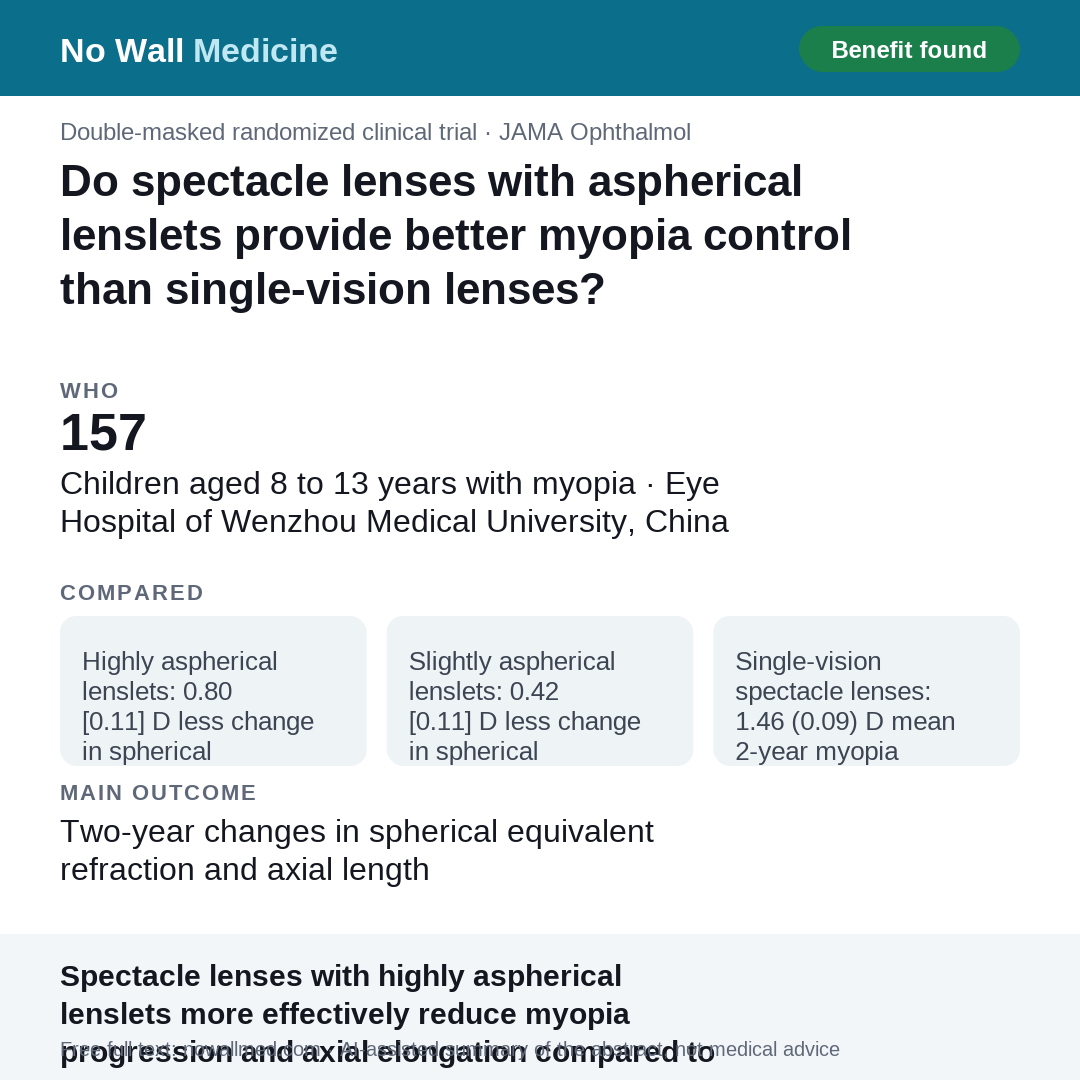
Do spectacle lenses with aspherical lenslets provide better myopia control than single-vision lenses?
Who
157
Children aged 8 to 13 years with myopia · Eye Hospital of Wenzhou Medical University, China
Compared
Highly aspherical lenslets: 0.80 [0.11] D less change in spherical equivalent refraction
Slightly aspherical lenslets: 0.42 [0.11] D less change in spherical equivalent refraction
Single-vision spectacle lenses: 1.46 (0.09) D mean 2-year myopia progression
Main outcome
Two-year changes in spherical equivalent refraction and axial length
Bottom line: Spectacle lenses with highly aspherical lenslets more effectively reduce myopia progression and axial elongation compared to single-vision lenses.
JAMA Ophthalmol · 2022-04-01Download image
Clinical question: Do spectacle lenses with aspherical lenslets provide better myopia control than single-vision lenses?
Why it matters: It was unknown whether spectacle lenses with higher lenslet asphericity provide greater efficacy in controlling myopia progression and eye growth compared to standard single-vision lenses.
Key points
- The study followed 157 children aged 8 to 13 years assigned to highly aspherical lenslets, slightly aspherical lenslets, or single-vision spectacle lenses.
- Compared to single-vision lenses, highly aspherical lenslets resulted in 0.80 [0.11] D less change in spherical equivalent refraction and 0.35 [0.05] mm less axial length increase.
- For children wearing highly aspherical lenslets at least 12 hours every day, the change in spherical equivalent refraction was slowed by 0.99 [0.12] D.
Headline and key points written with AI from the paper’s abstract, with every number checked against it. Read the paper before relying on them.
Was this summary helpful?
Subject terms
Cite this article
Bao J, Huang Y, Li X, Yang A, Zhou F, Wu J. Spectacle Lenses With Aspherical Lenslets for Myopia Control vs Single-Vision Spectacle Lenses: A Randomized Clinical Trial. JAMA Ophthalmol. 2022. doi:10.1001/jamaophthalmol.2022.0401
Spotted a mistake? Suggest a correction
Top studies every Monday
The week’s key trials and guidelines in your specialties, plus any topics you follow. By email, free.
Get the weekly digest