HiCommunication group intervention improved voice sound level and quality in people with Parkinson's disease
Speech and neuroimaging effects following HiCommunication: a randomized controlled group intervention trial in Parkinson's disease
Randomized controlled group intervention trialBenefit found
Does HiCommunication improve speech and neuroimaging outcomes in Parkinson's disease?
Who
95
Participants with Parkinson's disease
Compared
HiCommunication: 59% clinically relevant increase in voice sound level
Active control intervention
Main outcome
Voice sound level and voice quality
Bottom line: HiCommunication showed promising effects on voice sound level and quality and altered resting-state brain effective connectivity.
Brain Commun · 2024-07-12Download image
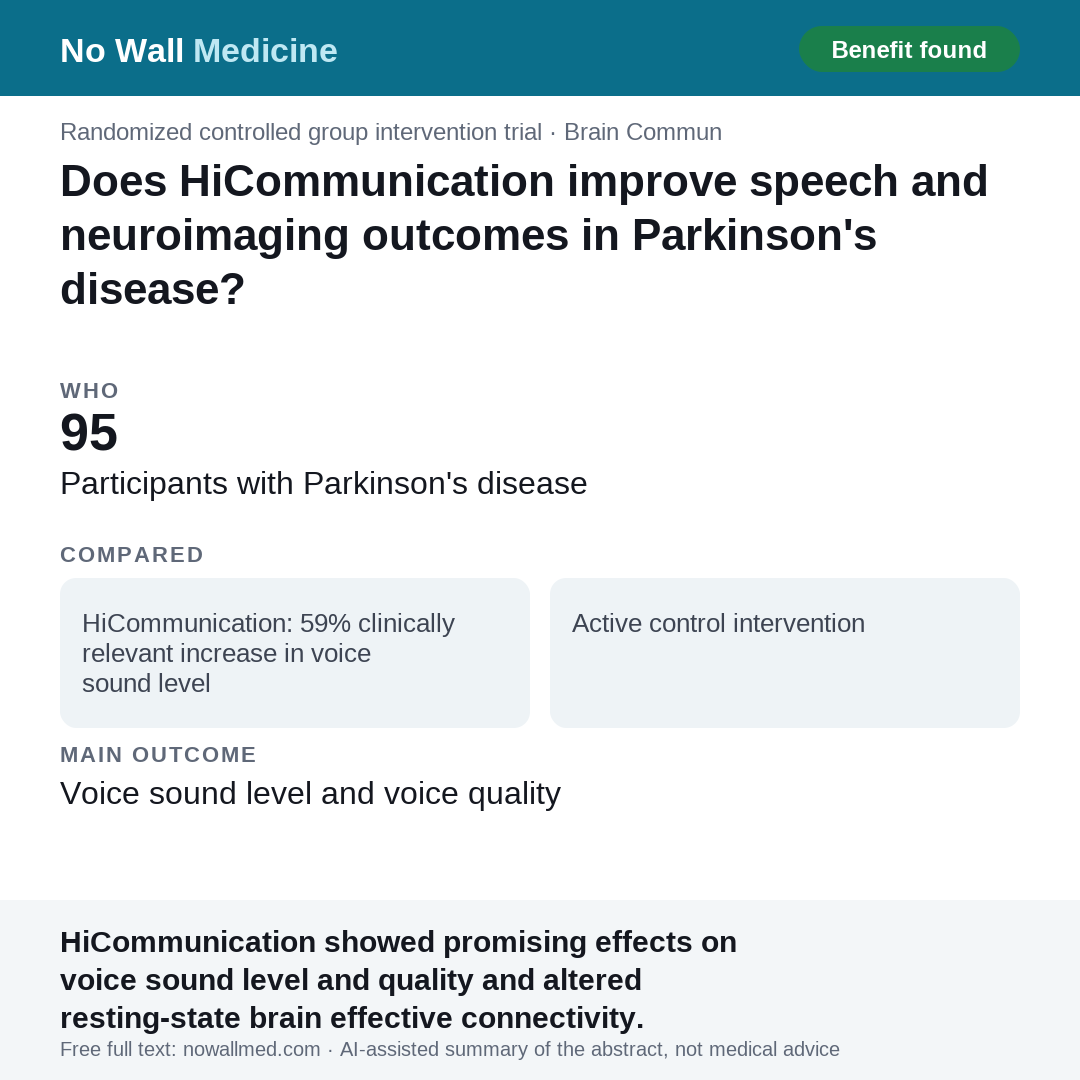
Clinical question: Does HiCommunication improve speech and neuroimaging outcomes in Parkinson's disease?
Why it matters: It is unknown if the HiCommunication group intervention, based on neuroplasticity principles, can improve speech and communication outcomes or alter brain connectivity in Parkinson's disease.
Key points
- Researchers conducted a randomized controlled trial with 95 participants with Parkinson's disease assigned to either HiCommunication or an active control intervention.
- Following the intervention, 59% of participants showed a clinically relevant increase in voice sound level, though no sustained effects were seen at six months.
- Brain imaging showed changes in connectivity within speech-motor networks, including decreased inhibitory self-connectivity in the left supplementary motor area.
Headline and key points written with AI from the paper’s abstract, with every number checked against it. Read the paper before relying on them.
Was this summary helpful?
Cite this article
Steurer H, Albrecht F, Gustafsson JK, Razi A, Franzén E, Schalling E. Speech and neuroimaging effects following HiCommunication: a randomized controlled group intervention trial in Parkinson's disease. Brain Commun. 2024. doi:10.1093/braincomms/fcae235
Spotted a mistake? Suggest a correction
Top studies every Monday
The week’s key trials and guidelines in your specialties, plus any topics you follow. By email, free.
Get the weekly digest