Cochlear implants provided better speech perception in noise than other treatments for single-sided deafness
Speech Perception in Noise After Cochlear Implantation for Single-Sided Deafness: A Randomized Clinical Trial
Single-center randomized clinical trialBenefit found
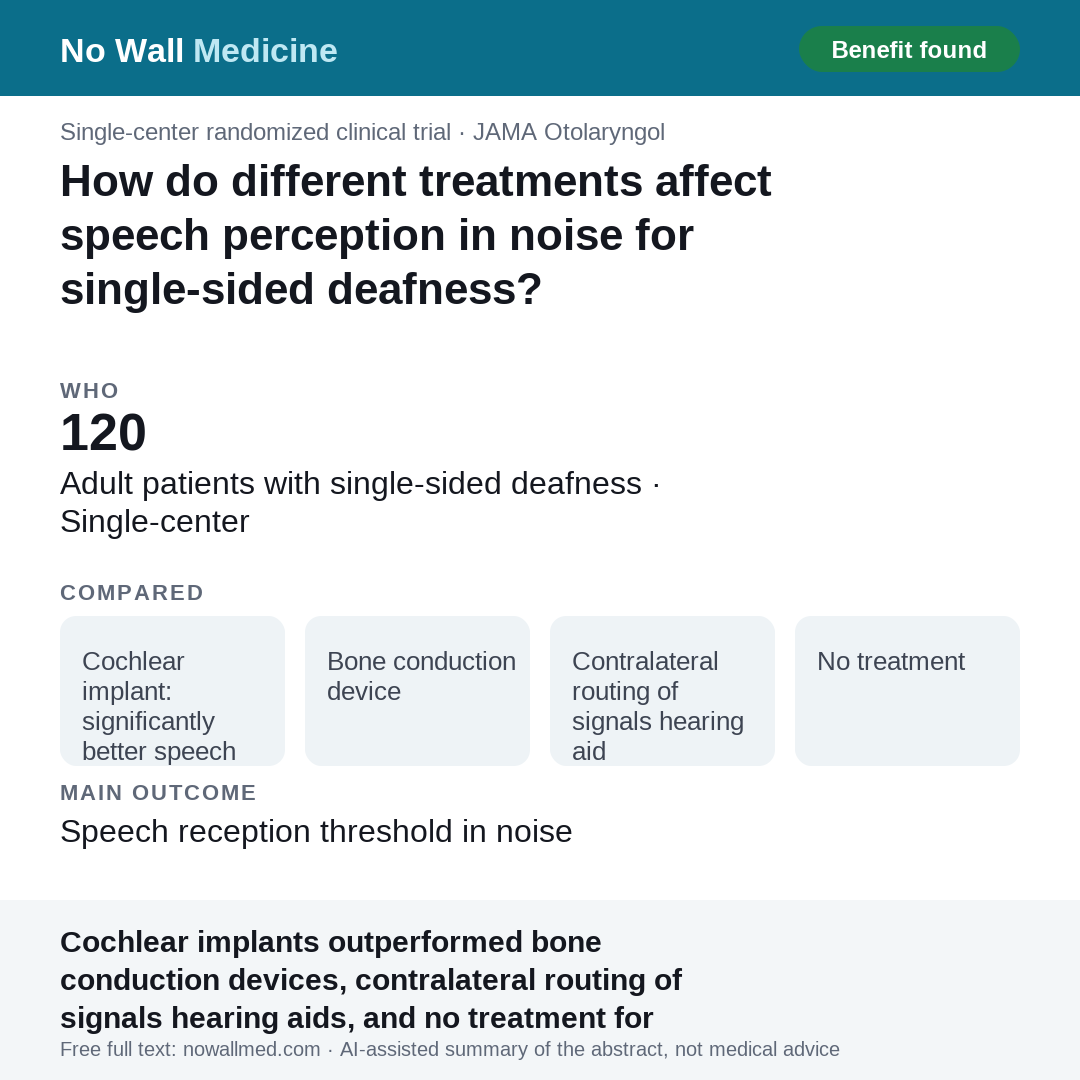
How do different treatments affect speech perception in noise for single-sided deafness?
Who
120
Adult patients with single-sided deafness · Single-center
Compared
Cochlear implant: significantly better speech perception in noise scores
Bone conduction device
Contralateral routing of signals hearing aid
No treatment
Main outcome
Speech reception threshold in noise
Result: difference in SRTn: SbeNpe, -6.3 dB (95% CI -7.5 to -4.9) for CI vs no treatment
Bottom line: Cochlear implants outperformed bone conduction devices, contralateral routing of signals hearing aids, and no treatment for speech perception in noise.
JAMA Otolaryngol · 2025-01-17Download image
Clinical question: How do different treatments affect speech perception in noise for single-sided deafness?
Why it matters: High-level evidence is lacking to compare the effectiveness of different treatment options for single-sided deafness regarding speech perception in noise.
Key points
- Researchers studied 120 adults with single-sided deafness, comparing cochlear implants, bone conduction devices, contralateral routing of signals hearing aids, and no treatment.
- At 24 months, the cochlear implant group had significantly better speech perception in noise scores than the bone conduction device, hearing aid, and no treatment groups.
- The cochlear implant group also reported significantly better self-reported speech perception abilities and disease-specific quality of life compared to the other groups.
Headline and key points written with AI from the paper’s abstract, with every number checked against it. Read the paper before relying on them.
Topics
Cite this article
van Heteren JAA, Wendrich AW, Peters JPM, Grolman W, Stokroos RJ, Smit AL. Speech Perception in Noise After Cochlear Implantation for Single-Sided Deafness: A Randomized Clinical Trial. JAMA Otolaryngol. 2025. doi:10.1001/jamaoto.2024.4760
Spotted a mistake? Suggest a correction