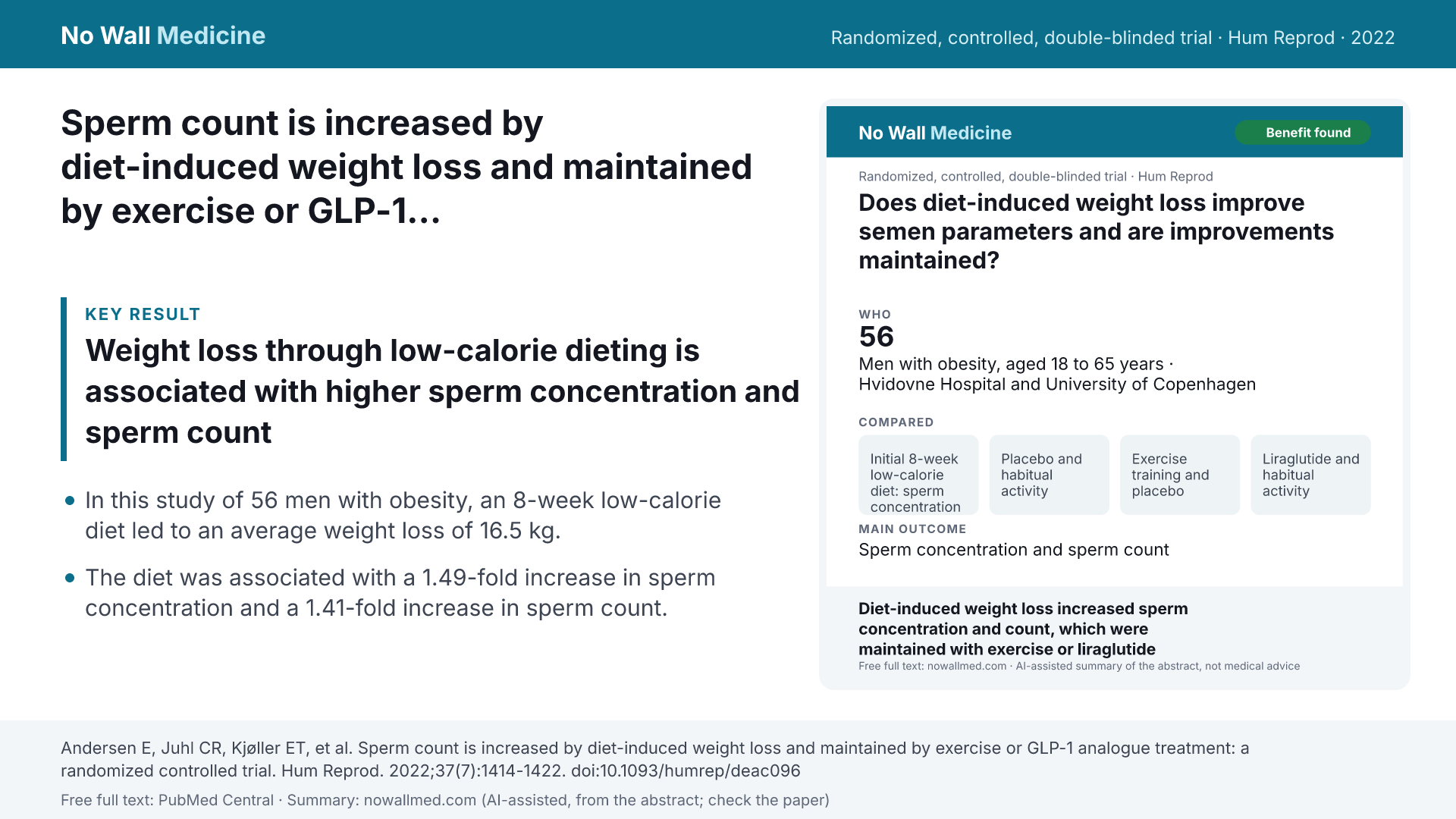
Weight loss through low-calorie dieting is associated with higher sperm concentration and sperm count
Sperm count is increased by diet-induced weight loss and maintained by exercise or GLP-1 analogue treatment: a randomized controlled trial
Randomized, controlled, double-blinded trialBenefit found
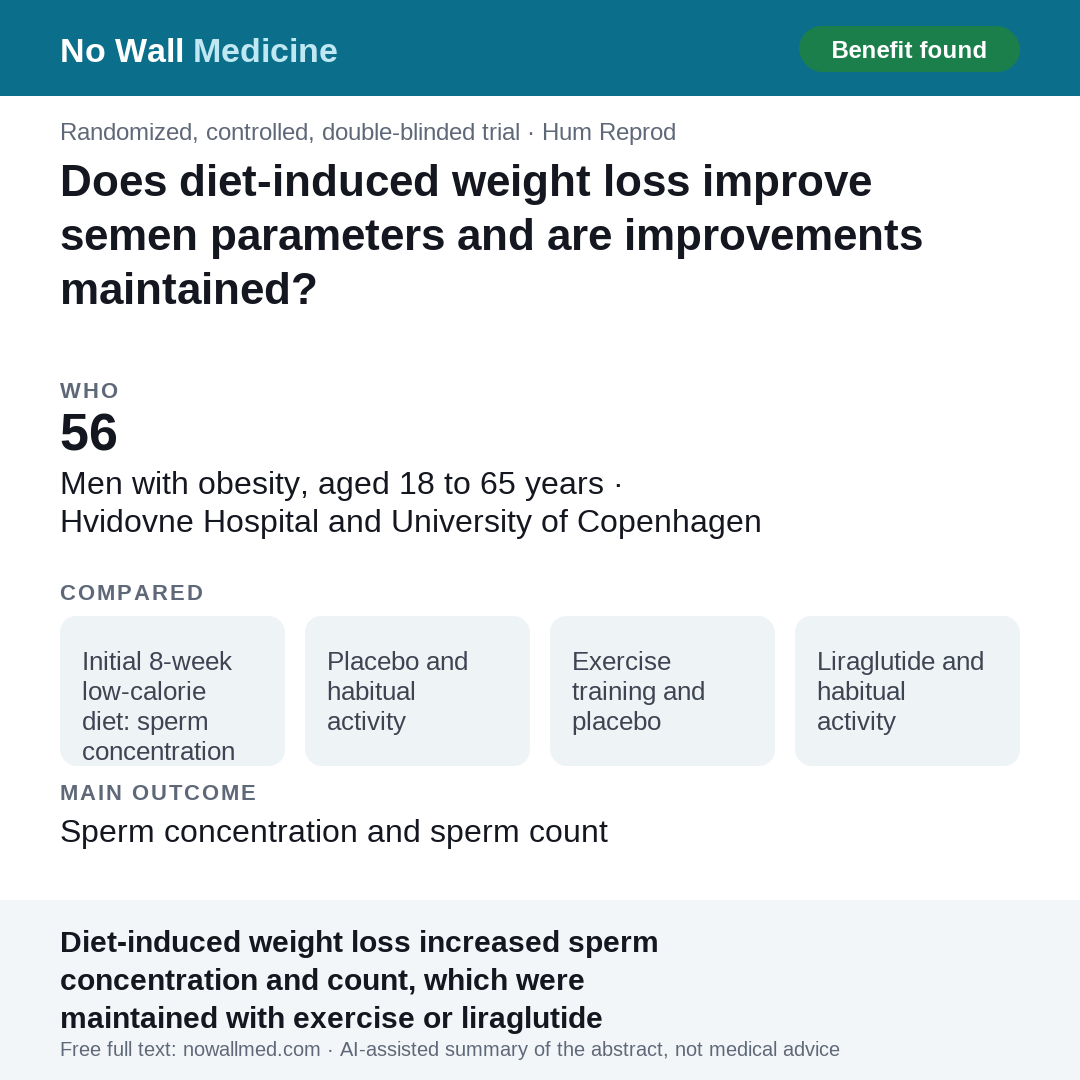
Does diet-induced weight loss improve semen parameters and are improvements maintained?
Who
56
Men with obesity, aged 18 to 65 years · Hvidovne Hospital and University of Copenhagen
Compared
Initial 8-week low-calorie diet: sperm concentration 1.49-fold (95% CI: 1.18-1.88), sperm count 1.41-fold (95% CI: 1.07-1.87)
Placebo and habitual activity
Exercise training and placebo
Liraglutide and habitual activity
Main outcome
Sperm concentration and sperm count
Bottom line: Diet-induced weight loss increased sperm concentration and count, which were maintained with exercise or liraglutide treatment.
Limitation: Definite inferences cannot be made as analysis of semen was preregistered to explore effects.
Funded by: Novo Nordisk Foundation and Helsefonden
Hum Reprod · 2022-05-18Download image
Clinical question: Does diet-induced weight loss improve semen parameters and are improvements maintained?
Why it matters: The acute and long-term effects of weight loss on semen parameters in men with obesity were unknown.
Key points
- In this study of 56 men with obesity, an 8-week low-calorie diet led to an average weight loss of 16.5 kg.
- The diet was associated with a 1.49-fold increase in sperm concentration and a 1.41-fold increase in sperm count.
- These improvements were maintained for 52 weeks in men who maintained weight loss, but not in those who regained weight.
Limitation the authors note: The authors state that while the analysis of semen was preregistered, definite inferences cannot be made.
Headline and key points written with AI from the paper’s abstract, with every number checked against it. Read the paper before relying on them.
Was this summary helpful?
Subject terms
Cite this article
Andersen E, Juhl CR, Kjøller ET, Lundgren JR, Janus C, Dehestani Y. Sperm count is increased by diet-induced weight loss and maintained by exercise or GLP-1 analogue treatment: a randomized controlled trial. Hum Reprod. 2022. doi:10.1093/humrep/deac096
Spotted a mistake? Suggest a correction
Top studies every Monday
The week’s key trials and guidelines in your specialties, plus any topics you follow. By email, free.
Get the weekly digest