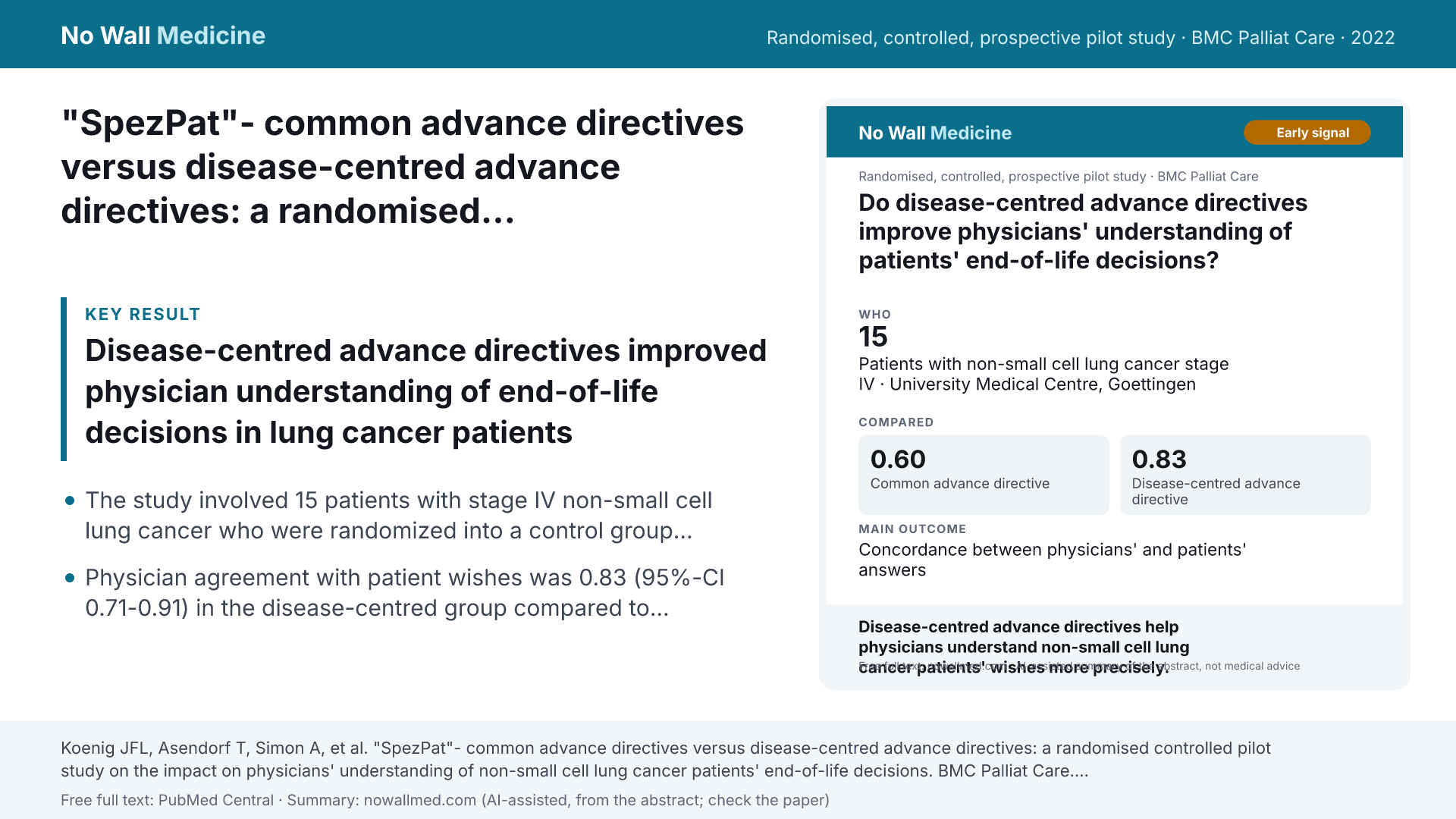
Disease-centred advance directives improved physician understanding of end-of-life decisions in lung cancer patients
"SpezPat"- common advance directives versus disease-centred advance directives: a randomised controlled pilot study on the impact on physicians' understanding of non-small cell lung cancer patients' end-of-life decisions
Randomised, controlled, prospective pilot studyEarly signal
Do disease-centred advance directives improve physicians' understanding of patients' end-of-life decisions?
Who
15
Patients with non-small cell lung cancer stage IV · University Medical Centre, Goettingen
Compared
0.60Common advance directive (95%-CI 0.48-0.70)
0.83Disease-centred advance directive (95%-CI 0.71-0.91)
Main outcome
Concordance between physicians' and patients' answers
Result: difference between the two groups was statistically significant (p = 0.005)
Bottom line: Disease-centred advance directives help physicians understand non-small cell lung cancer patients' wishes more precisely.
BMC Palliat Care · 2022-09-28Download image
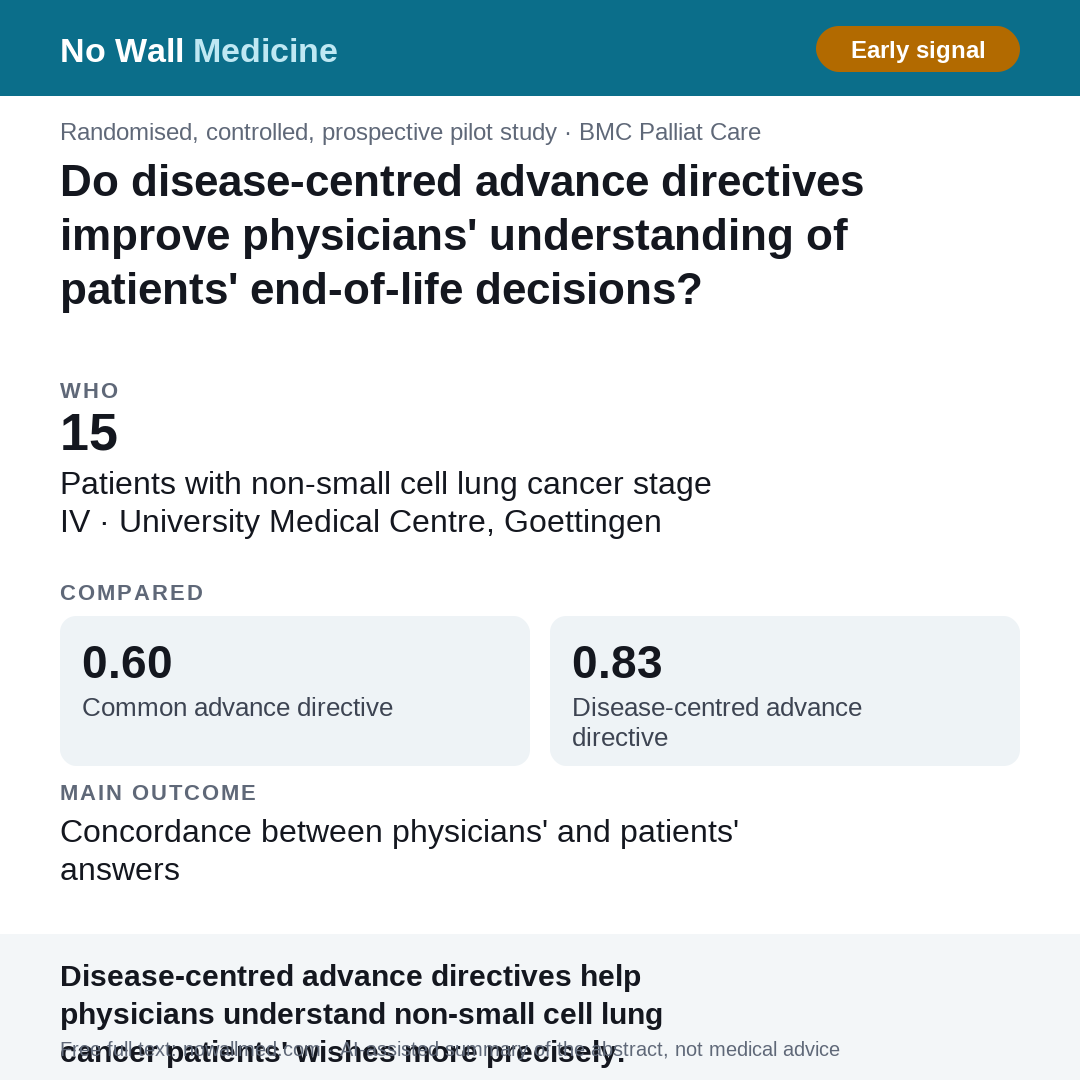
Clinical question: Do disease-centred advance directives improve physicians' understanding of patients' end-of-life decisions?
Why it matters: It is challenging for healthcare providers to correctly understand patient wishes based on the information provided in standard advance directives.
Key points
- The study involved 15 patients with stage IV non-small cell lung cancer who were randomized into a control group using common advance directives or an intervention group using disease-centred advance directives.
- Physician agreement with patient wishes was 0.83 (95%-CI 0.71-0.91) in the disease-centred group compared to 0.60 (95%-CI 0.48-0.70) in the common group, a statistically significant difference (p = 0.005).
- A total of 135 treatment decisions were evaluated across both groups.
Limitation the authors note: Recruitment was stopped prior to reaching the anticipated sample target.
Headline and key points written with AI from the paper’s abstract, with every number checked against it. Read the paper before relying on them.
Was this summary helpful?
Subject terms
Cite this article
Koenig JFL, Asendorf T, Simon A, et al. "SpezPat"- common advance directives versus disease-centred advance directives: a randomised controlled pilot study on the impact on physicians' understanding of non-small cell lung cancer patients' end-of-life decisions. BMC Palliat Care. 2022. doi:10.1186/s12904-022-01057-5
Spotted a mistake? Suggest a correction