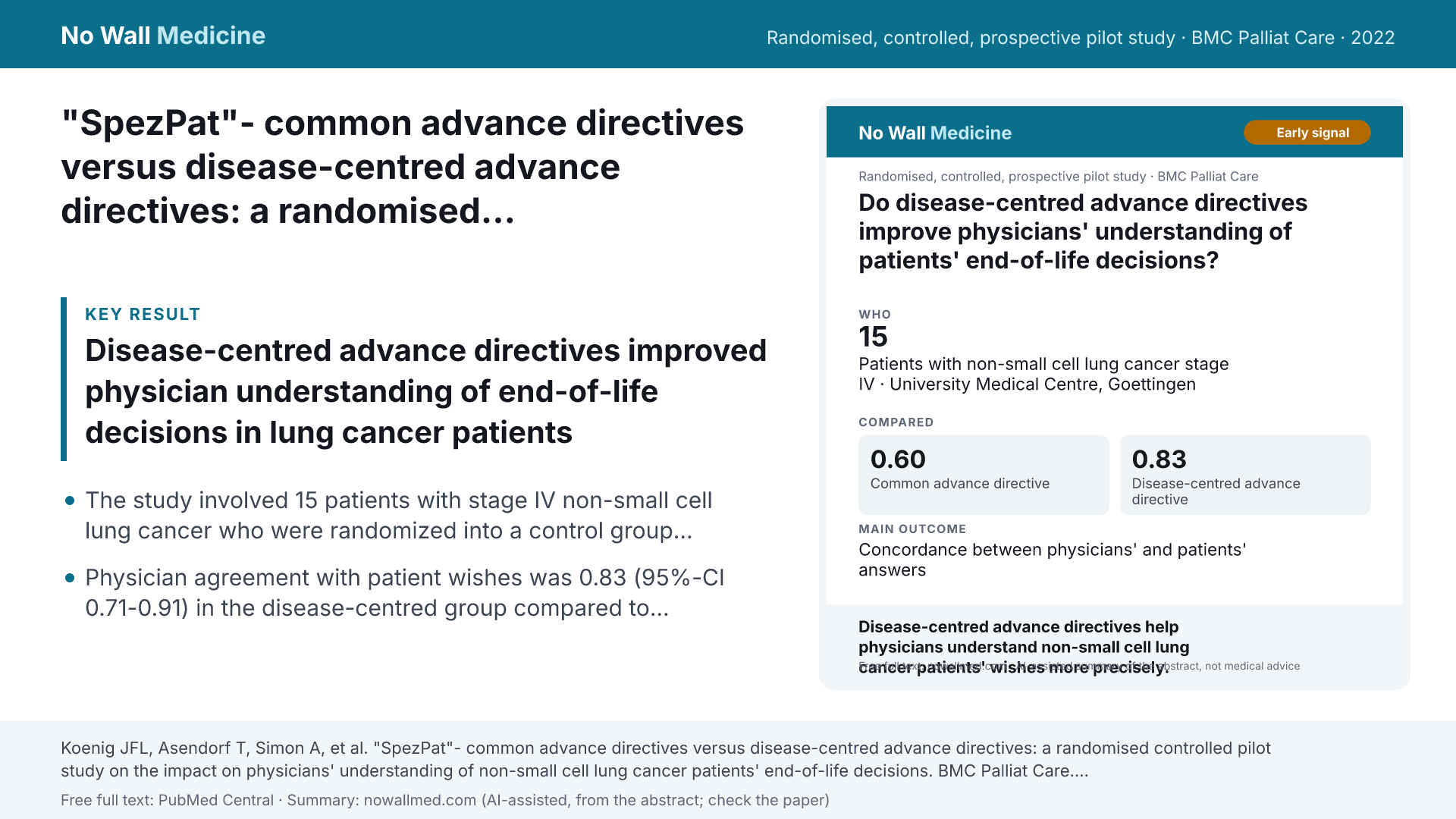
"SpezPat"- common advance directives versus disease-centred advance directives: a randomised controlled pilot study on the impact on physicians' understanding of non-small cell lung cancer patients' end-of-life decisions
Key result: Disease-centred advance directives improved physician understanding of end-of-life decisions in lung cancer patients
Key points
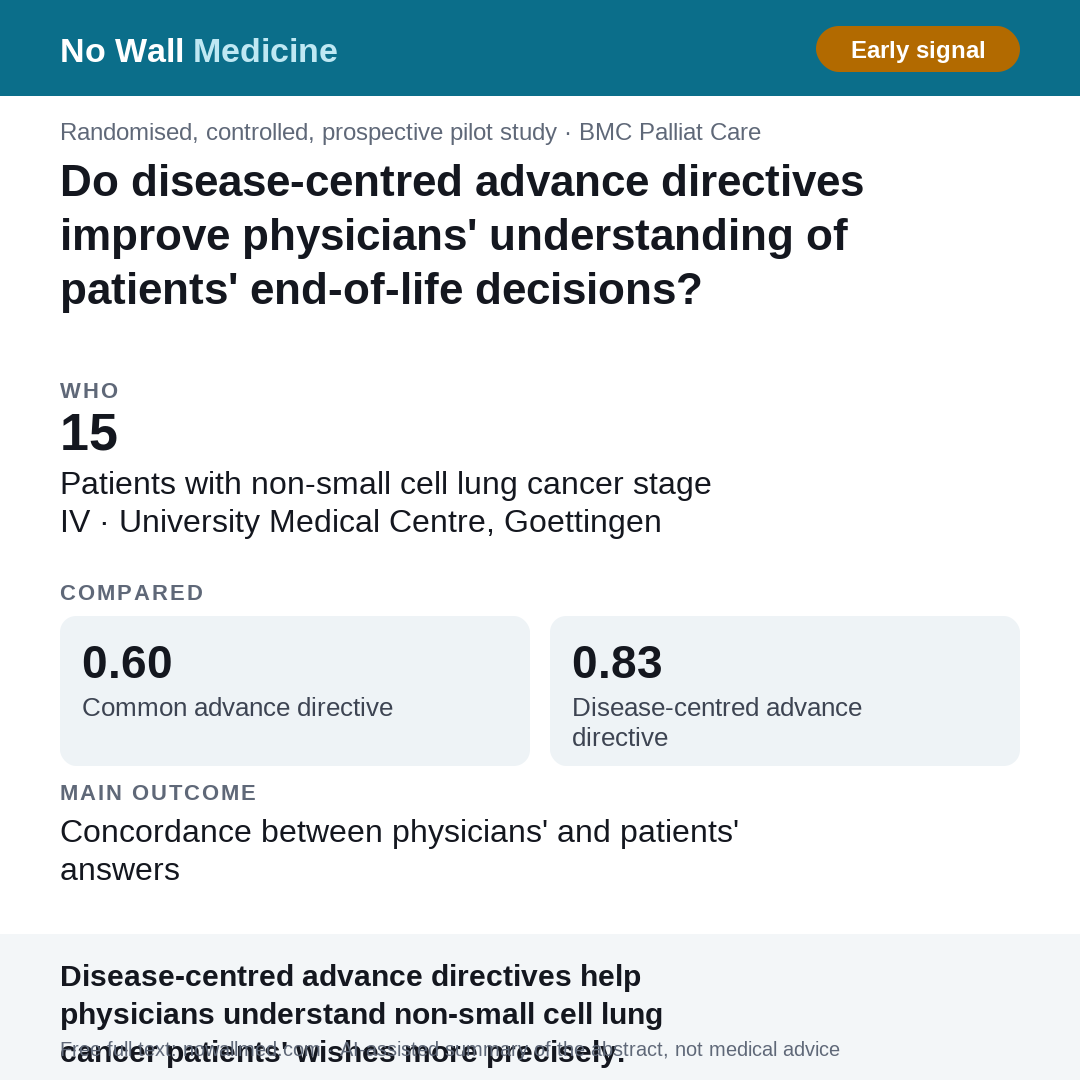
- The study involved 15 patients with stage IV non-small cell lung cancer who were randomized into a control group using common advance directives or an intervention group using disease-centred advance directives.
- Physician agreement with patient wishes was 0.83 (95%-CI 0.71-0.91) in the disease-centred group compared to 0.60 (95%-CI 0.48-0.70) in the common group, a statistically significant difference (p = 0.005).
- A total of 135 treatment decisions were evaluated across both groups.
Why it matters: It is challenging for healthcare providers to correctly understand patient wishes based on the information provided in standard advance directives.
Limitation the authors note: Recruitment was stopped prior to reaching the anticipated sample target.
Discussion prompts
- Would these patients look like yours? Who was left out?
- Is the main outcome one that matters to patients?
- Is the difference large enough to change what you do?
Cite: Koenig JFL, Asendorf T, Simon A, et al. "SpezPat"- common advance directives versus disease-centred advance directives: a randomised controlled pilot study on the impact on physicians' understanding of non-small cell lung cancer patients' end-of-life decisions. BMC Palliat Care. 2022. doi:10.1186/s12904-022-01057-5
Free full text: PubMed Central · Summary and visual abstract: nowallmed.com/a/spezpat-common-advance-directives-versus-disease-centred-advance-1ecryi1/ (AI-assisted from the abstract; check the paper before relying on it).