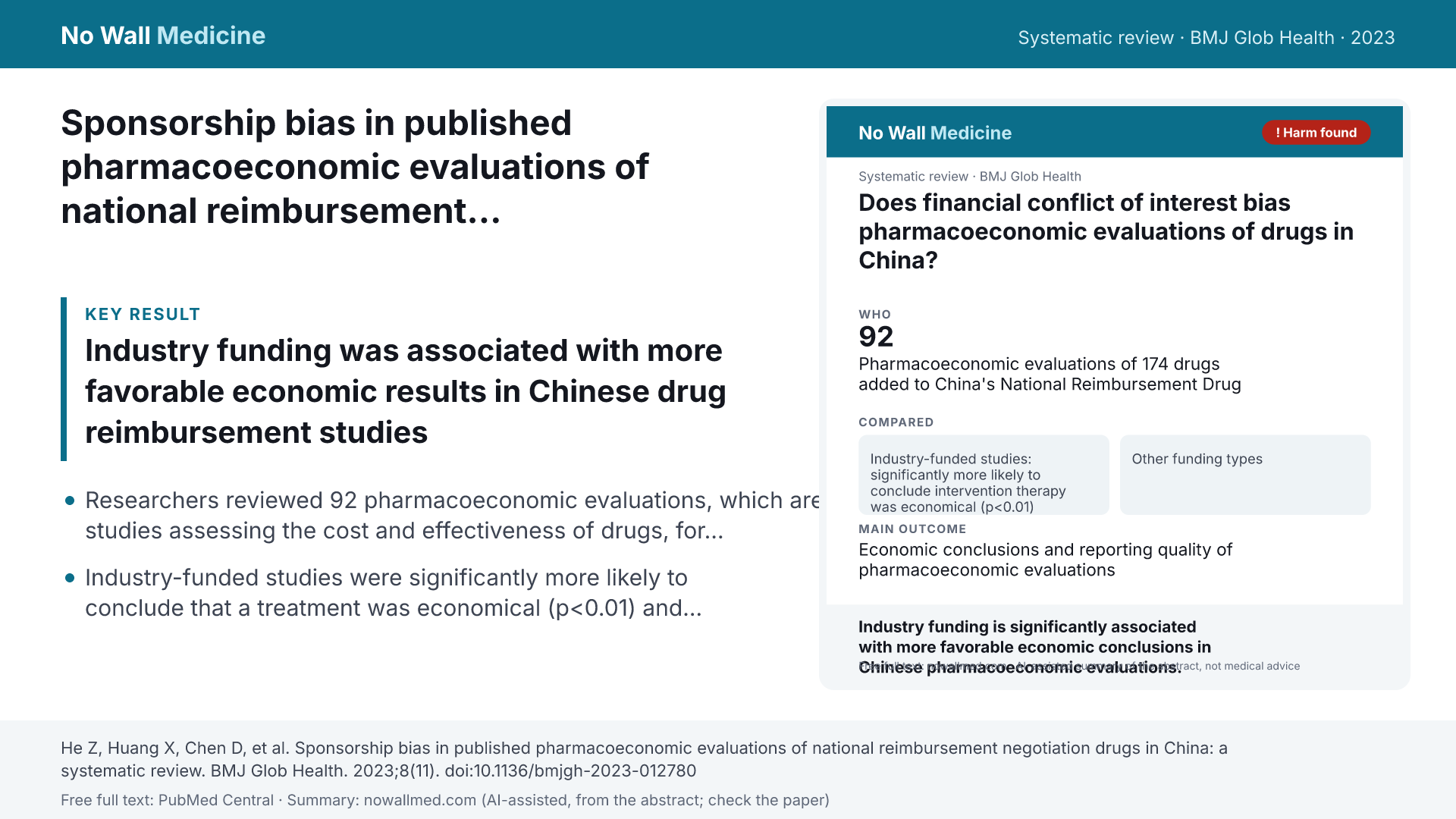
Industry funding was associated with more favorable economic results in Chinese drug reimbursement studies
Sponsorship bias in published pharmacoeconomic evaluations of national reimbursement negotiation drugs in China: a systematic review
Systematic reviewHarm found
Does financial conflict of interest bias pharmacoeconomic evaluations of drugs in China?
Who
92
Pharmacoeconomic evaluations of 174 drugs added to China's National Reimbursement Drug List · China
Compared
Industry-funded studies: significantly more likely to conclude intervention therapy was economical (p<0.01)
Other funding types
Main outcome
Economic conclusions and reporting quality of pharmacoeconomic evaluations
Bottom line: Industry funding is significantly associated with more favorable economic conclusions in Chinese pharmacoeconomic evaluations.
BMJ Glob Health · 2023-11-29 · Save PNG
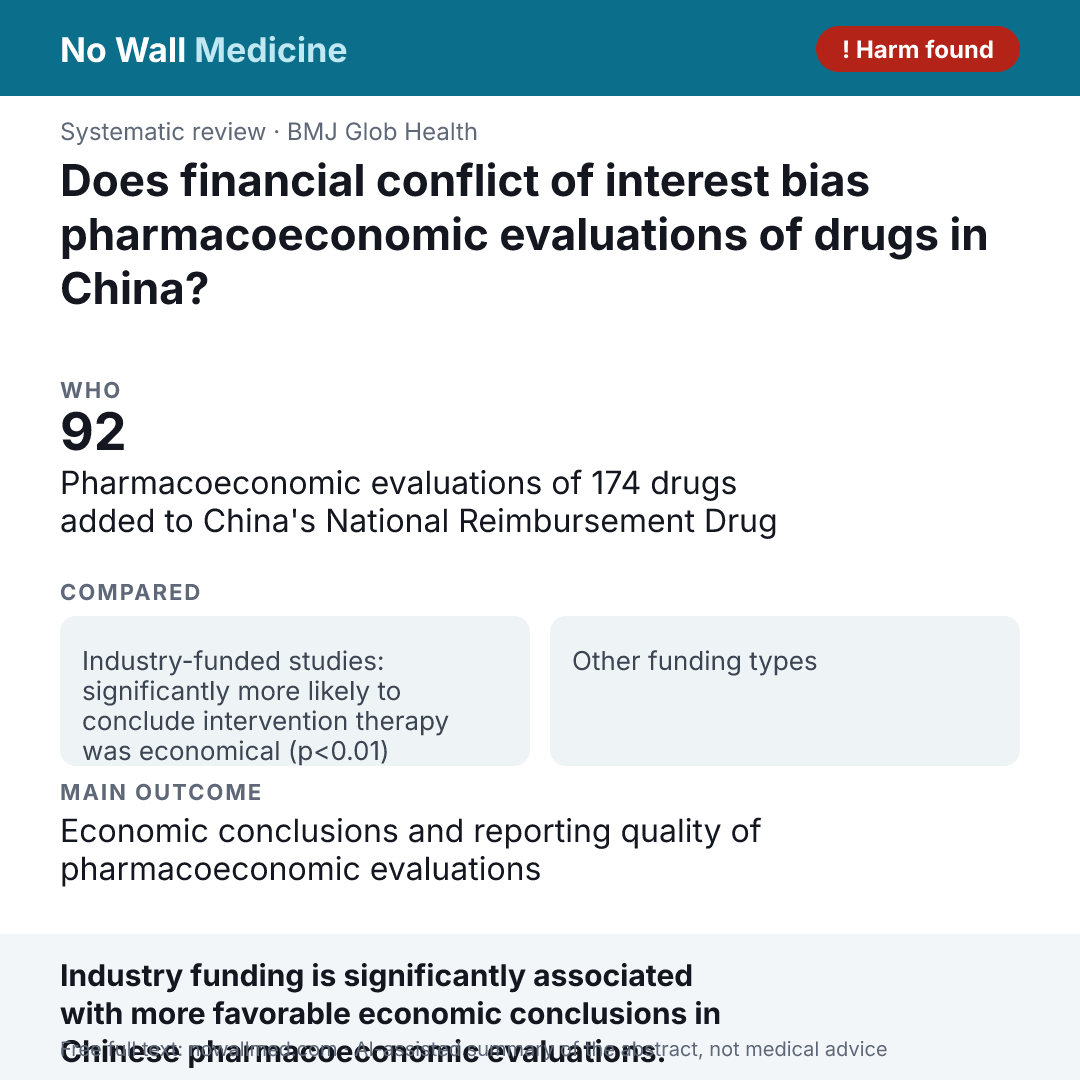
Clinical question: Does financial conflict of interest bias pharmacoeconomic evaluations of drugs in China?
Key points
- Researchers reviewed 92 pharmacoeconomic evaluations, which are studies assessing the cost and effectiveness of drugs, for 174 drugs added to China's National Reimbursement Drug List.
- Industry-funded studies were significantly more likely to conclude that a treatment was economical (p<0.01) and more likely to show the target drug was economically dominant (p<0.05).
- Of the included evaluations, 69.6% had at least one funding source and 57.6% reached favorable conclusions regarding the intervention drug.
Headline and key points written with AI from the paper’s abstract, with every number checked against it. Read the paper before relying on them.
Was this summary helpful?
Abstract
Background
China's National Reimbursement Drug List (NRDL) has become the primary route for drug reimbursement in China. More recently, the authority has made pharmacoeconomic evaluation an integral part of the application for NRDL inclusion. The underlying financial conflict of interests (FCOI) of pharmacoeconomic evaluations, however, has the potential to influence evidence generated and thus subsequent decision-making yet remains poorly understood. Methods
We searched for studies published between January 2012 and January 2022 on the 174 drugs added to the 2017-2020 NRDLs after successful negotiation. We categorised the study's FCOI status into no funding, industry funding, non-profit funding and multiple fundings based on authors' disclosure and assessed the reporting quality of included studies using the Consolidated Health Economic Evaluation Reporting Standards 2022 checklist. We compiled descriptive statistics of funding types and study outcomes using t-tests and χ2 tests and conducted multivariate regression analysis. Results
We identified 378 records and our final sample included 92 pharmacoeconomic evaluations, among which 69.6% were conducted with at least one funding source. More than half (57.6%) of the evaluations reached favourable conclusions towards the intervention drug and 12.6% reached a dominant result of the intervention drug over the comparison from model simulation. The reporting quality of included studies ranged from 19 to 25 (on a scale of 28), with an average of 22.3. The statistical tests indicated that industry-funded studies were significantly more likely to conclude that the intervention therapy was economical (p<0.01) and had a significantly higher proportion of resulting target drug economically dominated the comparison drug (p<0.05). Conclusion
The study revealed that FCOI bias is common in published pharmacoeconomic evaluations conducted in Chinese settings and could significantly influence the study's economical results and conclusions through various mechanisms. Multifaceted efforts are needed to improve transparency, comparability and reporting standardisation.
Abstract reproduced under the article’s CC BY NC licence.
Subject terms
Headline, design, result, key points, caveat and citation as plain text.
Cite this article
He Z, Huang X, Chen D, et al. Sponsorship bias in published pharmacoeconomic evaluations of national reimbursement negotiation drugs in China: a systematic review. BMJ Glob Health. 2023;8(11). doi:10.1136/bmjgh-2023-012780
Spotted a mistake? Suggest a correction