Five stakeholder groups influence how clinical artificial intelligence is implemented in healthcare settings
Stakeholder Perspectives of Clinical Artificial Intelligence Implementation: Systematic Review of Qualitative Evidence
Qualitative systematic reviewMixed results
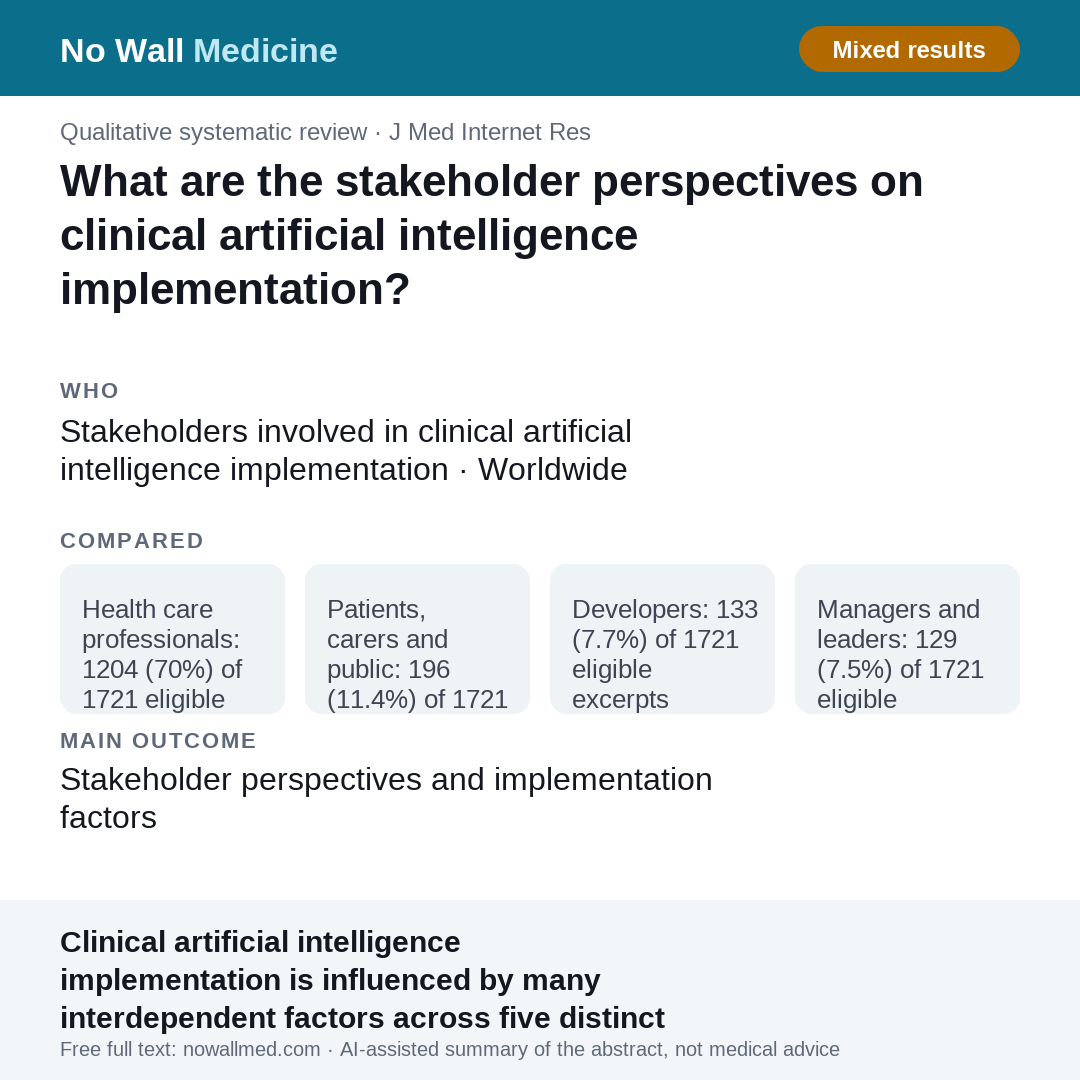
What are the stakeholder perspectives on clinical artificial intelligence implementation?
Who
Stakeholders involved in clinical artificial intelligence implementation · Worldwide
Compared
Health care professionals: 1204 (70%) of 1721 eligible excerpts
Patients, carers and public: 196 (11.4%) of 1721 eligible excerpts
Developers: 133 (7.7%) of 1721 eligible excerpts
Managers and leaders: 129 (7.5%) of 1721 eligible excerpts
Main outcome
Stakeholder perspectives and implementation factors
Bottom line: Clinical artificial intelligence implementation is influenced by many interdependent factors across five distinct stakeholder groups.
Limitation: Underrepresentation of perspectives from stakeholders other than health care professionals in the literature.
J Med Internet Res · 2023-01-10Download image
Clinical question: What are the stakeholder perspectives on clinical artificial intelligence implementation?
Why it matters: The factors that influence the successful implementation of clinical artificial intelligence in real-world care are not fully understood.
Key points
- Researchers reviewed 111 qualitative studies published between January 2014 and April 2021 to identify perspectives on clinical artificial intelligence implementation.
- Five groups were identified, including healthcare professionals who contributed 70% of the 1721 eligible excerpts and patients who contributed 11.4%.
- Implementation factors for rule-based tools were mostly similar to non-rule-based tools, except for regulation, intellectual property, and sociocultural attitudes.
Limitation the authors note: The literature shows an underrepresentation of perspectives from stakeholders other than healthcare professionals.
Headline and key points written with AI from the paper’s abstract, with every number checked against it. Read the paper before relying on them.
Was this summary helpful?
Subject terms
Cite this article
Hogg HDJ, Al-Zubaidy M, Technology Enhanced Macular Services Study Reference Group, Talks J, Denniston AK, Kelly CJ. Stakeholder Perspectives of Clinical Artificial Intelligence Implementation: Systematic Review of Qualitative Evidence. J Med Internet Res. 2023. doi:10.2196/39742
Spotted a mistake? Suggest a correction
Top studies every Monday
The week’s key trials and guidelines in your specialties, plus any topics you follow. By email, free.
Get the weekly digest