Stepwise reduction of dual antiplatelet therapy was non-inferior to standard 12 month treatment
Stepwise dual antiplatelet therapy de-escalation in patients after drug coated balloon angioplasty (REC-CAGEFREE II): multicentre, randomised, open label, assessor blind, non-inferiority trial
Multicentre, randomised, open label, assessor blind, non-inferiority trialBenefit found
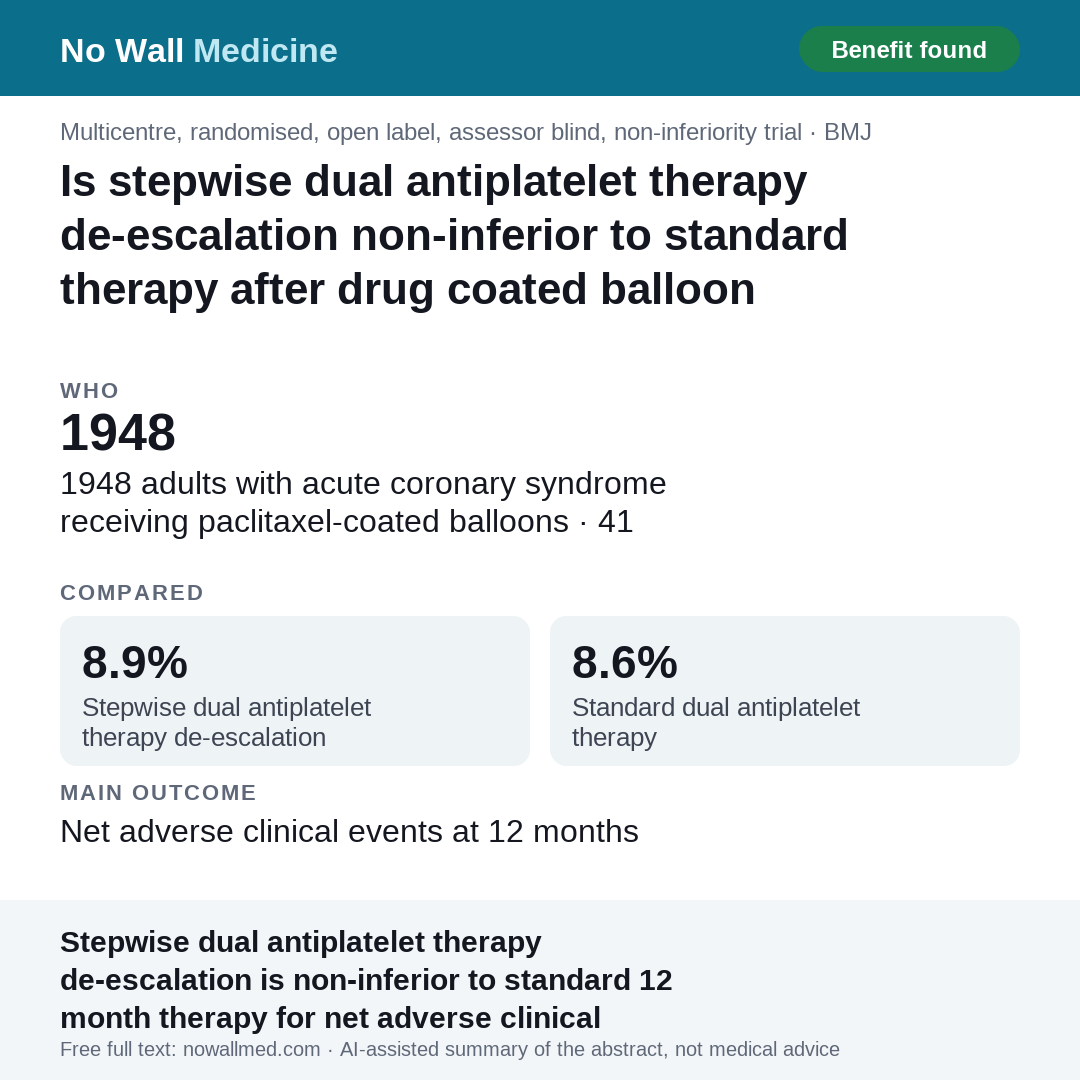
Is stepwise dual antiplatelet therapy de-escalation non-inferior to standard therapy after drug coated balloon angioplasty?
Who
1948
1948 adults with acute coronary syndrome receiving paclitaxel-coated balloons · 41 hospitals in China
Compared
8.9%Stepwise dual antiplatelet therapy de-escalation
8.6%Standard dual antiplatelet therapy
Main outcome
Net adverse clinical events at 12 months
Result: difference 0.36%; upper boundary of the one sided 95% CI 2.47%
Bottom line: Stepwise dual antiplatelet therapy de-escalation is non-inferior to standard 12 month therapy for net adverse clinical events.
BMJ · 2025-03-31Download image
Clinical question: Is stepwise dual antiplatelet therapy de-escalation non-inferior to standard therapy after drug coated balloon angioplasty?
Why it matters: It is unclear if a less intense antiplatelet regimen can be used safely for patients receiving drug coated balloons.
Key points
- The study compared 1948 adults with acute coronary syndrome treated with paclitaxel-coated balloons to either a stepwise de-escalation of antiplatelet drugs or standard 12 month therapy.
- At 12 months, the primary endpoint of net adverse clinical events occurred in 8.9% of the de-escalation group and 8.6% of the standard group.
- Severe bleeding, defined as Bleeding Academic Research Consortium type 3 or 5, occurred in 0.4% of the de-escalation group compared to 1.6% in the standard group.
Headline and key points written with AI from the paper’s abstract, with every number checked against it. Read the paper before relying on them.
Abstract
Objectives
To investigate whether a less intense antiplatelet regimen could be used for people receiving drug coated balloons. Design
Multicentre, randomised, open label, assessor blind, non-inferiority trial (REC-CAGEFREE II). Setting
41 hospitals in China between 27 November 2021 and 21 January 2023. Participants
1948 adults (18-80 years) with acute coronary syndrome who received treatment exclusively with paclitaxel-coated balloons according to the international drug coated balloon consensus. Interventions
Participants were randomly assigned (1:1) to either the stepwise dual antiplatelet therapy (DAPT) de-escalation group (n=975) consisting of aspirin plus ticagrelor for one month, followed by five months of ticagrelor monotherapy, and then six months of aspirin monotherapy, or to the standard DAPT group (n=973) consisting of aspirin plus ticagrelor for 12 months. Main outcome measures
The primary endpoint was net adverse clinical events (all cause death, stroke, myocardial infarction, revascularisation, and Bleeding Academic Research Consortium (BARC) type 3 or 5 bleeding) at 12 months in the intention-to-treat population. Non-inferiority was established if the upper limit of the one sided 95% confidence interval (CI) for the absolute risk difference was smaller than 3.2%. Results
The mean age of participants was 59.2 years, 74.9% were men, 30.5% had diabetes, and 20.6% were at high bleeding risk. 60.9% of treated lesions were in small vessels, and 17.8% were in-stent restenosis. The mean drug coated balloon diameter was 2.72 mm (standard deviation 0.49). At 12 months, the primary endpoint occurred in 87 (8.9%) participants in the stepwise de-escalation group and 84 (8.6%) in the standard group (difference 0.36%; upper boundary of the one sided 95% CI 2.47%; Pnon-inferiority=0.013). In the stepwise de-escalation versus standard groups, BARC type 3 or 5 bleeding occurred in four versus 16 participants (0.4% v 1.6%, difference -1.19% (95% CI -2.07% to -0.31%), P=0.008), and all cause death, stroke, myocardial infarction, and revascularisation occurred in 84 versus 74 participants (8.6% v 7.6%, difference 1.05% (95% CI -1.37% to 3.47%), P=0.396). Treated as having hierarchical clinical importance by the win ratio method, more wins were noted with the stepwise de-escalation group (14.4% wins) compared with the standard group (10.1% wins) for the predefined hierarchical composite endpoint of all cause death, stroke, myocardial infarction, BARC type 3 bleeding, revascularisation, and BARC type 2 bleeding (win ratio 1.43 (95% CI 1.12 to 1.83), P=0.004). Results from the per-protocol and the intention-to-treat analysis were similar. Conclusions
Among participants with acute coronary syndrome who could be treated by drug coated balloons exclusively, a stepwise DAPT de-escalation was non-inferior to 12 month DAPT for net adverse clinical events. Trial registration
Clinicaltrials.gov NCT04971356.
Abstract reproduced under the article’s CC BY NC licence.
Topics
Cite this article
Gao C, Zhu B, Ouyang F, Wen S, Xu Y, Jia W. Stepwise dual antiplatelet therapy de-escalation in patients after drug coated balloon angioplasty (REC-CAGEFREE II): multicentre, randomised, open label, assessor blind, non-inferiority trial. BMJ. 2025. doi:10.1136/bmj-2024-082945
Spotted a mistake? Suggest a correction