Stereotactic body radiotherapy showed similar disease-free survival compared to moderately hypofractionated radiation for prostate cancer
Stereotactic Body Radiotherapy vs Moderately Hypofractionated IMRT for Localized Intermediate-Risk Prostate Cancer: A Randomized Clinical Trial
Phase-3, international, open-label, randomized clinical trialMixed results
Is stereotactic body radiotherapy superior to moderately hypofractionated intensity-modulated radiation therapy for prostate cancer?
Who
698
Patients with localized intermediate-risk prostate cancer · 136 centers in Asia, Canada, Europe, and the United States
Compared
88.6%Stereotactic body radiotherapy (95% CI, 85.2%-92.1%)
92.1%Moderately hypofractionated intensity-modulated radiation therapy (95% CI, 88.9%-95.2%)
Main outcome
Disease-free survival at 3 years
Result: not superior
Bottom line: Stereotactic body radiotherapy improved quality-of-life domains but was not superior to moderately hypofractionated intensity-modulated radiation therapy for disease-free survival.
JAMA · 2026-08-13Download image
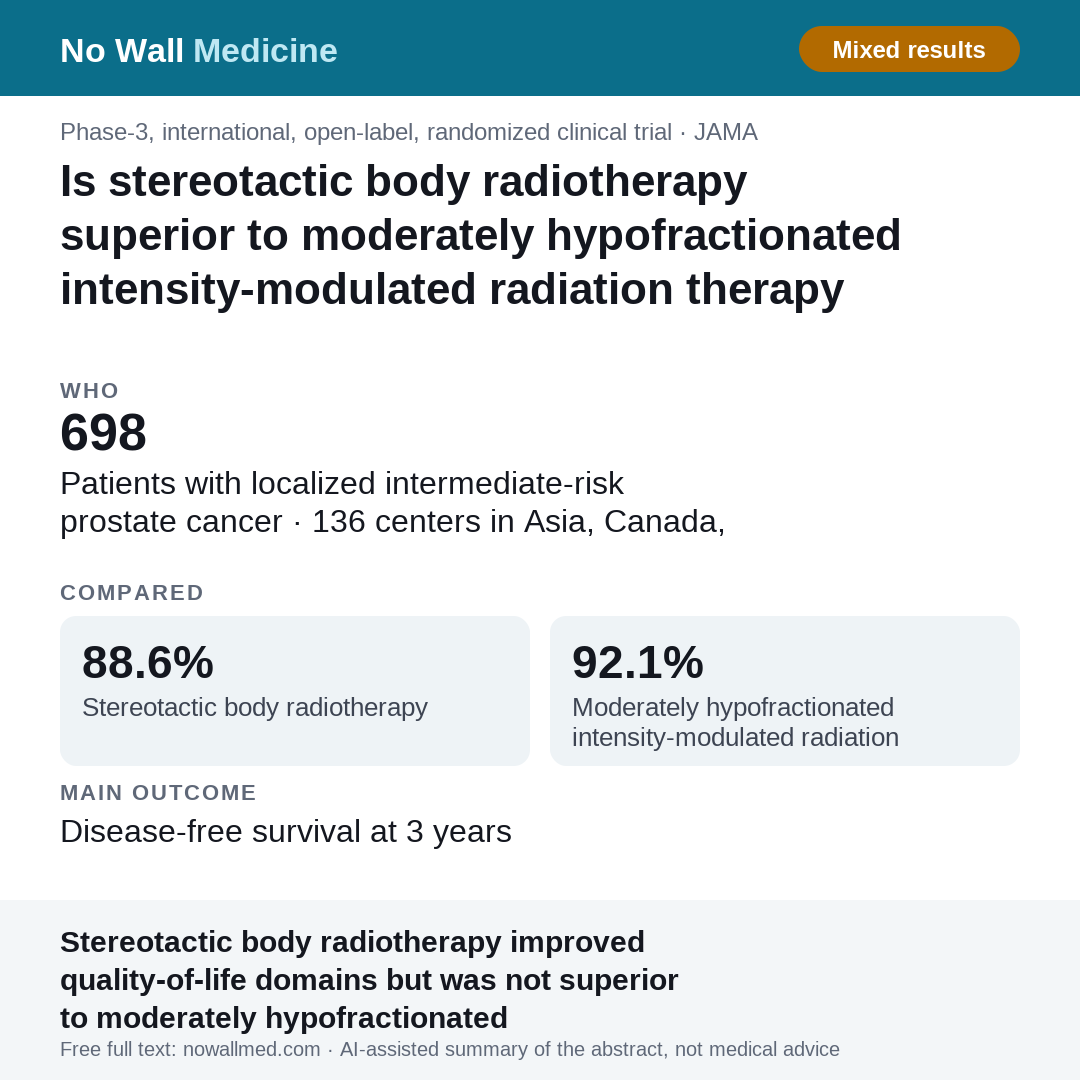
Clinical question: Is stereotactic body radiotherapy superior to moderately hypofractionated intensity-modulated radiation therapy for prostate cancer?
Why it matters: Radiotherapy methods are evolving, and researchers needed to determine if faster stereotactic body radiotherapy is superior to moderately hypofractionated radiation regarding quality of life and disease survival.
Key points
- Researchers studied 698 patients with localized intermediate-risk prostate cancer, comparing stereotactic body radiotherapy (SBRT) to moderately hypofractionated intensity-modulated radiation therapy (MH-IMRT).
- At 3 years, disease-free survival was 88.6% for the SBRT group compared to 92.1% for the MH-IMRT group, showing no significant difference.
- The SBRT group had significantly fewer bowel-related quality of life declines and fewer grade 3 or 4 genitourinary adverse events than the MH-IMRT group.
Headline and key points written with AI from the paper’s abstract, with every number checked against it. Read the paper before relying on them.
Topics
Spotted a mistake? Suggest a correction
More in Urology
Checkpoint inhibitor regimens benefit renal cell carcinoma patients with poor prognosis most
Which Patients with Advanced Clear Cell Renal Cell Carcinoma Benefit Most from First-line Checkpoint Inhibitor Combination Regimens: A Meta-analysis of Individual Patient Data and Aggregate Data from Randomised Trials
Male factor infertility is influenced by genetics, environment, and lifestyle choices
Key Determinants and Clinical Impact of Male Factor Infertility: From Etiology to Treatment
Nectin-4-targeted PET/CT compared to FDG PET/CT for urothelial carcinoma staging
Diagnostic Performance of Nectin-4-targeted [68Ga]Ga-DOTA-N188 PET/CT versus [18F]-FDG PET/CT for Staging of Locally Advanced and Metastatic Urothelial Carcinoma: A Prospective, Single-center, Phase 2 Feasibility Trial
Robotic surgery worked as well as open surgery for Wilms tumor in selected cases
Exploring the Limits of Robotic Surgery for Wilms Tumor: A Descriptive Analysis