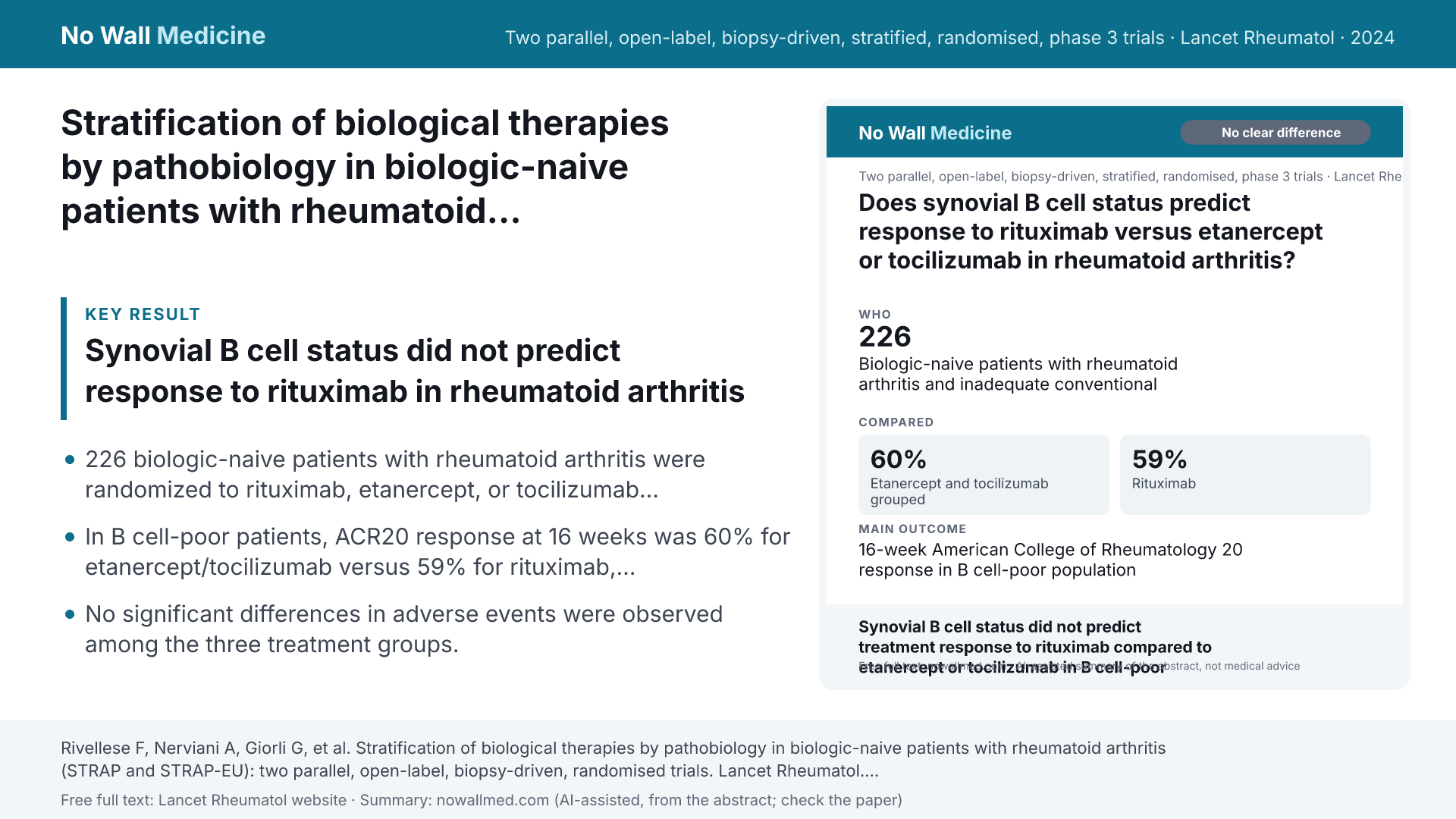
Synovial B cell status did not predict response to rituximab in rheumatoid arthritis
Stratification of biological therapies by pathobiology in biologic-naive patients with rheumatoid arthritis (STRAP and STRAP-EU): two parallel, open-label, biopsy-driven, randomised trials
Two parallel, open-label, biopsy-driven, stratified, randomised, phase 3 trialsNo clear difference
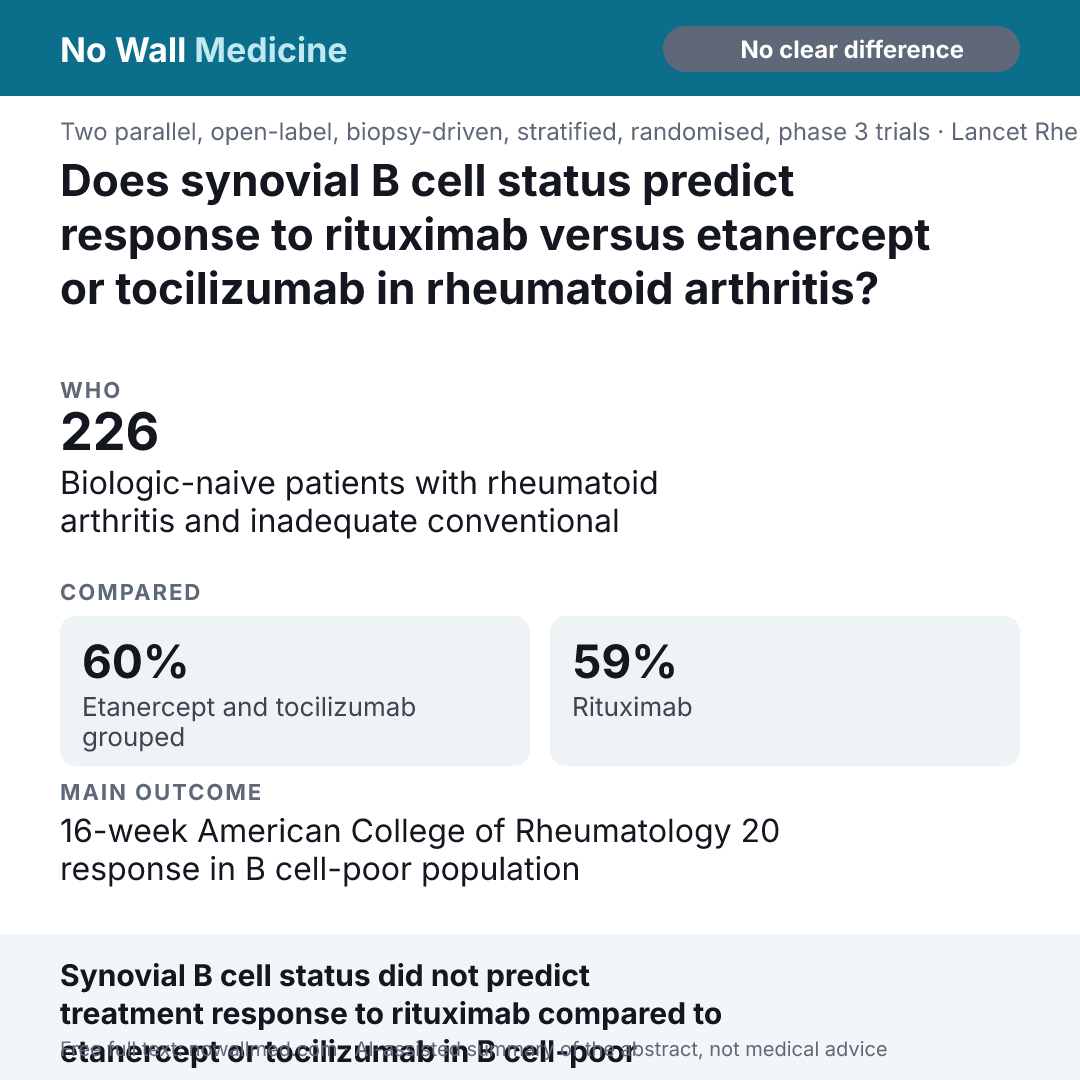
Does synovial B cell status predict response to rituximab versus etanercept or tocilizumab in rheumatoid arthritis?
Who
226
Biologic-naive patients with rheumatoid arthritis and inadequate conventional synthetic drug response · 26 university centres in the United Kingdom and Europe
Compared
60%Etanercept and tocilizumab grouped
59%Rituximab
Main outcome
16-week American College of Rheumatology 20 response in B cell-poor population
Result: odds ratio 1·02 (95% CI 0·47-2·17)
Bottom line: Synovial B cell status did not predict treatment response to rituximab compared to etanercept or tocilizumab in B cell-poor patients.
Limitation: The lack of response to rituximab in pauci-immune pathotype warrants further investigations.
Lancet Rheumatol · 2024-01-22 · Funded by UK Medical Research Council and Versus Arthritis
Why it matters: Predictive biomarkers for choosing between rituximab and other biologic therapies in rheumatoid arthritis are lacking.
Headline and visual abstract written with AI from the paper’s abstract, with every number checked against it. Read the paper before relying on them.
Was this summary helpful?
Abstract
Background
Despite highly effective targeted therapies for rheumatoid arthritis, about 40% of patients respond poorly, and predictive biomarkers for treatment choices are lacking. We did a biopsy-driven trial to compare the response to rituximab, etanercept, and tocilizumab in biologic-naive patients with rheumatoid arthritis stratified for synovial B cell status. Methods
STRAP and STRAP-EU were two parallel, open-label, biopsy-driven, stratified, randomised, phase 3 trials done across 26 university centres in the UK and Europe. Biologic-naive patients aged 18 years or older with rheumatoid arthritis based on American College of Rheumatology (ACR)-European League Against Rheumatism classification criteria and an inadequate response to conventional synthetic disease-modifying antirheumatic drugs (DMARDs) were included. Following ultrasound-guided synovial biopsy, patients were classified as B cell poor or B cell rich according to synovial B cell signatures and randomly assigned (1:1:1) to intravenous rituximab (1000 mg at week 0 and week 2), subcutaneous tocilizumab (162 mg per week), or subcutaneous etanercept (50 mg per week). The primary outcome was the 16-week ACR20 response in the B cell-poor, intention-to-treat population (defined as all randomly assigned patients), with data pooled from the two trials, comparing etanercept and tocilizumab (grouped) versus rituximab. Safety was assessed in all patients who received at least one dose of study drug. These trials are registered with the EU Clinical Trials Register, 2014-003529-16 (STRAP) and 2017-004079-30 (STRAP-EU). Findings
Between June 8, 2015, and July 4, 2019, 226 patients were randomly assigned to etanercept (n=73), tocilizumab (n=74), and rituximab (n=79). Three patients (one in each group) were excluded after randomisation because they received parenteral steroids in the 4 weeks before recruitment. 168 (75%) of 223 patients in the intention-to-treat population were women and 170 (76%) were White. In the B cell-poor population, ACR20 response at 16 weeks (primary endpoint) showed no significant differences between etanercept and tocilizumab grouped together and rituximab (46 [60%] of 77 patients vs 26 [59%] of 44; odds ratio 1·02 [95% CI 0·47-2·17], p=0·97). No differences were observed for adverse events, including serious adverse events, which occurred in six (6%) of 102 patients in the rituximab group, nine (6%) of 108 patients in the etanercept group, and three (4%) of 73 patients in the tocilizumab group (p=0·53). Interpretation
In this biologic-naive population of patients with rheumatoid arthrtitis, the dichotomic classification into synovial B cell poor versus rich did not predict treatment response to B cell depletion with rituximab compared with alternative treatment strategies. However, the lack of response to rituximab in patients with a pauci-immune pathotype and the higher risk of structural damage progression in B cell-rich patients treated with rituximab warrant further investigations into the ability of synovial tissue analyses to inform disease pathogenesis and treatment response. Funding
UK Medical Research Council and Versus Arthritis.
Abstract reproduced under the article’s CC BY licence.
Subject terms
Cite this article
Rivellese F, Nerviani A, Giorli G, et al. Stratification of biological therapies by pathobiology in biologic-naive patients with rheumatoid arthritis (STRAP and STRAP-EU): two parallel, open-label, biopsy-driven, randomised trials. Lancet Rheumatol. 2023;5(11):e648-e659. doi:10.1016/S2665-9913(23)00241-2
Spotted a mistake? Suggest a correction