Specific streptococcus species were associated with higher risks of infective endocarditis in bloodstream infections
Streptococcal endocarditis: a meta-analysis of species dependant risk
Meta-analysisMixed results
What is the risk of infective endocarditis across different streptococcal species?
Who
14183
Streptococcal bacteraemia isolates · Four large hospitals
Compared
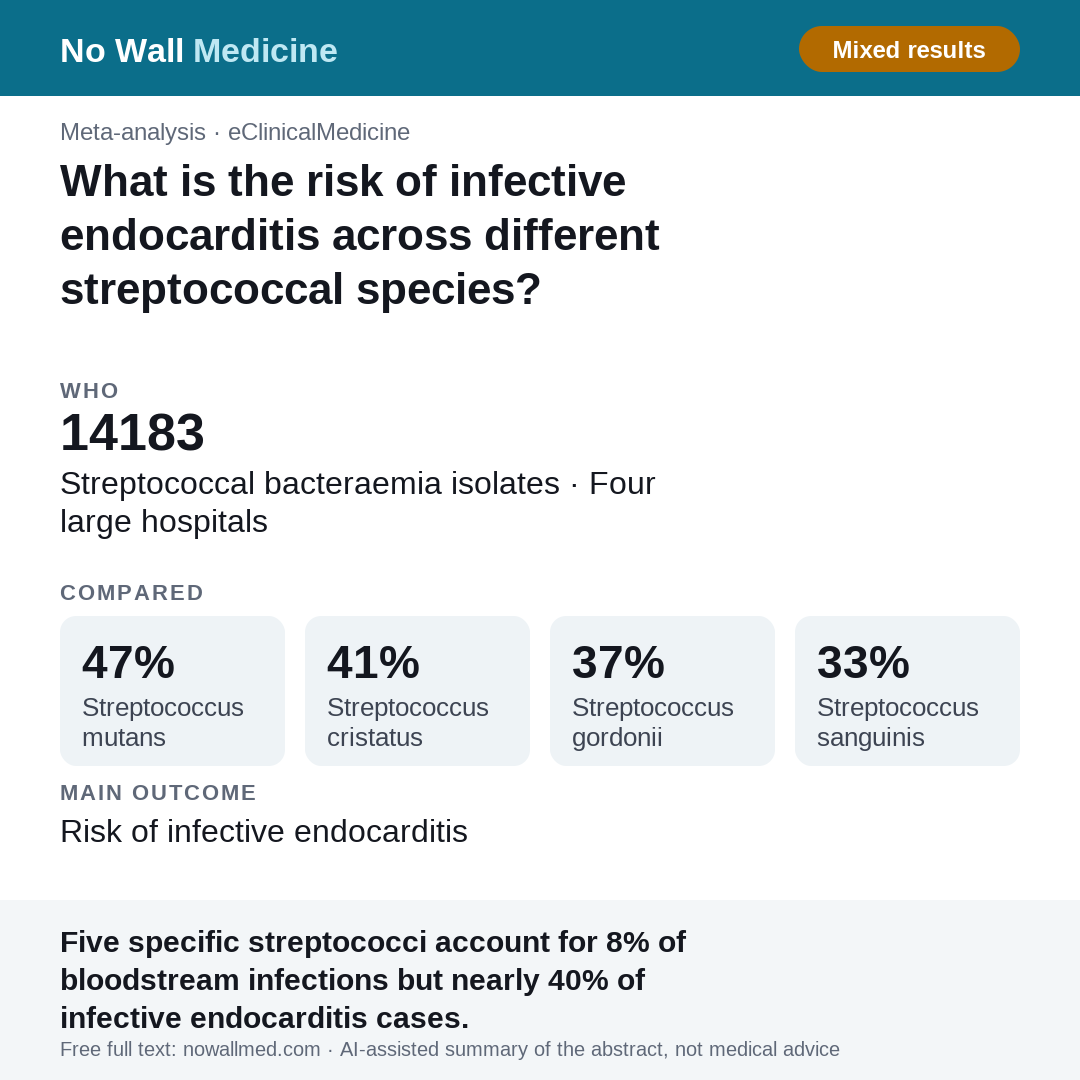
47%Streptococcus mutans (95% CI 38-56%)
41%Streptococcus cristatus (95% CI 21-62%)
37%Streptococcus gordonii (95% CI 30-44%)
33%Streptococcus sanguinis (95% CI 28-39%)
Main outcome
Risk of infective endocarditis
Bottom line: Five specific streptococci account for 8% of bloodstream infections but nearly 40% of infective endocarditis cases.
Limitation: Strong evidence of heterogeneity detected in Streptococcus mitis/oralis and Streptococcus gallolyticus.
Funded by: NIHR, Fonds de Recherche Québec - Santé, Medical Research Council
eClinicalMedicine · 2025-08-25Download image
Clinical question: What is the risk of infective endocarditis across different streptococcal species?
Why it matters: International guidance currently considers the risk of infective endocarditis from streptococci to be the same regardless of species, excluding Streptococcus pyogenes and Streptococcus pneumoniae.
Key points
- Researchers analyzed 14,183 isolates and 1028 cases of infective endocarditis, which is an infection of the heart lining or valves.
- Streptococcus mutans had the highest risk at 47%, followed by Streptococcus cristatus at 41% and Streptococcus gordonii at 37%.
- Five specific species accounted for 8.4% of bloodstream infections but were associated with 38.6% of all infective endocarditis cases.
Headline and key points written with AI from the paper’s abstract, with every number checked against it. Read the paper before relying on them.
Was this summary helpful?
Cite this article
Deas G, Lee TC, Colston J, Albur M, Vasant J, Nobbs AH. Streptococcal endocarditis: a meta-analysis of species dependant risk. eClinicalMedicine. 2025. doi:10.1016/j.eclinm.2025.103425
Spotted a mistake? Suggest a correction
Top studies every Monday
The week’s key trials and guidelines in your specialties, plus any topics you follow. By email, free.
Get the weekly digest