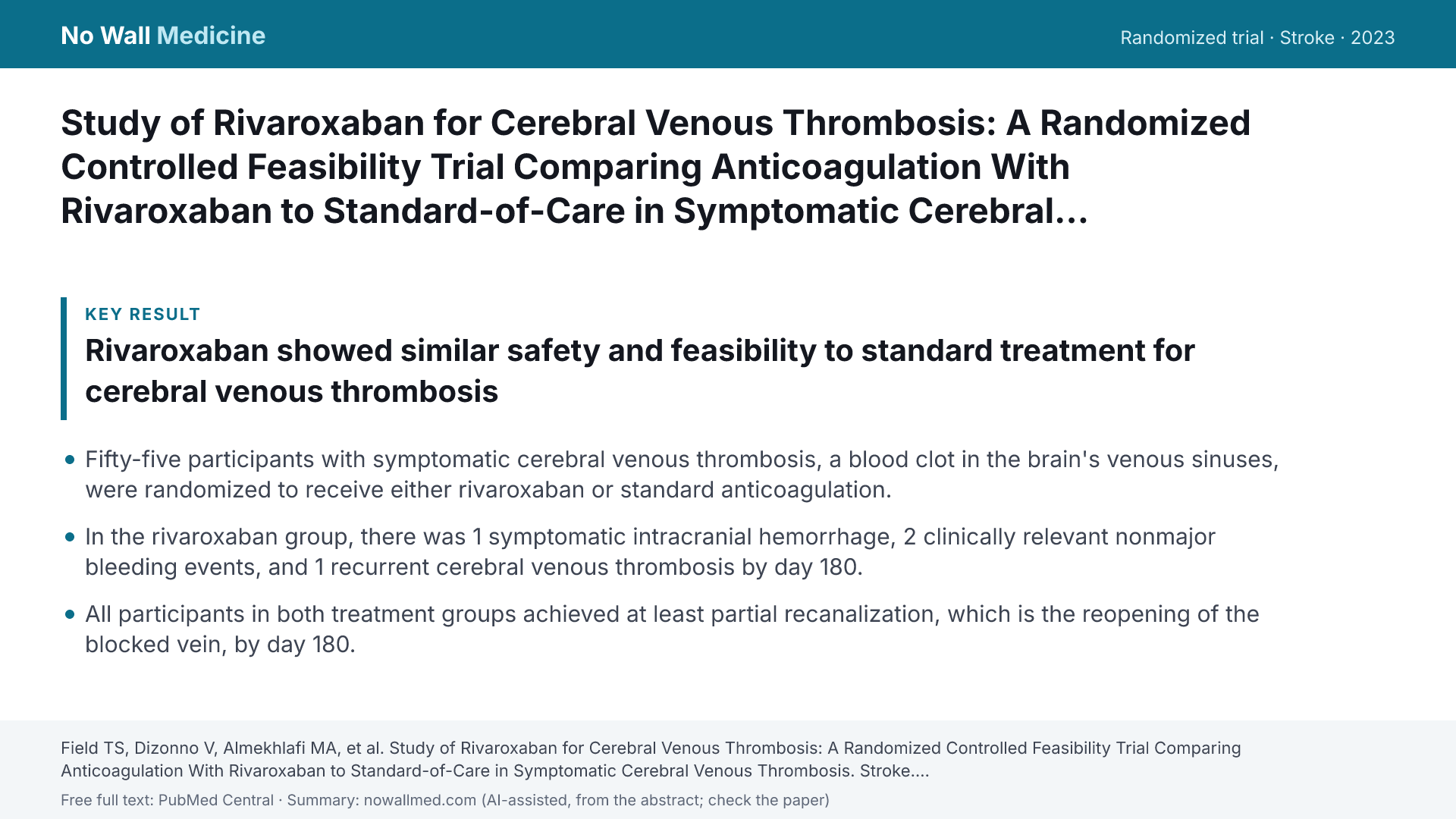
Rivaroxaban showed similar safety and feasibility to standard treatment for cerebral venous thrombosis
Study of Rivaroxaban for Cerebral Venous Thrombosis: A Randomized Controlled Feasibility Trial Comparing Anticoagulation With Rivaroxaban to Standard-of-Care in Symptomatic Cerebral Venous Thrombosis
Why it matters: It is unknown if direct oral anticoagulants are a feasible and safe alternative to standard-of-care treatments for patients with cerebral venous thrombosis.
Key points
- Fifty-five participants with symptomatic cerebral venous thrombosis, a blood clot in the brain's venous sinuses, were randomized to receive either rivaroxaban or standard anticoagulation.
- In the rivaroxaban group, there was 1 symptomatic intracranial hemorrhage, 2 clinically relevant nonmajor bleeding events, and 1 recurrent cerebral venous thrombosis by day 180.
- All participants in both treatment groups achieved at least partial recanalization, which is the reopening of the blocked vein, by day 180.
Headline and key points written with AI from the paper’s abstract, with every number checked against it. Read the paper before relying on them.
Was this summary helpful?
Subject terms
Cite this article
Field TS, Dizonno V, Almekhlafi MA, et al. Study of Rivaroxaban for Cerebral Venous Thrombosis: A Randomized Controlled Feasibility Trial Comparing Anticoagulation With Rivaroxaban to Standard-of-Care in Symptomatic Cerebral Venous Thrombosis. Stroke. 2023. doi:10.1161/STROKEAHA.123.044113
Spotted a mistake? Suggest a correction