Study of Rivaroxaban for Cerebral Venous Thrombosis: A Randomized Controlled Feasibility Trial Comparing Anticoagulation With Rivaroxaban to Standard-of-Care in Symptomatic Cerebral Venous Thrombosis
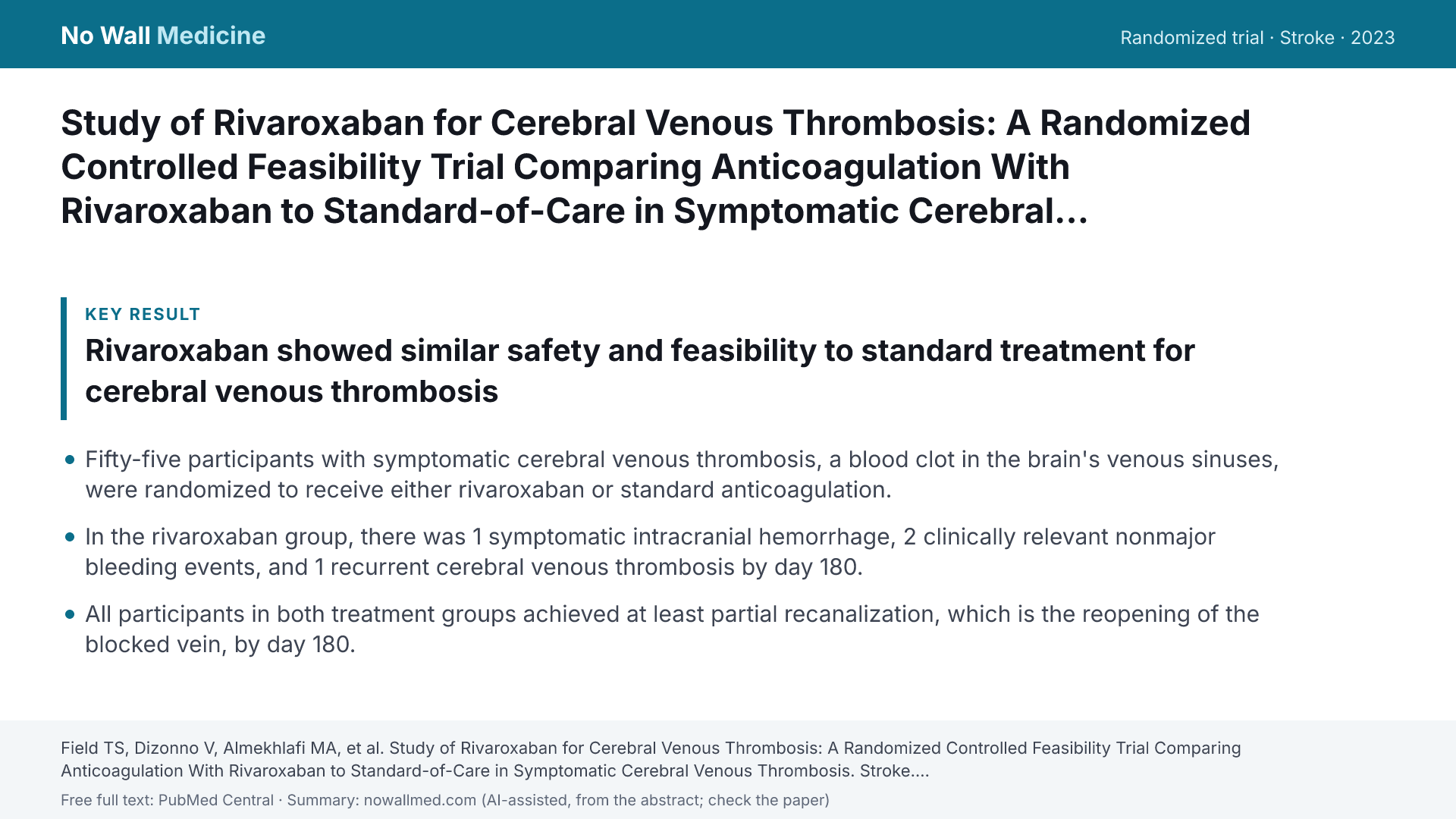
Key result: Rivaroxaban showed similar safety and feasibility to standard treatment for cerebral venous thrombosis
Key points
- Fifty-five participants with symptomatic cerebral venous thrombosis, a blood clot in the brain's venous sinuses, were randomized to receive either rivaroxaban or standard anticoagulation.
- In the rivaroxaban group, there was 1 symptomatic intracranial hemorrhage, 2 clinically relevant nonmajor bleeding events, and 1 recurrent cerebral venous thrombosis by day 180.
- All participants in both treatment groups achieved at least partial recanalization, which is the reopening of the blocked vein, by day 180.
Discussion prompts
- Would these patients look like yours? Who was left out?
- Is the main outcome one that matters to patients?
- Is the difference large enough to change what you do?
Cite: Field TS, Dizonno V, Almekhlafi MA, et al. Study of Rivaroxaban for Cerebral Venous Thrombosis: A Randomized Controlled Feasibility Trial Comparing Anticoagulation With Rivaroxaban to Standard-of-Care in Symptomatic Cerebral Venous Thrombosis. Stroke. 2023;54(11):2724-2736. doi:10.1161/STROKEAHA.123.044113
Free full text: PubMed Central · Summary and visual abstract: nowallmed.com/a/study-of-rivaroxaban-for-cerebral-venous-thrombosis-a-randomized-1k67orx/ (AI-assisted from the abstract; check the paper before relying on it).