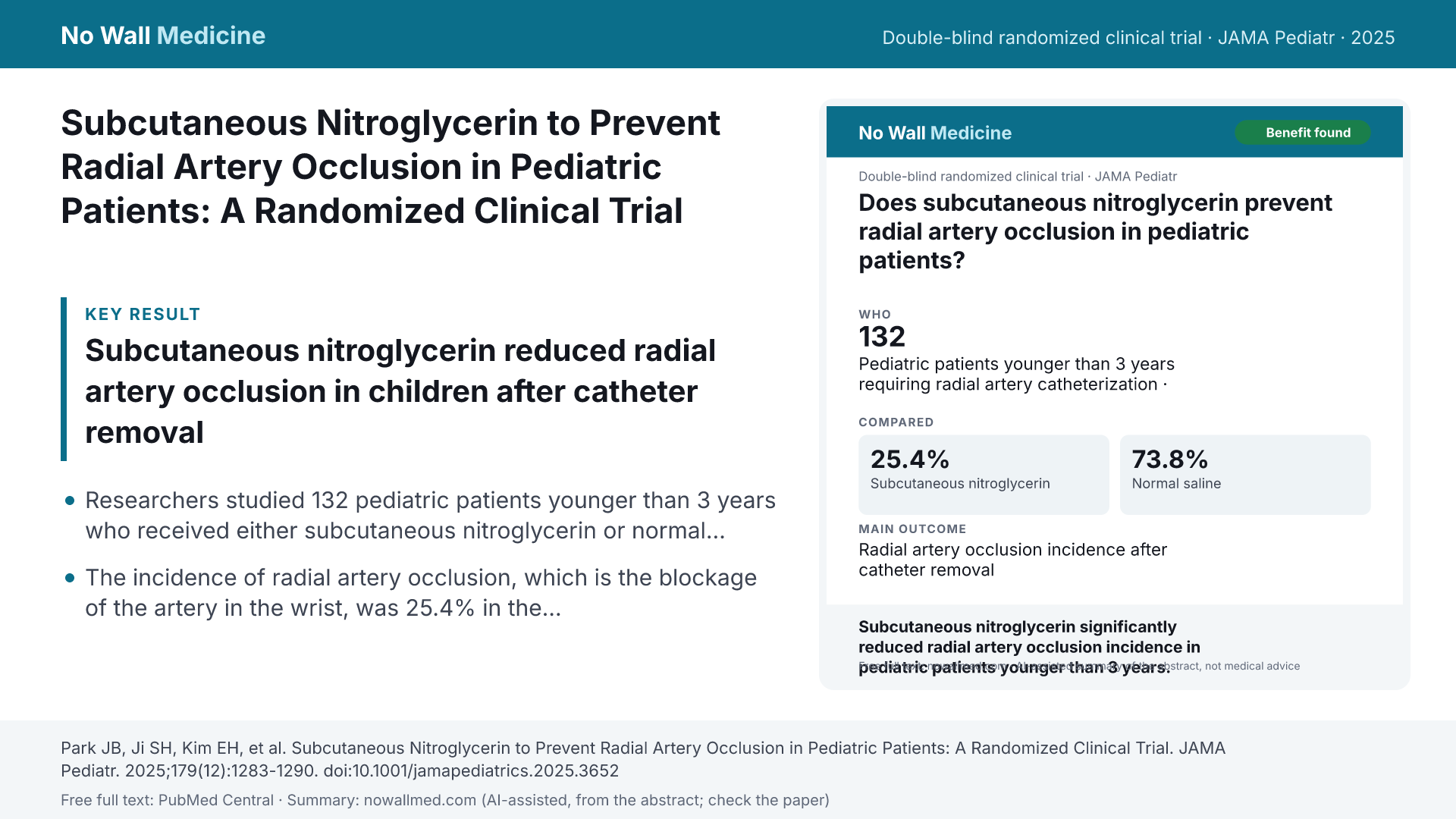
Subcutaneous nitroglycerin reduced radial artery occlusion in children after catheter removal
Subcutaneous Nitroglycerin to Prevent Radial Artery Occlusion in Pediatric Patients: A Randomized Clinical Trial
Double-blind randomized clinical trialBenefit found
Does subcutaneous nitroglycerin prevent radial artery occlusion in pediatric patients?
Who
132
Pediatric patients younger than 3 years requiring radial artery catheterization · Single tertiary center
Compared
25.4%Subcutaneous nitroglycerin (17 of 67)
73.8%Normal saline (48 of 65)
Main outcome
Radial artery occlusion incidence after catheter removal
Result: odds ratio 0.12 (95% CI 0.06-0.26)
Bottom line: Subcutaneous nitroglycerin significantly reduced radial artery occlusion incidence in pediatric patients younger than 3 years.
JAMA Pediatr · 2025-10-06Download image
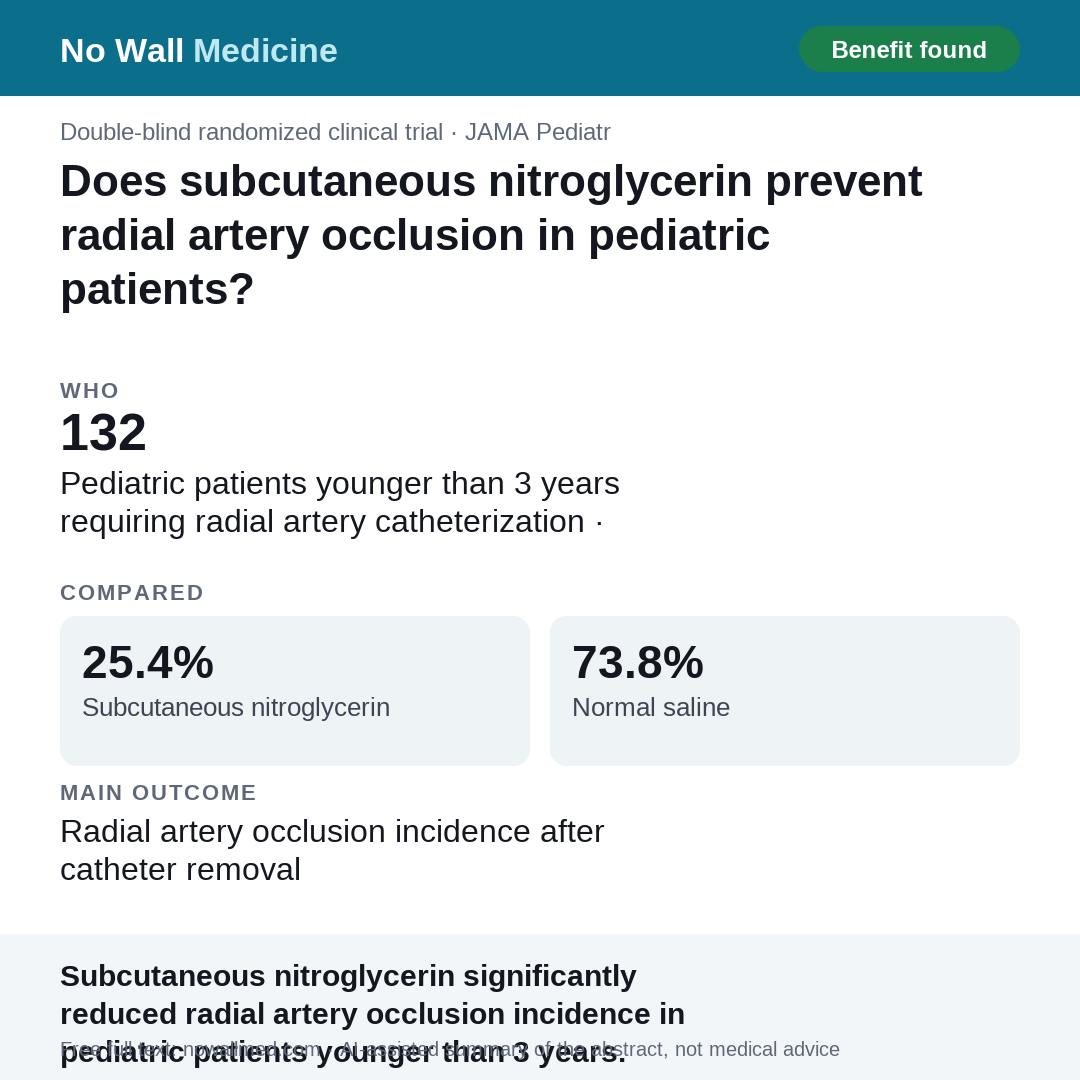
Clinical question: Does subcutaneous nitroglycerin prevent radial artery occlusion in pediatric patients?
Why it matters: It was unknown if subcutaneous nitroglycerin could prevent radial artery occlusion in pediatric patients after a catheter is removed.
Key points
- Researchers studied 132 pediatric patients younger than 3 years who received either subcutaneous nitroglycerin or normal saline before radial artery catheterization.
- The incidence of radial artery occlusion, which is the blockage of the artery in the wrist, was 25.4% in the nitroglycerin group compared to 73.8% in the control group.
- The nitroglycerin group showed higher peak blood flow velocity and perfusion index, though there was no significant difference in the duration of the artery blockage.
Limitation the authors note: The study was conducted at a single tertiary center.
Headline and key points written with AI from the paper’s abstract, with every number checked against it. Read the paper before relying on them.
Was this summary helpful?
Subject terms
Cite this article
Park JB, Ji SH, Kim EH, Lee JH, Kim HS, Kim JT. Subcutaneous Nitroglycerin to Prevent Radial Artery Occlusion in Pediatric Patients: A Randomized Clinical Trial. JAMA Pediatr. 2025. doi:10.1001/jamapediatrics.2025.3652
Spotted a mistake? Suggest a correction