Subcutaneous defibrillators were associated with fewer lead complications than transvenous versions in patients
Subcutaneous Versus Transvenous Implantable Defibrillator Therapy: A Systematic Review and Meta-Analysis of Randomized Trials and Propensity Score-Matched Studies
Meta-analysis of randomized trials and propensity score-matched studiesBenefit found
Is subcutaneous implantable cardioverter-defibrillator therapy comparable to transvenous implantable cardioverter-defibrillator therapy?
Who
2387
Patients with an implantable cardioverter-defibrillator indication
Compared
Subcutaneous implantable cardioverter-defibrillator
Transvenous implantable cardioverter-defibrillator
Main outcome
Device-related and lead-related complications
Result: lead-related complication risk ratio 0.14 (95% CI 0.07-0.29)
Bottom line: Subcutaneous implantable cardioverter-defibrillators have significantly lower lead-related complications and comparable device-related complications to transvenous therapy.
J Am Heart Assoc · 2022-06-03Download image
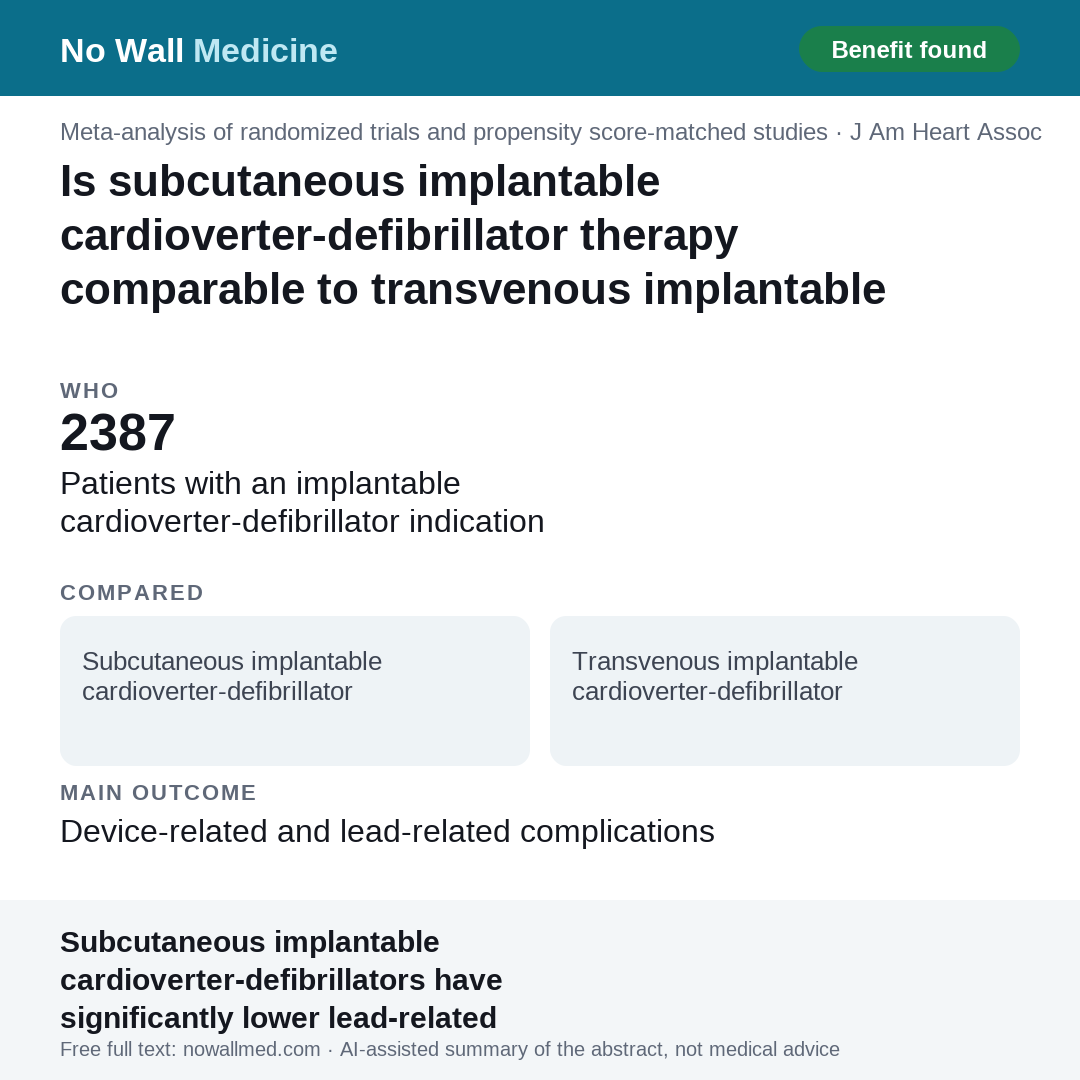
Clinical question: Is subcutaneous implantable cardioverter-defibrillator therapy comparable to transvenous implantable cardioverter-defibrillator therapy?
Why it matters: It was unknown if subcutaneous implantable cardioverter-defibrillators are a suitable substitute for transvenous versions regarding complications and safety.
Key points
- Researchers analyzed 5 studies involving 2387 patients to compare subcutaneous implantable cardioverter-defibrillators with transvenous implantable cardioverter-defibrillators.
- The subcutaneous devices were associated with a significantly lower rate of lead-related complications with a risk ratio of 0.14 (95% CI, 0.07-0.29).
- Device-related complications were similar between the two types of defibrillators with a risk ratio of 0.59 (95% CI, 0.33-1.04).
Headline and key points written with AI from the paper’s abstract, with every number checked against it. Read the paper before relying on them.
Was this summary helpful?
Subject terms
Cite this article
Fong KY, Ng CJR, Wang Y, Yeo C, Tan VH. Subcutaneous Versus Transvenous Implantable Defibrillator Therapy: A Systematic Review and Meta-Analysis of Randomized Trials and Propensity Score-Matched Studies. J Am Heart Assoc. 2022. doi:10.1161/JAHA.121.024756
Spotted a mistake? Suggest a correction
Top studies every Monday
The week’s key trials and guidelines in your specialties, plus any topics you follow. By email, free.
Get the weekly digest