Subthalamic deep brain stimulation showed efficacy for treating isolated generalised or segmental dystonia
Subthalamic deep brain stimulation in isolated generalised or segmental dystonia (RELAX Study): a multicentre, randomised, double-blind, controlled trial
Multicentre, randomised, double-blind, controlled trialBenefit found
Is subthalamic nucleus deep brain stimulation effective for isolated generalised or segmental dystonia?
Who
67
Patients aged 6-60 years with genetic or idiopathic isolated generalised or segmental dystonia · Seven hospitals in China
Compared
Subthalamic nucleus neurostimulation: significant improvement (p<0.001)
Subthalamic nucleus sham stimulation
Main outcome
Burke-Fahn-Marsden Dystonia Rating Scale movement score
Bottom line: Subthalamic nucleus deep brain stimulation is a safe and effective treatment for isolated generalised or segmental dystonia.
J Neurol Neurosurg Psychiatry · 2025-10-15Download image
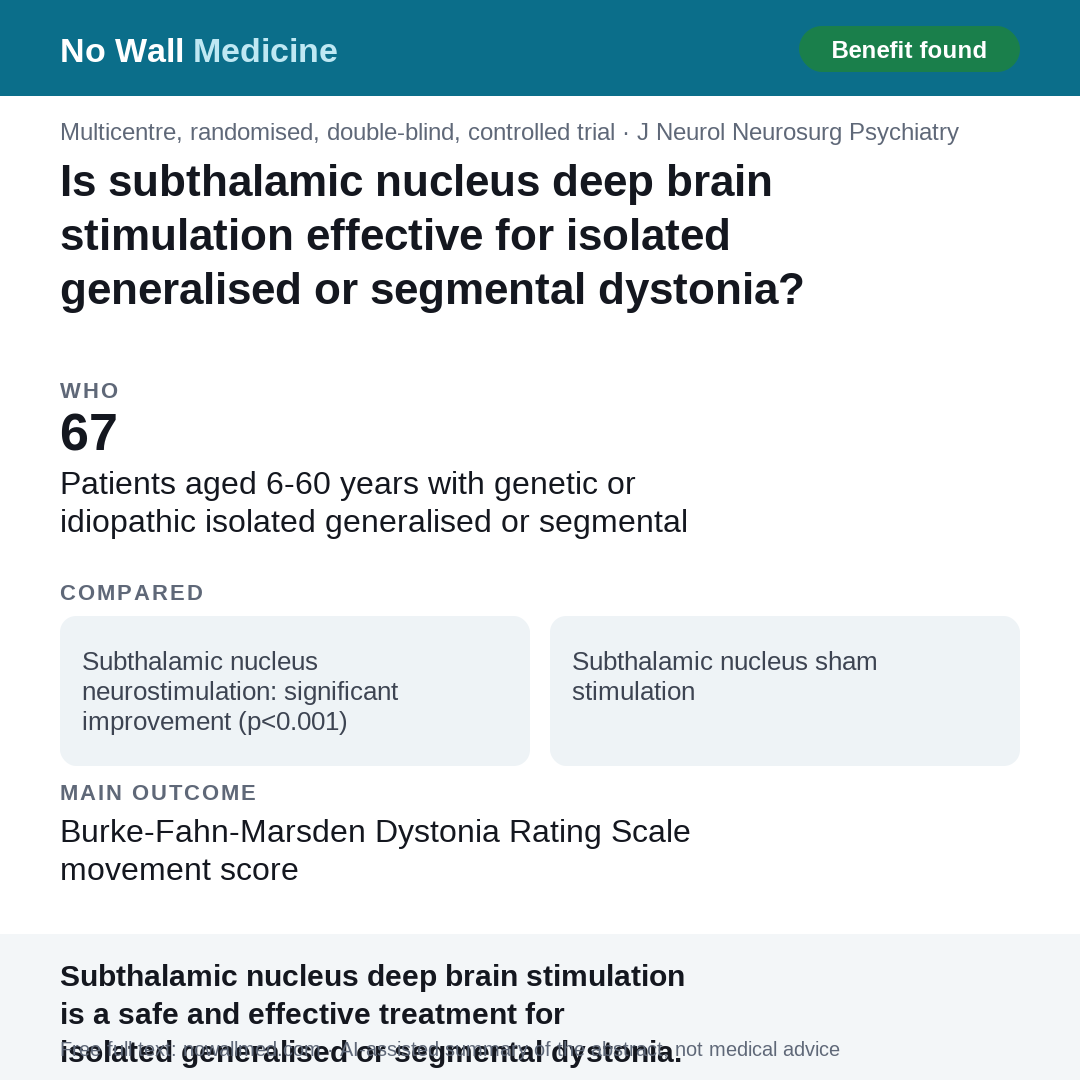
Clinical question: Is subthalamic nucleus deep brain stimulation effective for isolated generalised or segmental dystonia?
Why it matters: High-level evidence is lacking regarding the safety and effectiveness of subthalamic nucleus deep brain stimulation for treating dystonia.
Key points
- Researchers studied 67 patients aged 6-60 years with genetic or idiopathic isolated generalised or segmental dystonia across seven hospitals in China.
- At 3 months, the subthalamic nucleus deep brain stimulation neurostimulation subgroup showed significant improvement in movement scores compared to the sham stimulation subgroup.
- A post hoc analysis showed that subthalamic nucleus and internal globus pallidus deep brain stimulation produced similar therapeutic effects on motor symptoms.
Headline and key points written with AI from the paper’s abstract, with every number checked against it. Read the paper before relying on them.
Abstract
Background
The safety and effectiveness of deep brain stimulation of the subthalamic nucleus (STN-DBS) for the treatment of dystonia lack high-level evidence-based medical support. This study aimed to clarify the efficacy and safety of STN-DBS and perform a post hoc analysis comparing it with DBS of the internal globus pallidus (GPi-DBS). Methods
This multicentre, randomised, double-blind, controlled trial included 67 patients aged 6-60 years old diagnosed with genetic or idiopathic isolated generalised or segmental dystonia. They were enrolled from seven hospitals in China and randomly assigned to undergo GPi-DBS or STN-DBS. After surgery, they were randomised to receive either neurostimulation or sham stimulation for 3 months. At the 3-month follow-up, neurostimulation was also initiated in the sham stimulation group, and all patients were followed up for more than 3 years after treatment. The primary outcome was the Burke-Fahn-Marsden Dystonia Rating Scale movement (BFMDRS-M) score. Results
In the STN group, the neurostimulation subgroup exhibited significant improvement (p<0.001), which is also superior to the sham stimulation subgroup (p=0.028) at 3-month follow-up. At the 6-month and >3-year follow-ups, all patients receiving STN-DBS showed a significant improvement in BFMDRS-M scores (p<0.001). Further post hoc analysis revealed that both STN-DBS and GPi-DBS could produce similar therapeutic effects on motor symptoms (P6 months=0.865, P>3 years=0.905). There were no ongoing serious adverse events throughout the study. Conclusions
For isolated generalised and segmental dystonia patients, the STN is a selectable DBS target with ensured safety and efficacy. STN-DBS and GPi-DBS may achieve comparable therapeutic effects on motor symptoms. Trial registration number
NCT03017586.
Abstract reproduced under the article’s CC BY NC licence.
Topics
Cite this article
Wang L, Shang H, Jin L, Xiong N, Hu X, Wang W. Subthalamic deep brain stimulation in isolated generalised or segmental dystonia (RELAX Study): a multicentre, randomised, double-blind, controlled trial. J Neurol Neurosurg Psychiatry. 2025. doi:10.1136/jnnp-2025-335829
Spotted a mistake? Suggest a correction