Researchers identify inconsistent definitions for refractory disease in rheumatoid arthritis and polyarticular juvenile idiopathic arthritis
Summarizing current refractory disease definitions in rheumatoid arthritis and polyarticular juvenile idiopathic arthritis: systematic review
Systematic reviewUnclear result
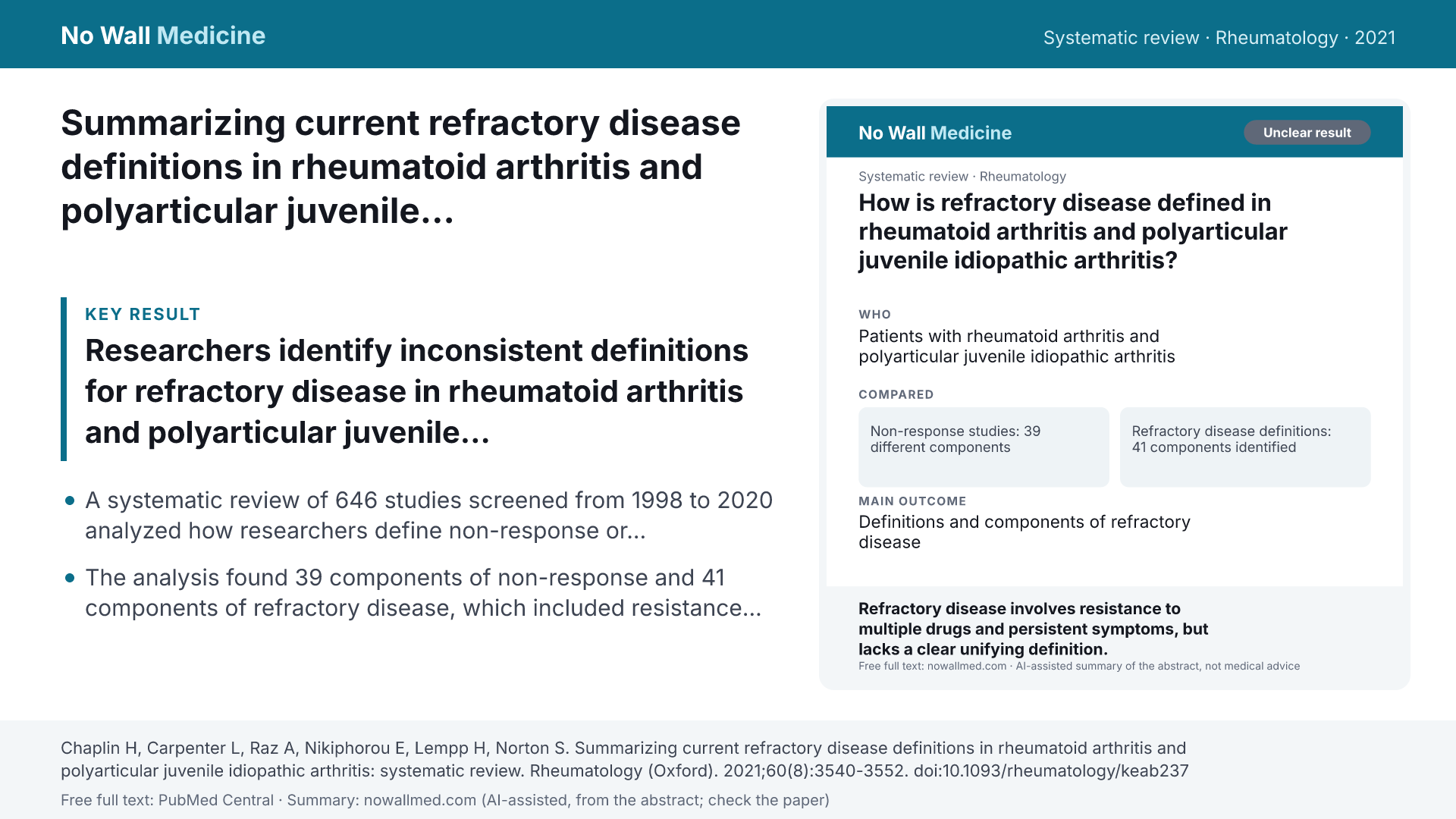
How is refractory disease defined in rheumatoid arthritis and polyarticular juvenile idiopathic arthritis?
Who
Patients with rheumatoid arthritis and polyarticular juvenile idiopathic arthritis
Compared
Non-response studies: 39 different components
Refractory disease definitions: 41 components identified
Main outcome
Definitions and components of refractory disease
Bottom line: Refractory disease involves resistance to multiple drugs and persistent symptoms, but lacks a clear unifying definition.
Rheumatology · 2021-03-13 · Save PNG

Clinical question: How is refractory disease defined in rheumatoid arthritis and polyarticular juvenile idiopathic arthritis?
Why it matters: The lack of a unifying definition for refractory disease makes it difficult to compare studies and identify appropriate patients.
Key points
- A systematic review of 646 studies screened from 1998 to 2020 analyzed how researchers define non-response or refractory disease in rheumatoid arthritis and polyarticular juvenile idiopathic arthritis.
- The analysis found 39 components of non-response and 41 components of refractory disease, which included resistance to two or more biologic disease-modifying antirheumatic drugs and persistent symptoms.
- The term refractory was used in 80% of studies, but only 16.9% of papers explicitly stated how their specific definition was created.
Headline and key points written with AI from the paper’s abstract, with every number checked against it. Read the paper before relying on them.
Was this summary helpful?
Subject terms
Headline, design, result, key points, caveat and citation as plain text.
Cite this article
Chaplin H, Carpenter L, Raz A, Nikiphorou E, Lempp H, Norton S. Summarizing current refractory disease definitions in rheumatoid arthritis and polyarticular juvenile idiopathic arthritis: systematic review. Rheumatology (Oxford). 2021;60(8):3540-3552. doi:10.1093/rheumatology/keab237
Spotted a mistake? Suggest a correction