Summarizing current refractory disease definitions in rheumatoid arthritis and polyarticular juvenile idiopathic arthritis: systematic review
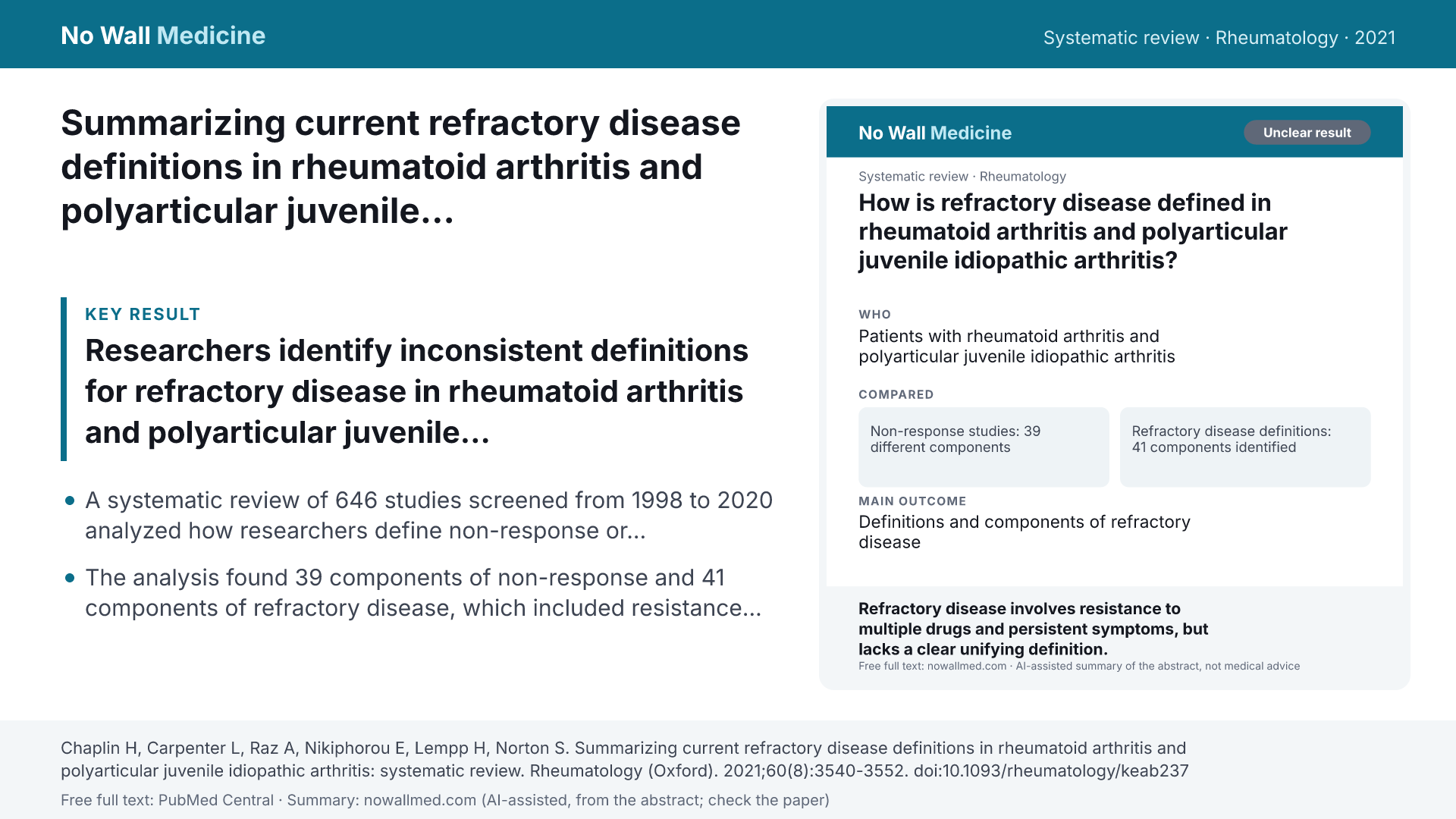
Key result: Researchers identify inconsistent definitions for refractory disease in rheumatoid arthritis and polyarticular juvenile idiopathic arthritis

Key points
- A systematic review of 646 studies screened from 1998 to 2020 analyzed how researchers define non-response or refractory disease in rheumatoid arthritis and polyarticular juvenile idiopathic arthritis.
- The analysis found 39 components of non-response and 41 components of refractory disease, which included resistance to two or more biologic disease-modifying antirheumatic drugs and persistent symptoms.
- The term refractory was used in 80% of studies, but only 16.9% of papers explicitly stated how their specific definition was created.
Why it matters: The lack of a unifying definition for refractory disease makes it difficult to compare studies and identify appropriate patients.
Discussion prompts
- Would these patients look like yours? Who was left out?
- Is the main outcome one that matters to patients?
- Is the difference large enough to change what you do?
Cite: Chaplin H, Carpenter L, Raz A, Nikiphorou E, Lempp H, Norton S. Summarizing current refractory disease definitions in rheumatoid arthritis and polyarticular juvenile idiopathic arthritis: systematic review. Rheumatology (Oxford). 2021;60(8):3540-3552. doi:10.1093/rheumatology/keab237
Free full text: PubMed Central · Summary and visual abstract: nowallmed.com/a/summarizing-current-refractory-disease-definitions-in-rheumatoid-1nr613s/ (AI-assisted from the abstract; check the paper before relying on it).