Educational website increased contraceptive knowledge and perceived access compared to standard consent forms
Supporting informed decisions about tubal sterilization with a patient-facing website: a randomized trial
Randomized controlled trialBenefit found
Does a patient-facing website increase perceived access and knowledge of contraceptive options?
Who
350
Individuals considering tubal sterilization · United States
Compared
Advancing Access website: 62% perceived access
Attention control: 58% perceived access
Main outcome
Multidimensional measure of access to reproductive health services
Result: adjusted mean difference 3.24 (95% confidence interval, 1.81-4.67)
Bottom line: The Advancing Access website increases perceived access to birth control and contraceptive knowledge compared to standard materials.
AJOG · 2026-10-08Download image
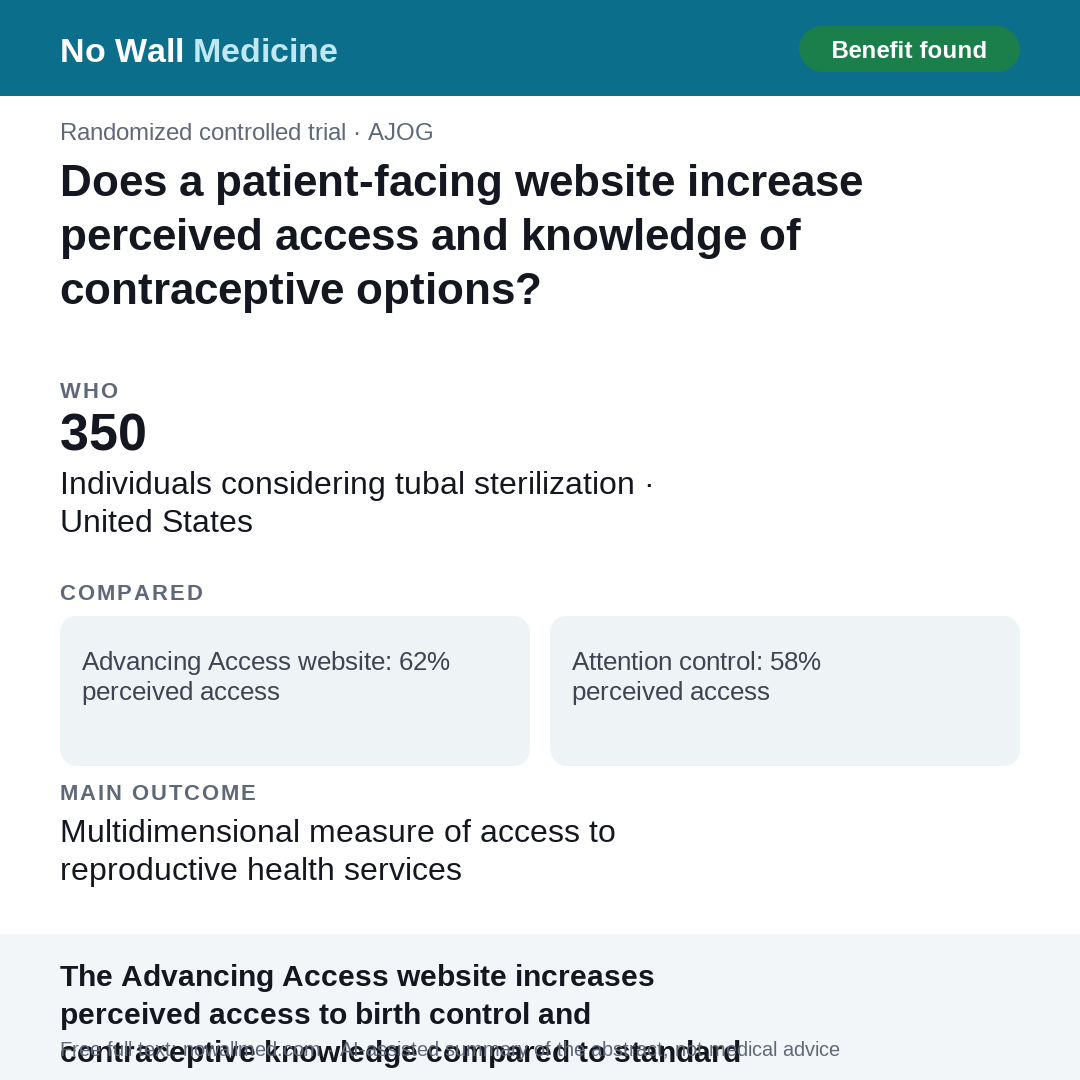
Clinical question: Does a patient-facing website increase perceived access and knowledge of contraceptive options?
Why it matters: One in five patients undergoing tubal sterilization later reports wanting to reverse the procedure, suggesting a need for better informed decision-making.
In absolute numbers
Advancing Access website: 62% · Attention control: 58% → a difference of 4 percentage points, so about 25 people would need the treatment for 1 more to benefit (number needed to treat) over the trial’s follow-up.
Worked out by us from the two group results above, not reported by the authors. Check the paper for the exact outcome and timing.
Key points
- Researchers studied 350 individuals considering tubal sterilization, comparing an educational website to a standard federal consent form and a Planned Parenthood website.
- The website group showed higher contraceptive knowledge scores at one week (68% vs 52%) and three months (61% vs 52%) than the control group.
- At three months, the intervention group reported greater perceived access to birth control (62% vs 58%) and higher preference for contraceptive implants (17% vs 9%).
Headline and key points written with AI from the paper’s abstract, with every number checked against it. Read the paper before relying on them.
Cite this article
Schwarz EB, Begna H, Okobi A, Chiang AY, Treder K, Sudore RL. Supporting informed decisions about tubal sterilization with a patient-facing website: a randomized trial. AJOG. 2026. doi:10.1016/j.ajog.2026.10.003
Spotted a mistake? Suggest a correction