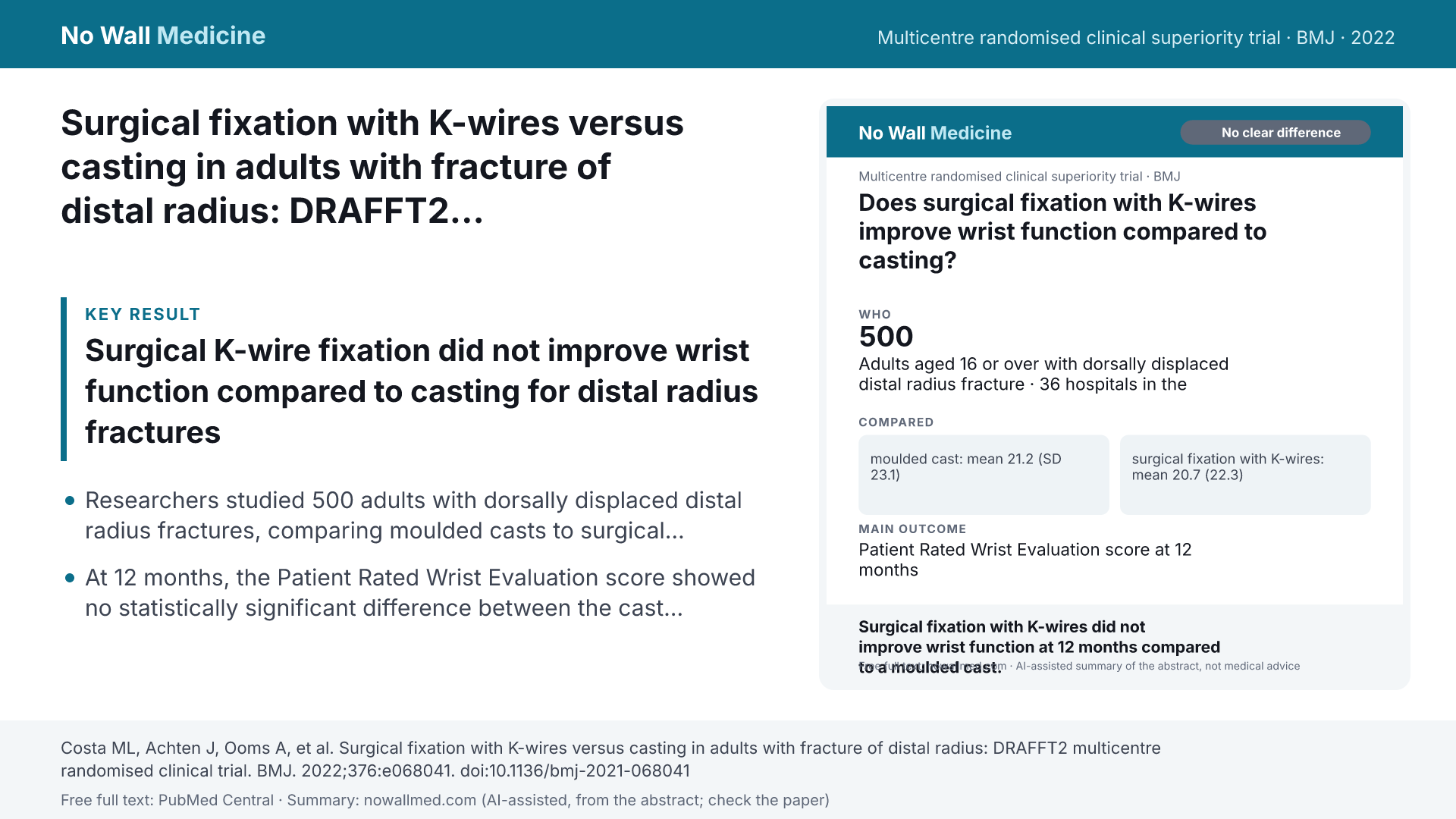
Surgical K-wire fixation did not improve wrist function compared to casting for distal radius fractures
Surgical fixation with K-wires versus casting in adults with fracture of distal radius: DRAFFT2 multicentre randomised clinical trial
Multicentre randomised clinical superiority trialNo clear difference
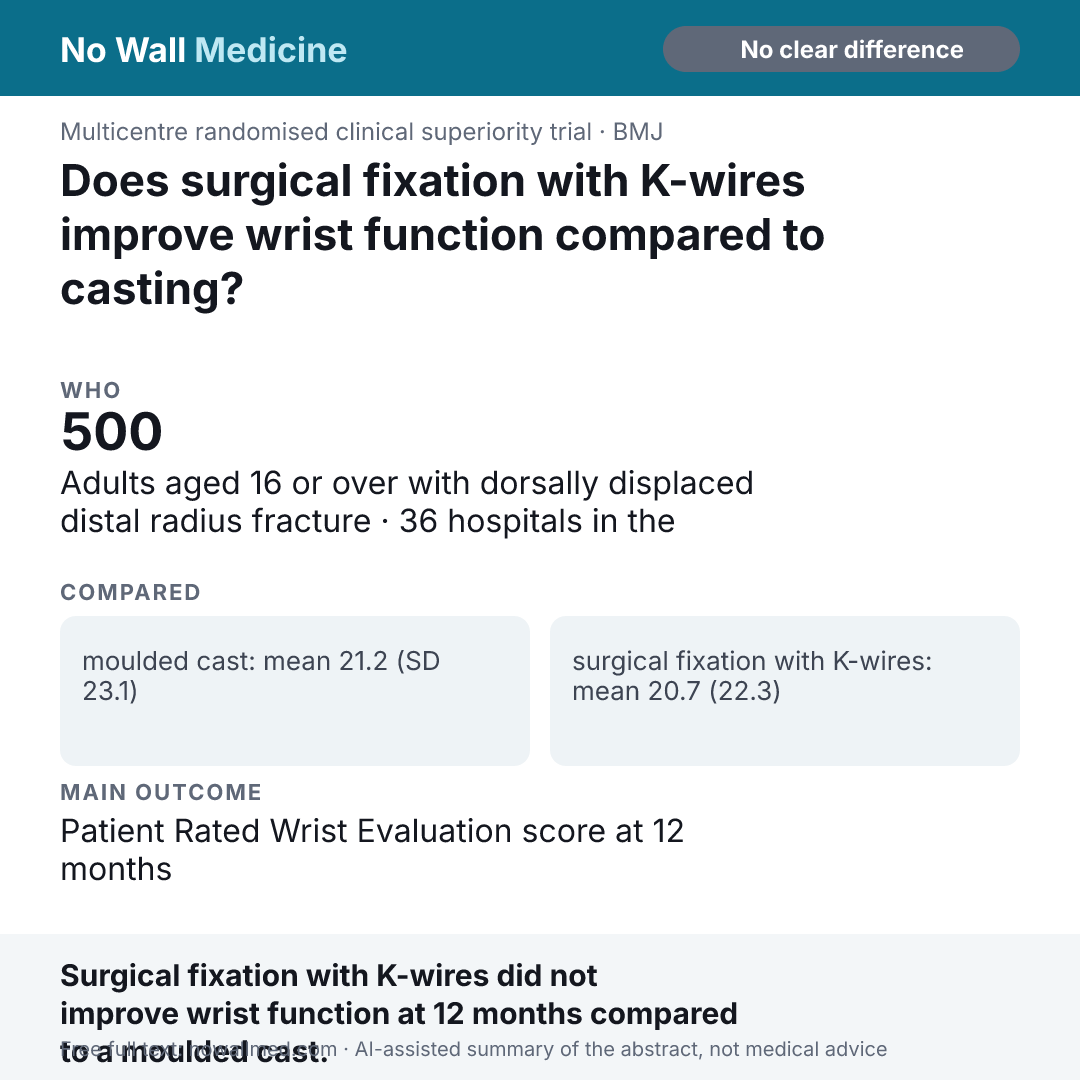
Does surgical fixation with K-wires improve wrist function compared to casting?
Who
500
Adults aged 16 or over with dorsally displaced distal radius fracture · 36 hospitals in the United Kingdom National Health Service
Compared
moulded cast: mean 21.2 (SD 23.1)
surgical fixation with K-wires: mean 20.7 (22.3)
Main outcome
Patient Rated Wrist Evaluation score at 12 months
Result: adjusted mean difference -0.34 (95% confidence interval -4.33 to 3.66)
Bottom line: Surgical fixation with K-wires did not improve wrist function at 12 months compared to a moulded cast.
BMJ · 2022-01-19 · ISRCTN11980540
Headline and visual abstract written with AI from the paper’s abstract, with every number checked against it. Read the paper before relying on them.
Was this summary helpful?
Abstract
Objective
To assess wrist function, quality of life, and complications in adult patients with a dorsally displaced fracture of the distal radius, treated with either a moulded cast or surgical fixation with K-wires. Design
Multicentre randomised clinical superiority trial, SETTING: 36 hospitals in the UK National Health Service (NHS). Participants
500 adults aged 16 or over with a dorsally displaced fracture of the distal radius, randomised after manipulation of their fracture (255 to moulded cast; 245 to surgical fixation). Interventions
Manipulation and moulded cast was compared with manipulation and surgical fixation with K-wires plus cast. Details of the application of the cast and the insertion of the K-wires were at the discretion of the treating surgeon, according to their normal clinical practice. Main outcome measures
The primary outcome measure was the Patient Rated Wrist Evaluation (PRWE) score at 12 months (five questions about pain and 10 about function and disability; overall score out of 100 (best score=0 and worst score=100)). Secondary outcomes were PRWE score at three and six months, quality of life, and complications, including the need for surgery due to loss of fracture position in the first six weeks. Results
The mean age of participants was 60 years and 417 (83%) were women; 395 (79%) completed follow-up. No statistically significant difference in the PRWE score was seen at 12 months (cast group (n=200), mean 21.2 (SD 23.1); K-wire group (n=195), mean 20.7 (22.3); adjusted mean difference -0.34 (95% confidence interval -4.33 to 3.66), P=0.87). No difference was seen at earlier time points. In the cast group, 33 (13%) of participants needed surgical fixation for loss of fracture position in the first six weeks compared with one revision surgery in the K-wire group (odds ratio 0.02, 95% confidence interval 0.001 to 0.10). Conclusions
Among patients with a dorsally displaced distal radius fracture that needed manipulation, surgical fixation with K-wires did not improve patients' wrist function at 12 months compared with a cast. Trial registration
ISRCTN registry ISRCTN11980540.
Abstract reproduced under the article’s CC BY licence.
Subject terms
Cite this article
Costa ML, Achten J, Ooms A, et al. Surgical fixation with K-wires versus casting in adults with fracture of distal radius: DRAFFT2 multicentre randomised clinical trial. BMJ. 2022;376:e068041. doi:10.1136/bmj-2021-068041
Spotted a mistake? Suggest a correction