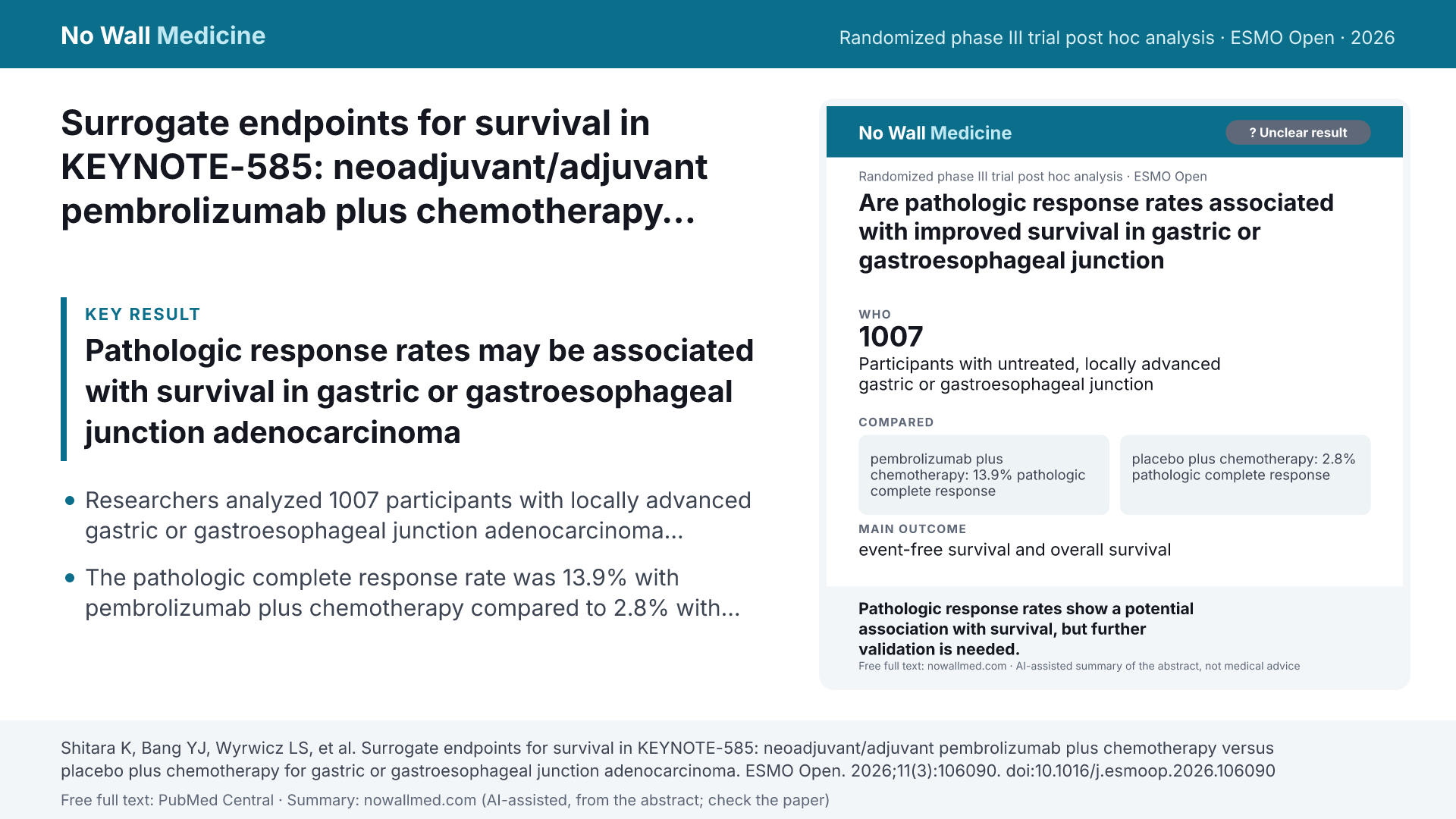
Pathologic response rates may be associated with survival in gastric or gastroesophageal junction adenocarcinoma
Surrogate endpoints for survival in KEYNOTE-585: neoadjuvant/adjuvant pembrolizumab plus chemotherapy versus placebo plus chemotherapy for gastric or gastroesophageal junction adenocarcinoma
Randomized phase III trial post hoc analysisUnclear result
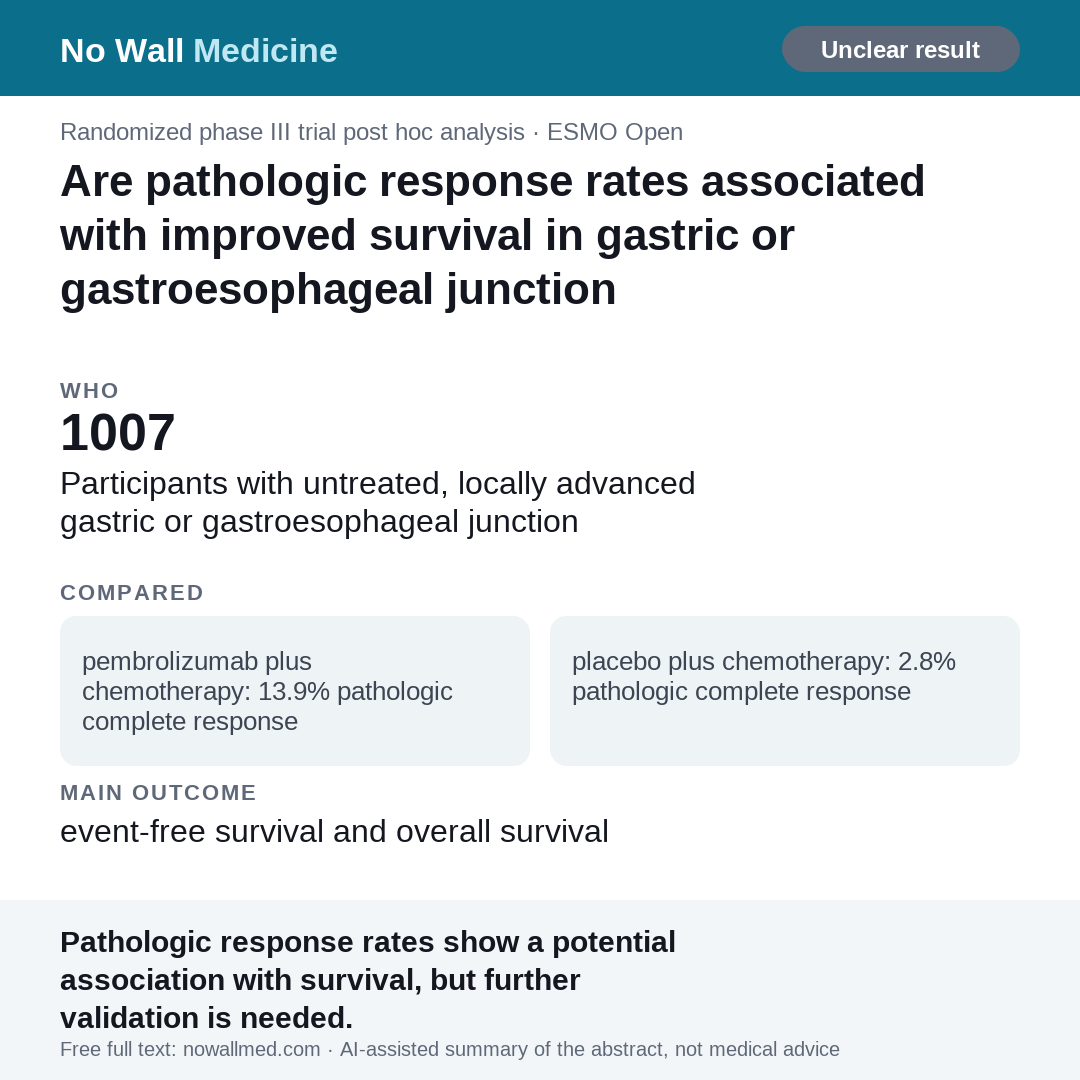
Are pathologic response rates associated with improved survival in gastric or gastroesophageal junction adenocarcinoma?
Who
1007
Participants with untreated, locally advanced gastric or gastroesophageal junction adenocarcinoma
Compared
pembrolizumab plus chemotherapy: 13.9% pathologic complete response
placebo plus chemotherapy: 2.8% pathologic complete response
Main outcome
event-free survival and overall survival
Result: hazard ratio 0.6 (95% CI 0.4-1.0) for event-free survival
Bottom line: Pathologic response rates show a potential association with survival, but further validation is needed.
Limitation: This was a post hoc analysis and further validation is needed.
ESMO Open · 2026-02-26Download image
Clinical question: Are pathologic response rates associated with improved survival in gastric or gastroesophageal junction adenocarcinoma?
Why it matters: Researchers wanted to see if pathologic response rates could serve as indicators for survival in patients with locally advanced gastric or gastroesophageal junction adenocarcinoma.
Key points
- Researchers analyzed 1007 participants with locally advanced gastric or gastroesophageal junction adenocarcinoma who received pembrolizumab plus chemotherapy or a placebo plus chemotherapy.
- The pathologic complete response rate was 13.9% with pembrolizumab plus chemotherapy compared to 2.8% with placebo plus chemotherapy.
- Among participants with a major pathologic response, the hazard ratios for event-free survival and overall survival were 0.6 and 0.7, respectively.
Limitation the authors note: The authors state that further validation is needed to confirm these findings.
Headline and key points written with AI from the paper’s abstract, with every number checked against it. Read the paper before relying on them.
Was this summary helpful?
Subject terms
Cite this article
Shitara K, Bang YJ, Wyrwicz LS, et al. Surrogate endpoints for survival in KEYNOTE-585: neoadjuvant/adjuvant pembrolizumab plus chemotherapy versus placebo plus chemotherapy for gastric or gastroesophageal junction adenocarcinoma. ESMO Open. 2026. doi:10.1016/j.esmoop.2026.106090
Spotted a mistake? Suggest a correction