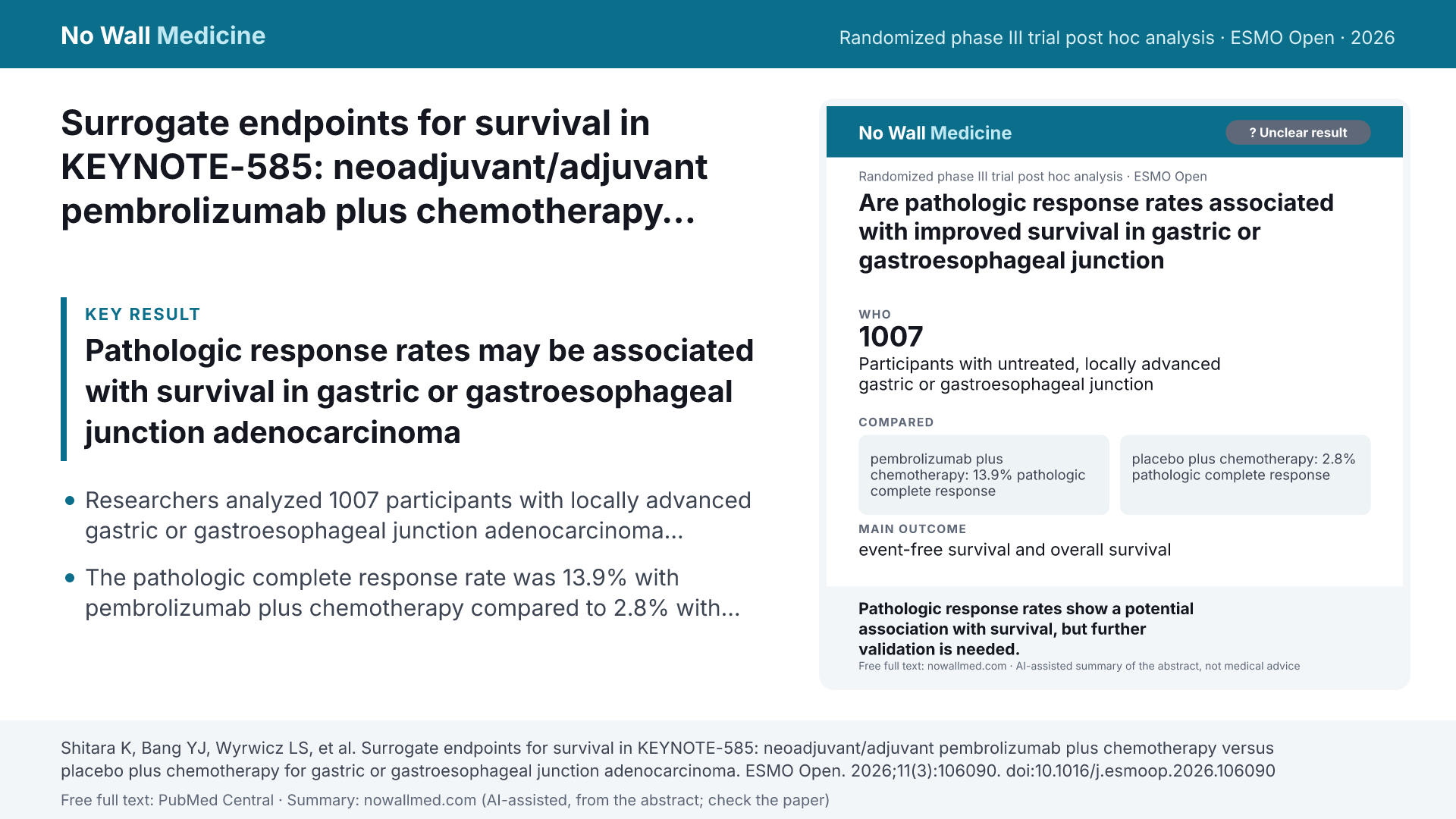
Surrogate endpoints for survival in KEYNOTE-585: neoadjuvant/adjuvant pembrolizumab plus chemotherapy versus placebo plus chemotherapy for gastric or gastroesophageal junction adenocarcinoma
Key result: Pathologic response rates may be associated with survival in gastric or gastroesophageal junction adenocarcinoma
Key points
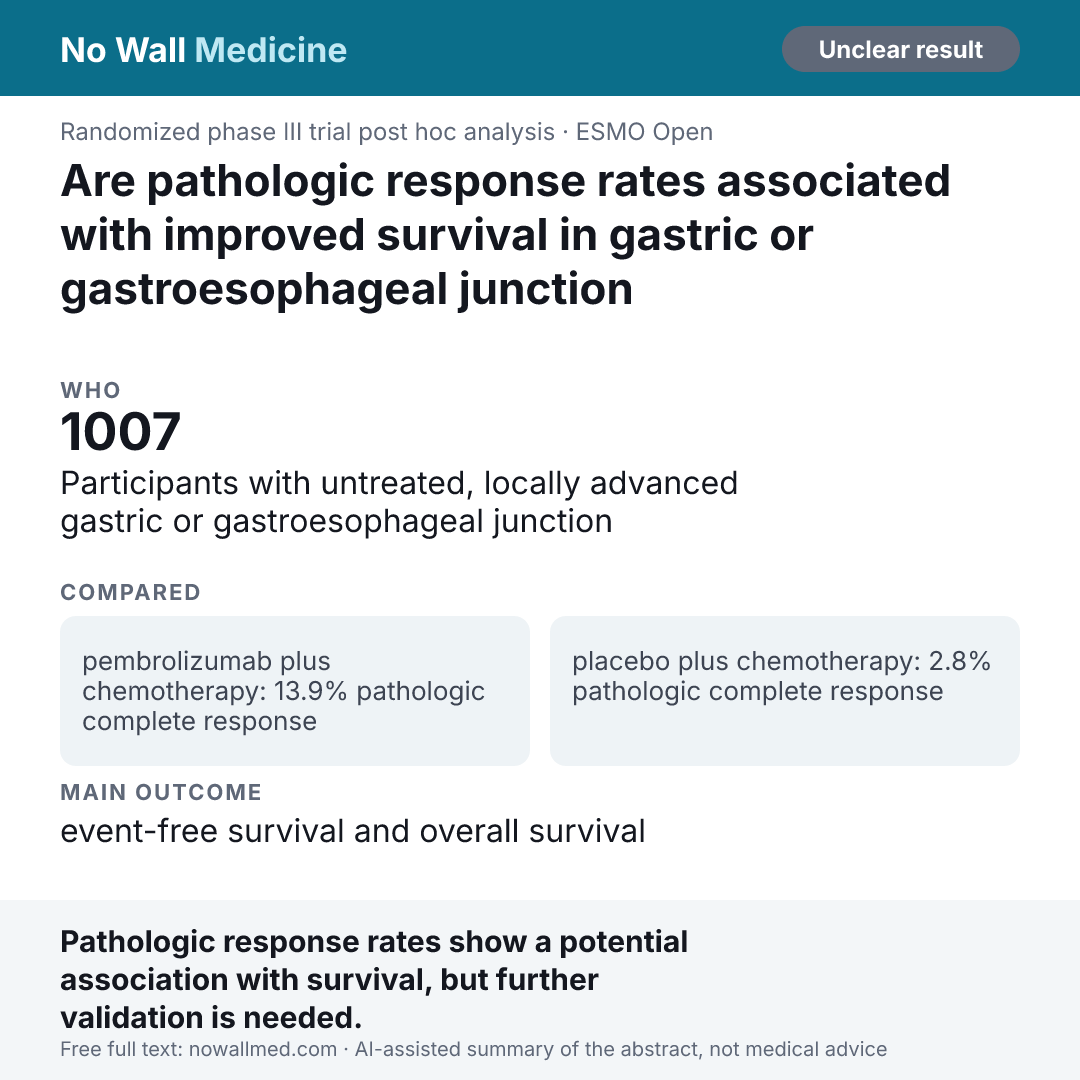
- Researchers analyzed 1007 participants with locally advanced gastric or gastroesophageal junction adenocarcinoma who received pembrolizumab plus chemotherapy or a placebo plus chemotherapy.
- The pathologic complete response rate was 13.9% with pembrolizumab plus chemotherapy compared to 2.8% with placebo plus chemotherapy.
- Among participants with a major pathologic response, the hazard ratios for event-free survival and overall survival were 0.6 and 0.7, respectively.
Why it matters: Researchers wanted to see if pathologic response rates could serve as indicators for survival in patients with locally advanced gastric or gastroesophageal junction adenocarcinoma.
Limitation the authors note: The authors state that further validation is needed to confirm these findings.
Discussion prompts
- Would these patients look like yours? Who was left out?
- Is the main outcome one that matters to patients?
- Is the difference large enough to change what you do?
Cite: Shitara K, Bang YJ, Wyrwicz LS, et al. Surrogate endpoints for survival in KEYNOTE-585: neoadjuvant/adjuvant pembrolizumab plus chemotherapy versus placebo plus chemotherapy for gastric or gastroesophageal junction adenocarcinoma. ESMO Open. 2026;11(3):106090. doi:10.1016/j.esmoop.2026.106090
Free full text: PubMed Central · Summary and visual abstract: nowallmed.com/a/surrogate-endpoints-for-survival-in-keynote-585-neoadjuvant-adjuvant-14gqcky/ (AI-assisted from the abstract; check the paper before relying on it).