Active surveillance is cost-effective compared to standard surgery for esophageal cancer patients after chemoradiotherapy
Surveillance vs Standard Surgery and Cost-Effectiveness After Neoadjuvant Chemoradiotherapy for Esophageal Cancer: Secondary Analysis of a Randomized Clinical Trial
Cluster randomized study secondary analysisBenefit found
Is active surveillance cost-effective compared with standard surgery after neoadjuvant chemoradiotherapy?
Who
309
Patients with esophageal cancer achieving complete clinical response after neoadjuvant chemoradiotherapy · 12 hospitals in the Netherlands
Compared
Active surveillance: 2.99 QALYs (95% CI, 2.73-3.26)
Standard surgery: 2.88 QALYs (95% CI 2.69-3.06)
Main outcome
Incremental cost-effectiveness and quality-adjusted life-years
Result: incremental QALY 0.11 (95% CI, -0.10 to 0.33)
Bottom line: Active surveillance is cost-effective and reduces mean health care costs compared with standard surgery over 5 years.
JAMA Netw Open · 2026-07-01Download image
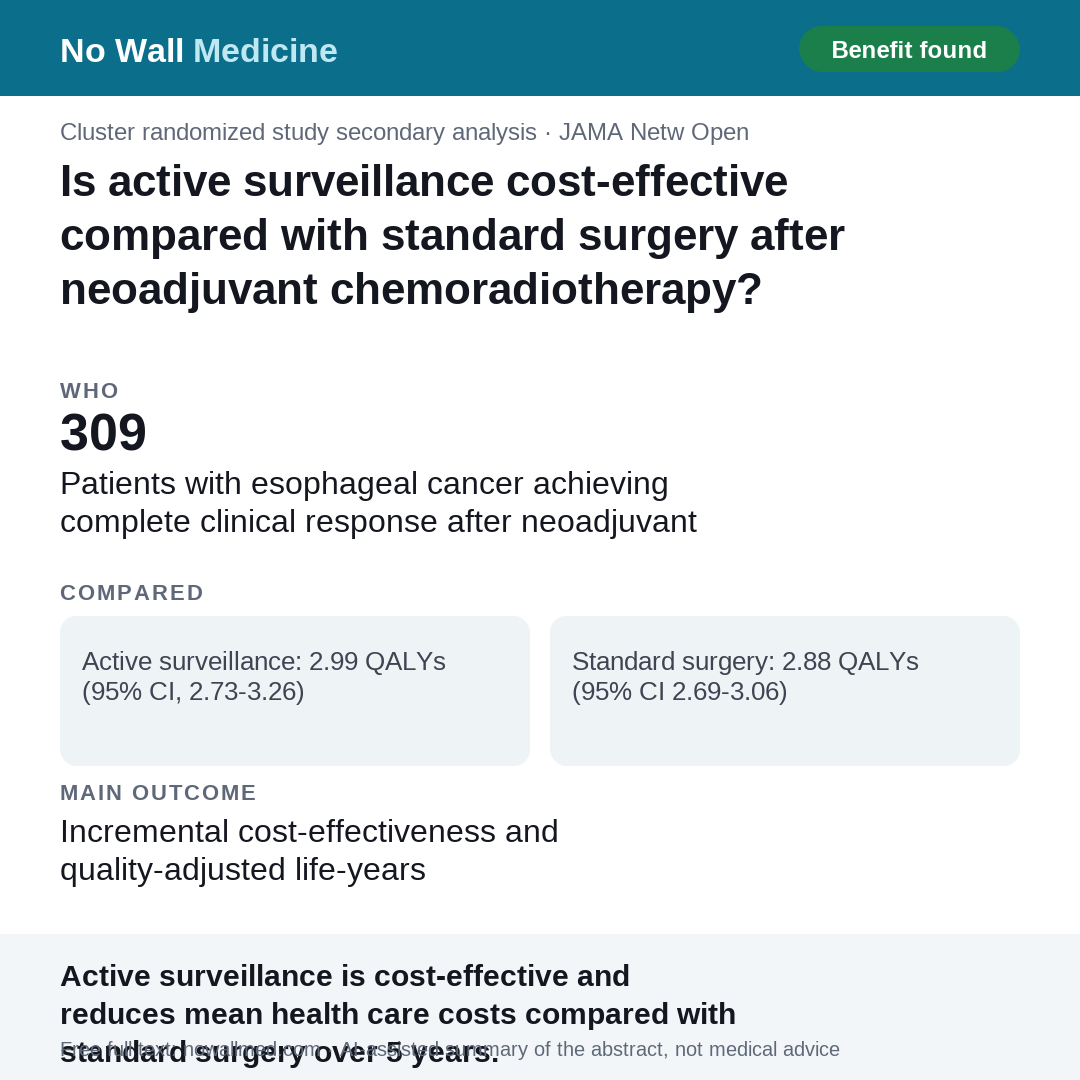
Clinical question: Is active surveillance cost-effective compared with standard surgery after neoadjuvant chemoradiotherapy?
Why it matters: It is unclear if monitoring patients instead of performing immediate surgery is a cost-effective strategy for those who respond completely to chemoradiotherapy.
Key points
- Researchers analyzed 309 patients with esophageal cancer who achieved a complete clinical response after chemoradiotherapy, comparing active surveillance to standard surgery.
- At 5 years, active surveillance resulted in 2.99 quality-adjusted life-years versus 2.88 for standard surgery and mean costs of €36,733 versus €45,106.
- Active surveillance was found to be cost-effective, with mean costs being €8,374 lower than standard surgery.
Headline and key points written with AI from the paper’s abstract, with every number checked against it. Read the paper before relying on them.
Topics
Spotted a mistake? Suggest a correction