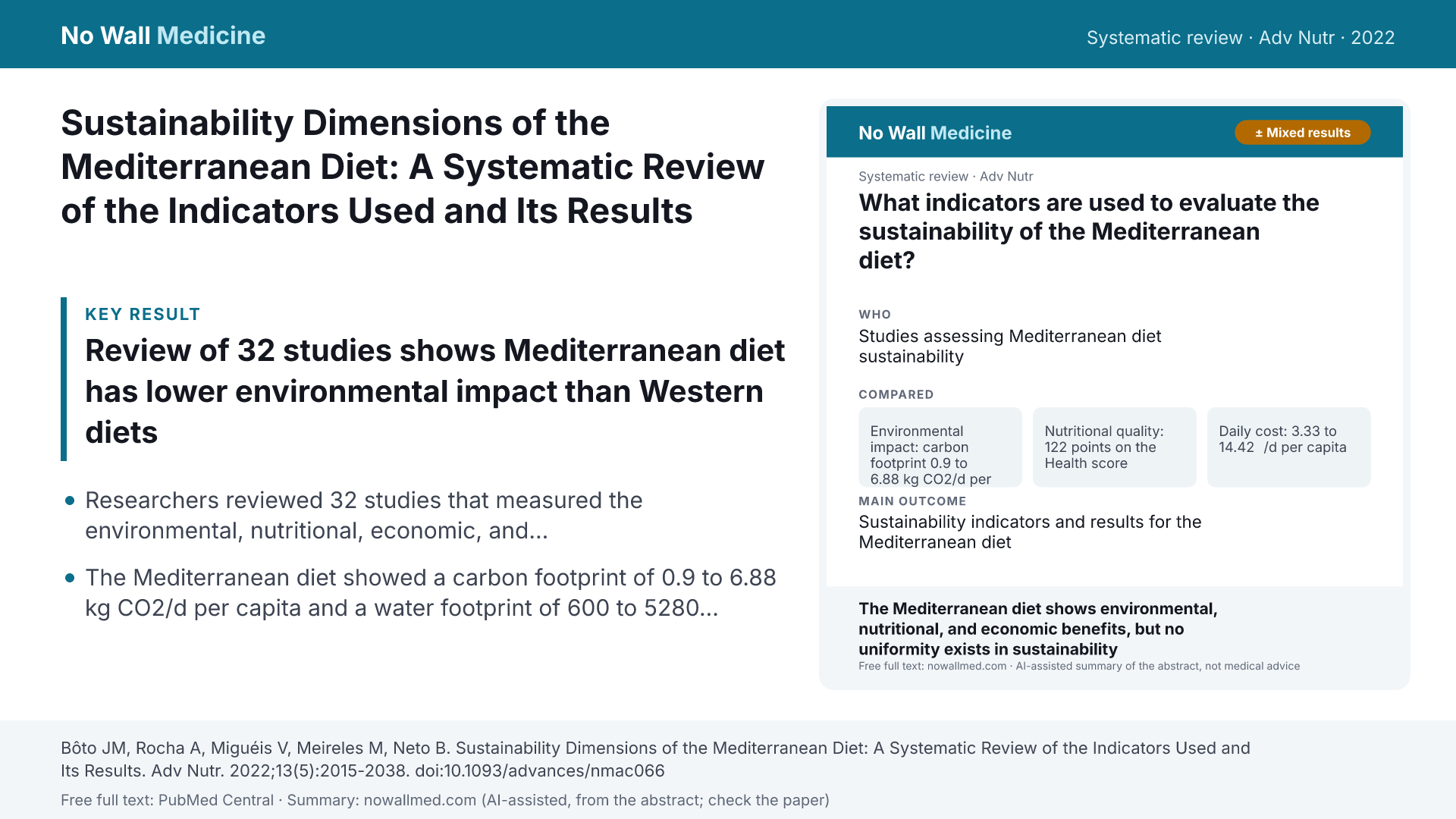
Review of 32 studies shows Mediterranean diet has lower environmental impact than Western diets
Sustainability Dimensions of the Mediterranean Diet: A Systematic Review of the Indicators Used and Its Results
Systematic reviewMixed results
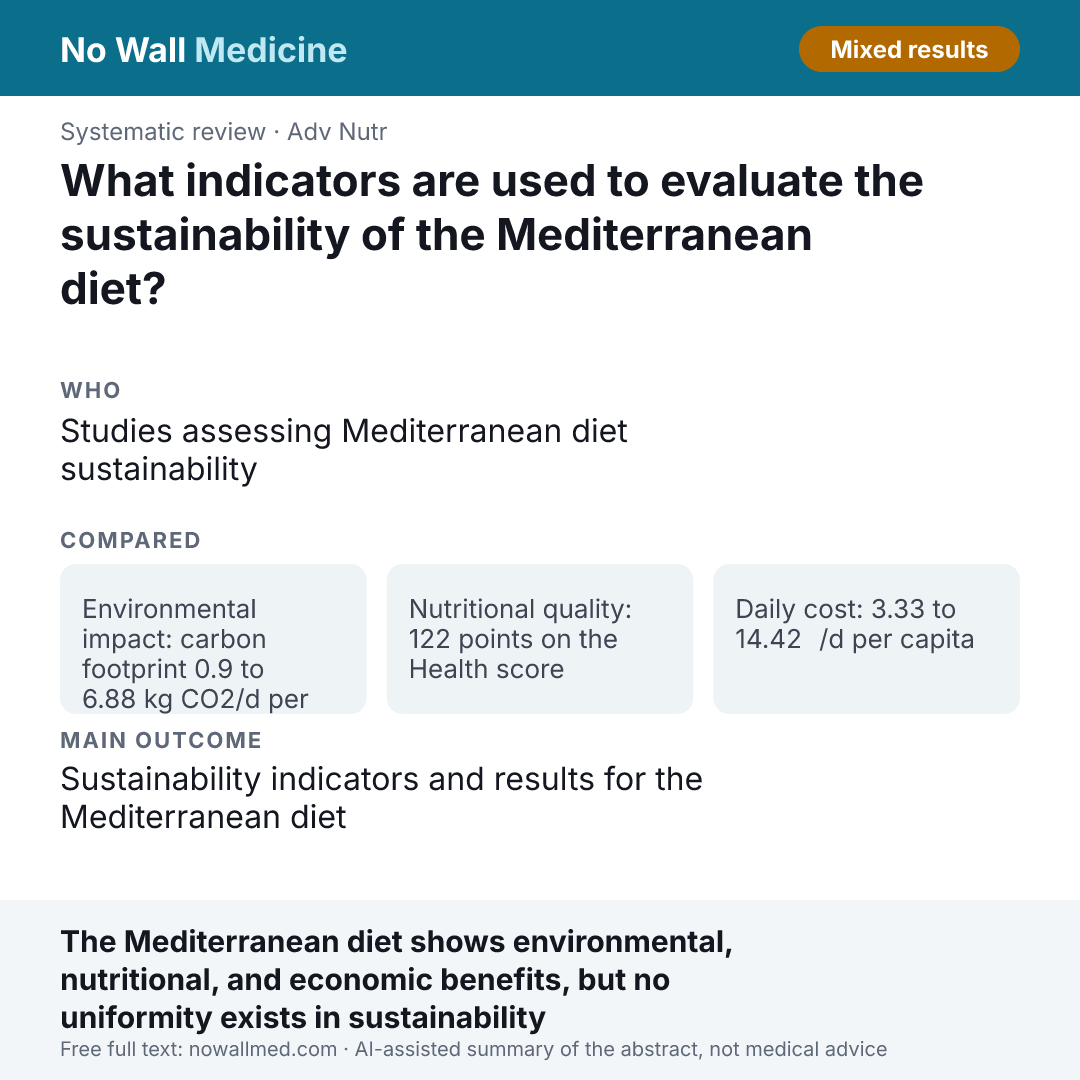
What indicators are used to evaluate the sustainability of the Mediterranean diet?
Who
Studies assessing Mediterranean diet sustainability
Compared
Environmental impact: carbon footprint 0.9 to 6.88 kg CO2/d per capita
Nutritional quality: 122 points on the Health score
Daily cost: 3.33 to 14.42€/d per capita
Main outcome
Sustainability indicators and results for the Mediterranean diet
Bottom line: The Mediterranean diet shows environmental, nutritional, and economic benefits, but no uniformity exists in sustainability assessment methods.
Adv Nutr · 2022-06-10 · Save PNG
Clinical question: What indicators are used to evaluate the sustainability of the Mediterranean diet?
Key points
- Researchers reviewed 32 studies that measured the environmental, nutritional, economic, and sociocultural sustainability of the Mediterranean diet.
- The Mediterranean diet showed a carbon footprint of 0.9 to 6.88 kg CO2/d per capita and a water footprint of 600 to 5280 m3/d per capita.
- Nutritional quality was high, with a Health score of 122 points and a Nutrient Rich Food Index between 12.95 and 90.6 points.
Headline and key points written with AI from the paper’s abstract, with every number checked against it. Read the paper before relying on them.
Was this summary helpful?
Subject terms
Headline, design, result, key points, caveat and citation as plain text.
Cite this article
Bôto JM, Rocha A, Miguéis V, Meireles M, Neto B. Sustainability Dimensions of the Mediterranean Diet: A Systematic Review of the Indicators Used and Its Results. Adv Nutr. 2022. doi:10.1093/advances/nmac066
Spotted a mistake? Suggest a correction