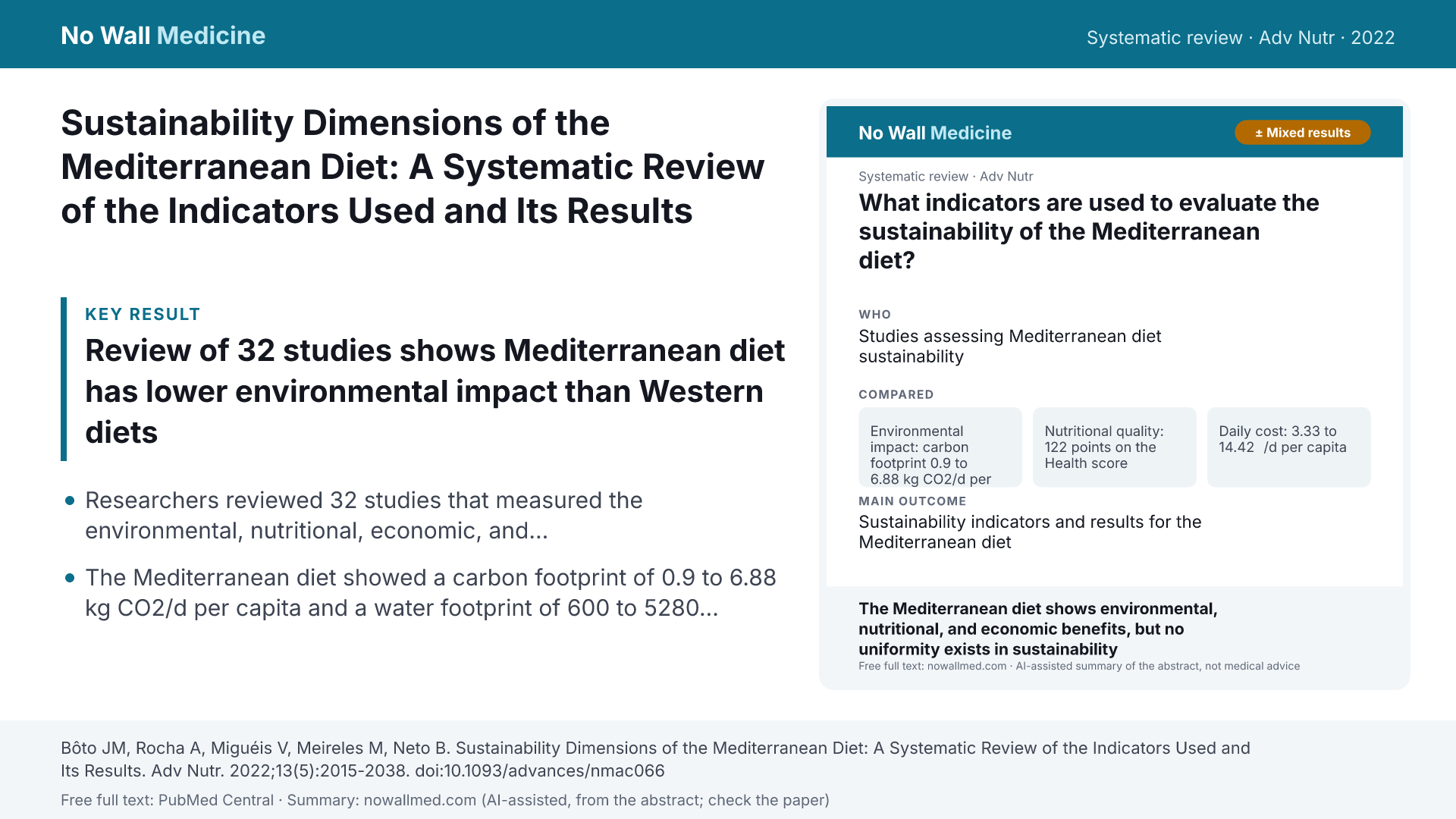
Sustainability Dimensions of the Mediterranean Diet: A Systematic Review of the Indicators Used and Its Results
Key result: Review of 32 studies shows Mediterranean diet has lower environmental impact than Western diets
Systematic reviewMixed results
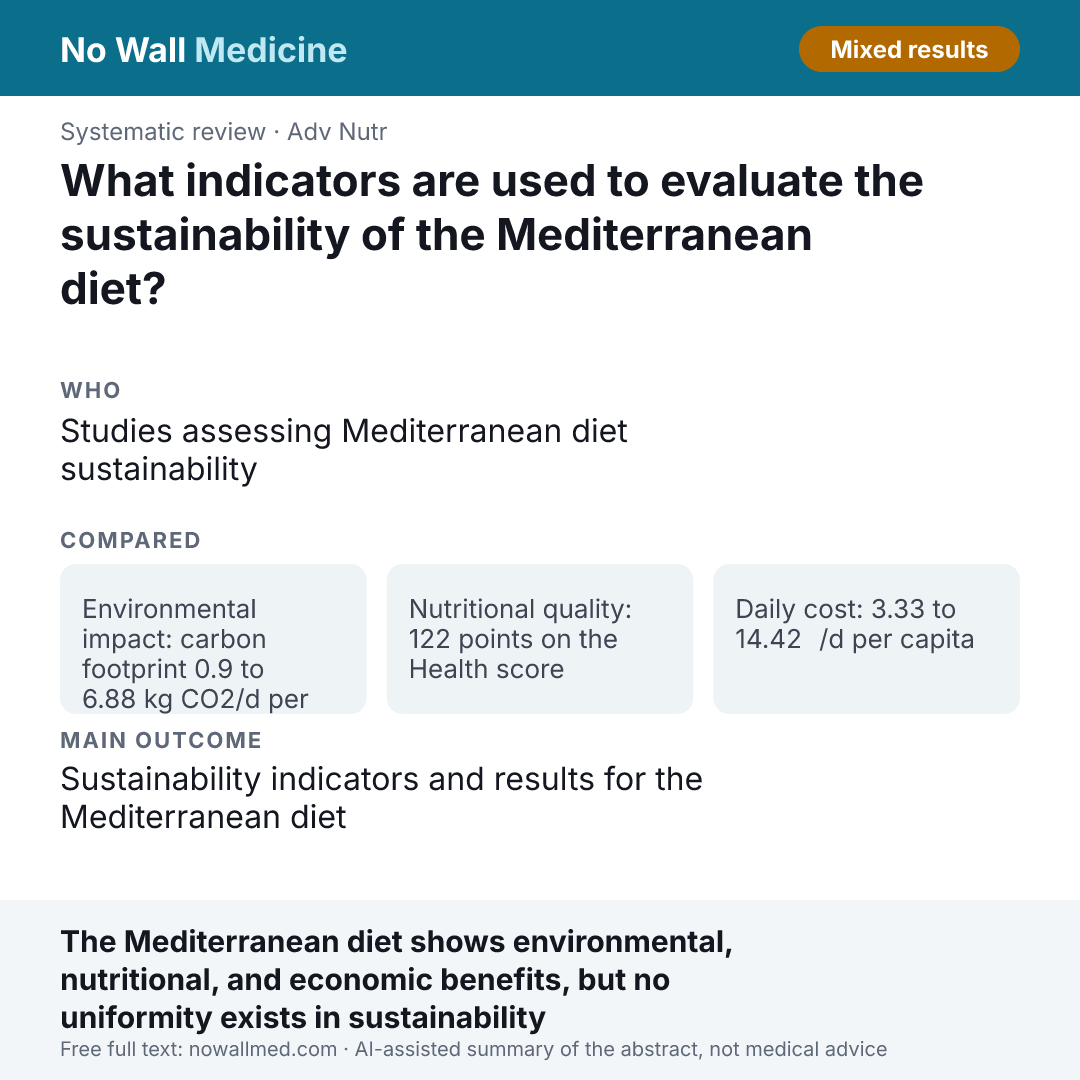
What indicators are used to evaluate the sustainability of the Mediterranean diet?
Who
Studies assessing Mediterranean diet sustainability
Compared
Environmental impact: carbon footprint 0.9 to 6.88 kg CO2/d per capita
Nutritional quality: 122 points on the Health score
Daily cost: 3.33 to 14.42€/d per capita
Main outcome
Sustainability indicators and results for the Mediterranean diet
Bottom line: The Mediterranean diet shows environmental, nutritional, and economic benefits, but no uniformity exists in sustainability assessment methods.
Adv Nutr · 2022-06-10 · Save PNG
Key points
- Researchers reviewed 32 studies that measured the environmental, nutritional, economic, and sociocultural sustainability of the Mediterranean diet.
- The Mediterranean diet showed a carbon footprint of 0.9 to 6.88 kg CO2/d per capita and a water footprint of 600 to 5280 m3/d per capita.
- Nutritional quality was high, with a Health score of 122 points and a Nutrient Rich Food Index between 12.95 and 90.6 points.
Discussion prompts
- Would these patients look like yours? Who was left out?
- Is the main outcome one that matters to patients?
- Is the difference large enough to change what you do?
Cite: Bôto JM, Rocha A, Miguéis V, Meireles M, Neto B. Sustainability Dimensions of the Mediterranean Diet: A Systematic Review of the Indicators Used and Its Results. Adv Nutr. 2022;13(5):2015-2038. doi:10.1093/advances/nmac066
Free full text: PubMed Central · Summary and visual abstract: nowallmed.com/a/sustainability-dimensions-of-the-mediterranean-diet-a-systematic-1kyo2a7/ (AI-assisted from the abstract; check the paper before relying on it).