Sustained minimal residual disease negativity in newly diagnosed multiple myeloma and the impact of daratumumab in MAIA and ALCYONE
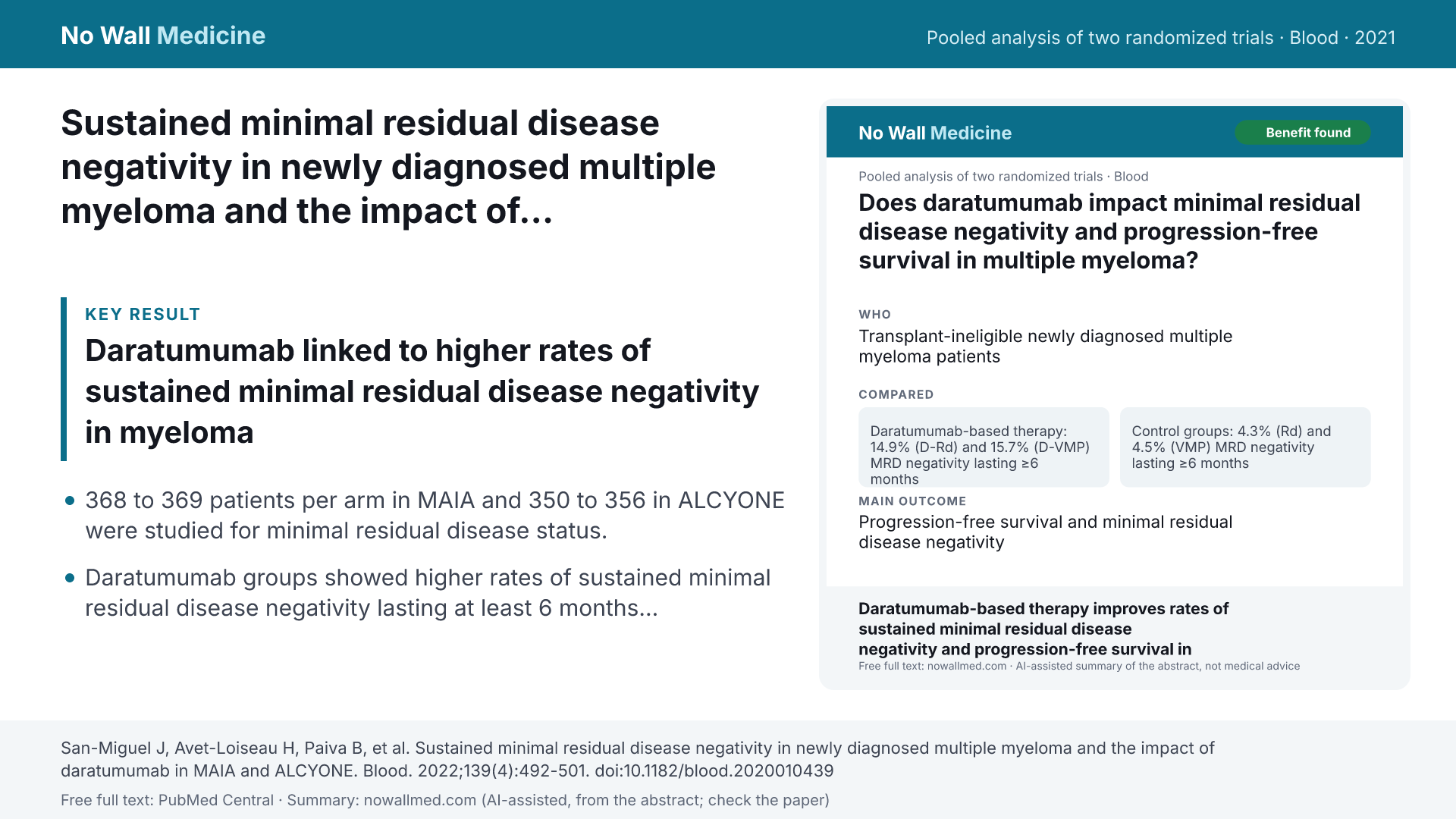
Key result: Daratumumab linked to higher rates of sustained minimal residual disease negativity in myeloma
Pooled analysis of two randomized trialsBenefit found
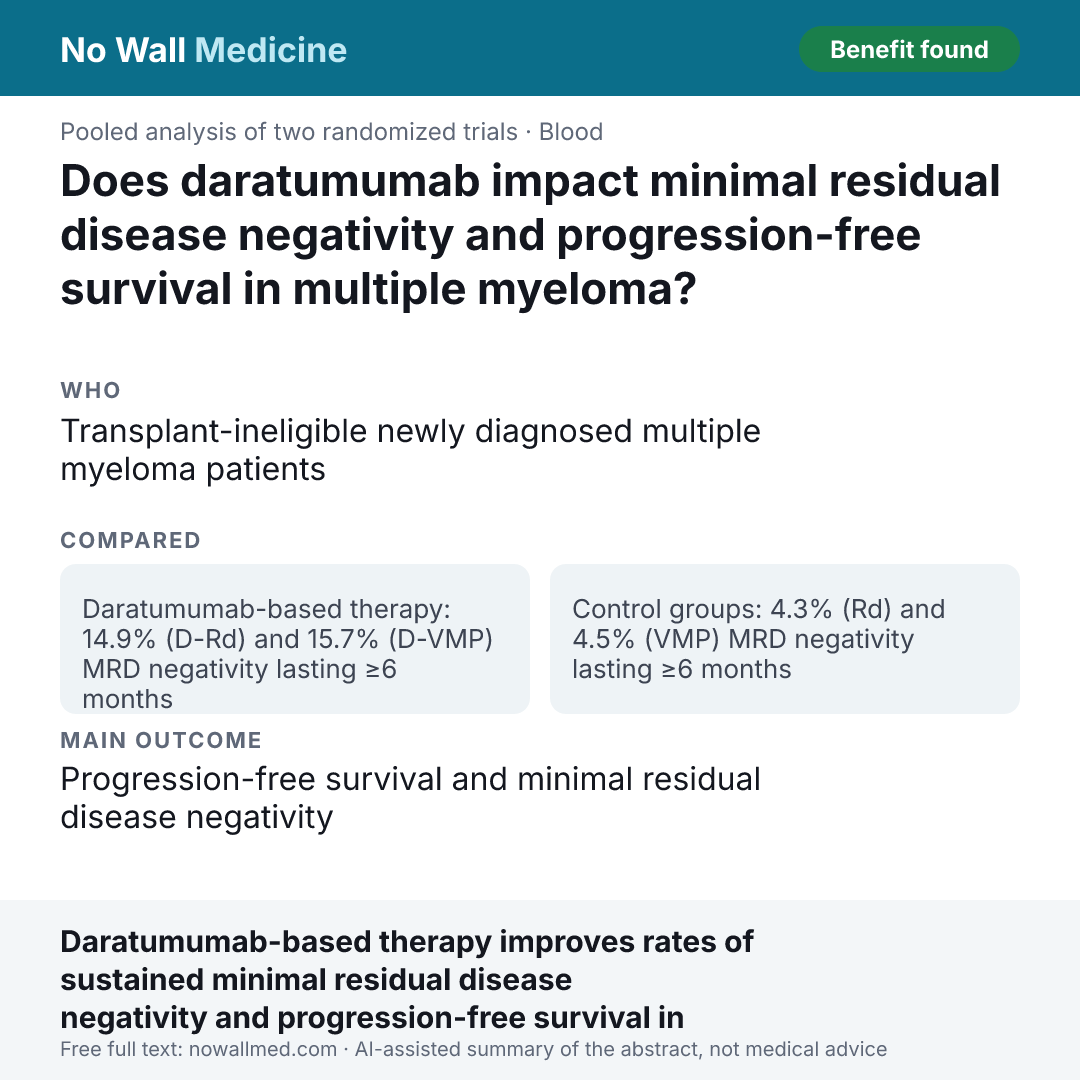
Does daratumumab impact minimal residual disease negativity and progression-free survival in multiple myeloma?
Who
Transplant-ineligible newly diagnosed multiple myeloma patients
Compared
Daratumumab-based therapy: 14.9% (D-Rd) and 15.7% (D-VMP) MRD negativity lasting ≥6 months
Control groups: 4.3% (Rd) and 4.5% (VMP) MRD negativity lasting ≥6 months
Main outcome
Progression-free survival and minimal residual disease negativity
Bottom line: Daratumumab-based therapy improves rates of sustained minimal residual disease negativity and progression-free survival in transplant-ineligible patients.
Blood · 2021-07-17 · Save PNG
Key points
- 368 to 369 patients per arm in MAIA and 350 to 356 in ALCYONE were studied for minimal residual disease status.
- Daratumumab groups showed higher rates of sustained minimal residual disease negativity lasting at least 6 months compared to controls.
- Sustained minimal residual disease negativity was associated with improved progression-free survival regardless of the specific treatment group.
Discussion prompts
- Would these patients look like yours? Who was left out?
- Is the main outcome one that matters to patients?
- Is the difference large enough to change what you do?
Cite: San-Miguel J, Avet-Loiseau H, Paiva B, et al. Sustained minimal residual disease negativity in newly diagnosed multiple myeloma and the impact of daratumumab in MAIA and ALCYONE. Blood. 2022;139(4):492-501. doi:10.1182/blood.2020010439
Free full text: PubMed Central · Summary and visual abstract: nowallmed.com/a/sustained-minimal-residual-disease-negativity-in-newly-diagnosed-ldv5q2/ (AI-assisted from the abstract; check the paper before relying on it).