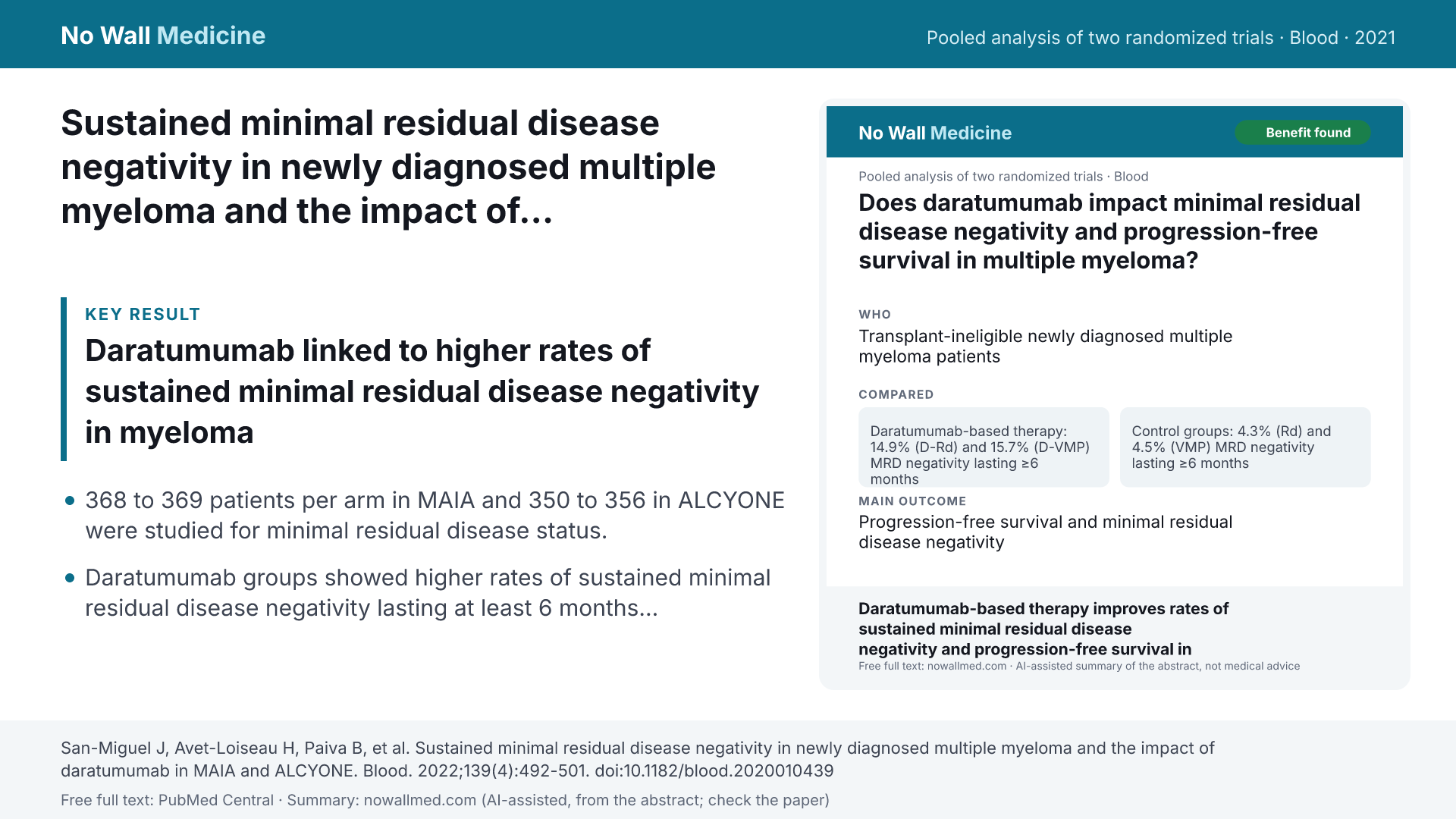
Sustained minimal residual disease negativity in newly diagnosed multiple myeloma and the impact of daratumumab in MAIA and ALCYONE
Pooled analysis of two randomized trialsBenefit found
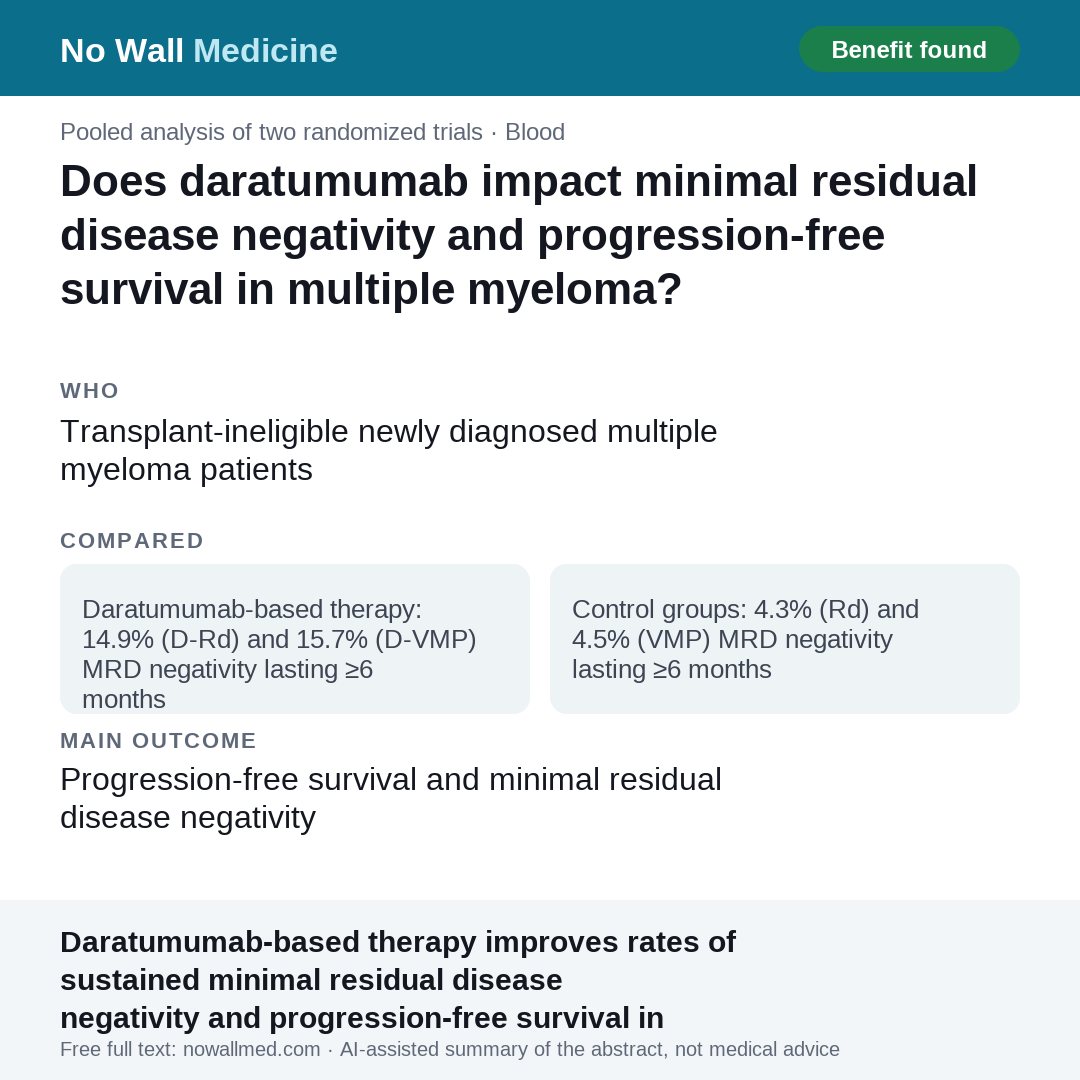
Does daratumumab impact minimal residual disease negativity and progression-free survival in multiple myeloma?
Who
Transplant-ineligible newly diagnosed multiple myeloma patients
Compared
Daratumumab-based therapy: 14.9% (D-Rd) and 15.7% (D-VMP) MRD negativity lasting ≥6 months
Control groups: 4.3% (Rd) and 4.5% (VMP) MRD negativity lasting ≥6 months
Main outcome
Progression-free survival and minimal residual disease negativity
Bottom line: Daratumumab-based therapy improves rates of sustained minimal residual disease negativity and progression-free survival in transplant-ineligible patients.
Blood · 2021-07-17Download image
Clinical question: Does daratumumab impact minimal residual disease negativity and progression-free survival in multiple myeloma?
Abstract
In patients with transplant-ineligible newly diagnosed multiple myeloma (NDMM), daratumumab reduced the risk of disease progression or death by 44% in MAIA (daratumumab/lenalidomide/dexamethasone [D-Rd]) and 58% in ALCYONE (daratumumab/bortezomib/melphalan/prednisone [D-VMP]). Minimal residual disease (MRD) is a sensitive measure of disease and response to therapy. MRD-negativity status and durability were assessed in MAIA and ALCYONE. MRD assessments using next-generation sequencing (10-5) occurred for patients achieving complete response (CR) or better and after at least CR at 12, 18, 24, and 30 months from the first dose. Progression-free survival (PFS) by MRD status and sustained MRD negativity lasting ≥6 and ≥12 months were analyzed in the intent-to-treat population and among patients achieving at least CR. In MAIA (D-Rd, n = 368; lenalidomide and dexamethasone [Rd], n = 369) and ALCYONE (D-VMP, n = 350; bortezomib/melphalan/prednisone [VMP], n = 356), the median duration of follow-up was 36.4 and 40.1 months, respectively. MRD-negative status and sustained MRD negativity lasting ≥6 and ≥12 months were associated with improved PFS, regardless of treatment group. However, daratumumab-based therapy improved rates of MRD negativity lasting ≥6 months (D-Rd, 14.9% vs Rd, 4.3%; D-VMP, 15.7% vs VMP, 4.5%) and ≥12 months (D-Rd, 10.9% vs Rd, 2.4%; D-VMP, 14.0% vs VMP, 2.8%), both of which translated to improved PFS vs control groups. In a pooled analysis, patients who were MRD negative had improved PFS vs patients who were MRD positive. Patients with NDMM who achieved MRD-negative status or sustained MRD negativity had deep remission and improved clinical outcomes. These trials were registered at www.clinicaltrials.gov as #NCT02252172 (MAIA) and #NCT02195479 (ALCYONE).
Subject terms
Cite this article
San-Miguel J, Avet-Loiseau H, Paiva B, Kumar S, Dimopoulos MA, Facon T. Sustained minimal residual disease negativity in newly diagnosed multiple myeloma and the impact of daratumumab in MAIA and ALCYONE. Blood. 2021. doi:10.1182/blood.2020010439
Spotted a mistake? Suggest a correction
Top studies every Monday
The week’s key trials and guidelines in your specialties, plus any topics you follow. By email, free.
Get the weekly digest