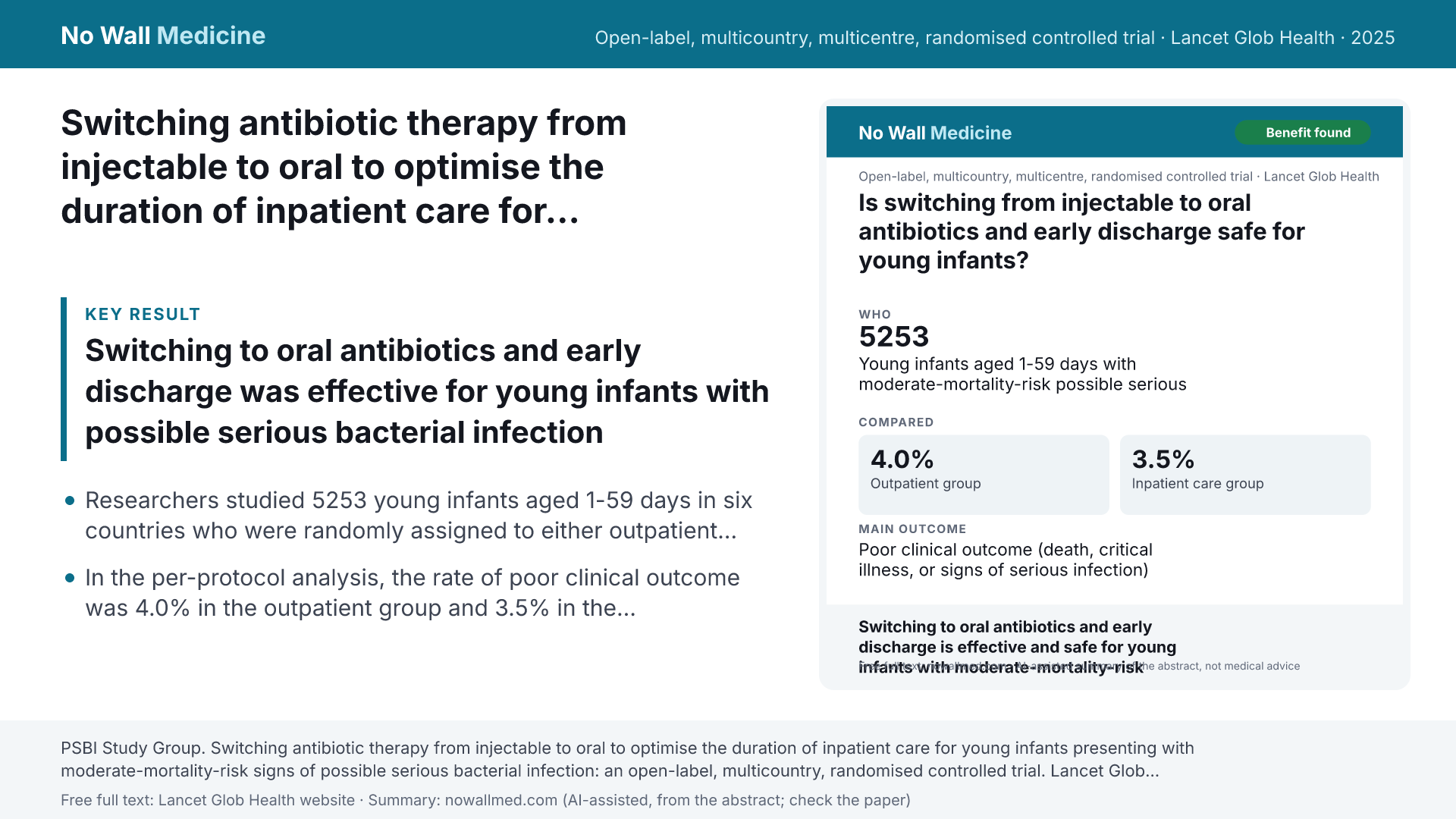
Switching to oral antibiotics and early discharge was effective for young infants with possible serious bacterial infection
Switching antibiotic therapy from injectable to oral to optimise the duration of inpatient care for young infants presenting with moderate-mortality-risk signs of possible serious bacterial infection: an open-label, multicountry, randomised controlled trial
Open-label, multicountry, multicentre, randomised controlled trialBenefit found
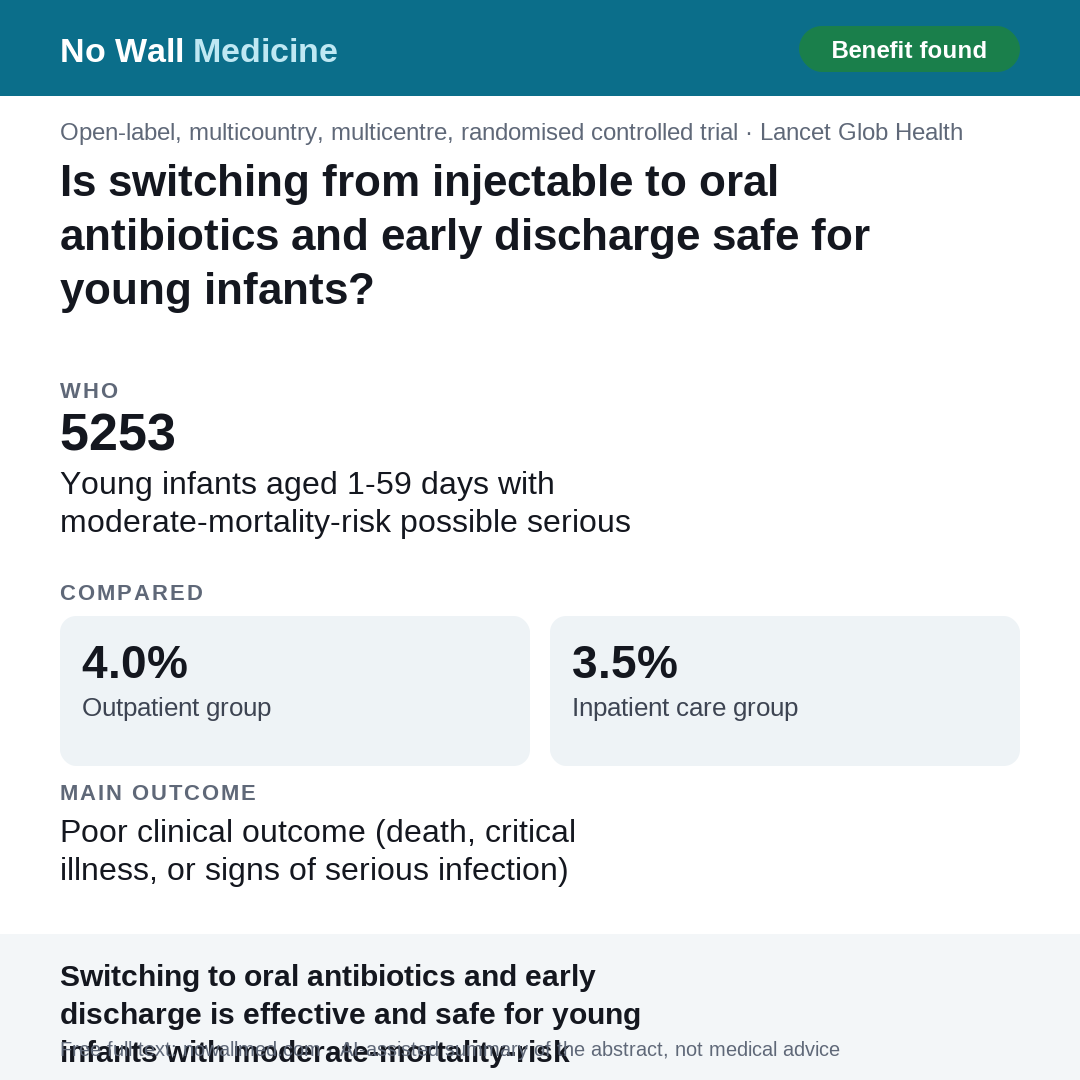
Is switching from injectable to oral antibiotics and early discharge safe for young infants?
Who
5253
Young infants aged 1-59 days with moderate-mortality-risk possible serious bacterial infection signs · Bangladesh, Ethiopia, India, Nigeria, Pakistan, and Tanzania
Compared
4.0%Outpatient group (105 of 2616)
3.5%Inpatient care group (90 of 2603)
Main outcome
Poor clinical outcome (death, critical illness, or signs of serious infection)
Result: risk difference 0.0056 (95% CI -0.0047 to 0.0158)
Bottom line: Switching to oral antibiotics and early discharge is effective and safe for young infants with moderate-mortality-risk possible serious bacterial infection.
Funded by: Gates Foundation
Lancet Glob Health · 2025-10-19Download image
Clinical question: Is switching from injectable to oral antibiotics and early discharge safe for young infants?
Why it matters: Hospitalization for 7-10 days is currently recommended for young infants with moderate-mortality-risk signs of possible serious bacterial infection, but early discharge may optimize resources.
Key points
- Researchers studied 5253 young infants aged 1-59 days in six countries who were randomly assigned to either outpatient oral amoxicillin after 48 hours or continued inpatient care.
- In the per-protocol analysis, the rate of poor clinical outcome was 4.0% in the outpatient group and 3.5% in the inpatient group.
- Six infants (0.2%) died in the outpatient group compared to eight infants (0.3%) in the inpatient group.
Headline and key points written with AI from the paper’s abstract, with every number checked against it. Read the paper before relying on them.
Was this summary helpful?
Abstract
Background
In low-resource settings, challenges in hospitalisation stay for sick young infants younger than 2 months persist. Early discharge of young infants with moderate-mortality-risk possible serious bacterial infection (PSBI) signs might provide a safe and effective alternative. We compared the clinical outcomes of switching parenteral antibiotics to oral antibiotics along with hospital discharge after 48 h of admission with those who continued hospitalisation for 7 days. Methods
An open-label, multicountry, multicentre, individually randomised controlled trial was done in Bangladesh, Ethiopia, India, Nigeria, Pakistan, and Tanzania. Young infants aged 1-59 days presenting with moderate-mortality-risk PSBI signs were screened and hospitalised for inpatient care with injectable ampicillin and gentamicin. After 48 h of admission, young infants without any PSBI sign, and negative C-reactive protein, were randomly assigned to either the intervention (outpatient) group (discontinuation of injectable antibiotics and hospital discharge after switching to oral amoxicillin twice daily for 5 more days) or the control group (continued inpatient care). Treatment received throughout was documented on days 4 and 8 of initiation, and outcomes on days 4, 8, and 15. The primary outcome of poor clinical outcome was a hierarchical composite indicator that included death (any time after randomisation up to day 15 of initiation of therapy), presence of any sign of critical illness (no movement at all, unable to feed at all, or convulsions), or any sign suggestive of another serious infection, such as meningitis, bone or joint infection (on day 4 or day 8 of initiation of therapy), and presence of any sign of clinical severe infection (CSI) (on day 8 of initiation of therapy). The non-inferiority margin was set at 2%. We did a per-protocol analysis to compare the proportions of primary outcome between the two groups and reported risk differences (RDs) with 95% CI. The study is registered with the ISRCTN registry (ISRCTN16872570). Findings
Between June 24, 2021, and Aug 7, 2024, of 6549 young infants with moderate-mortality-risk PSBI signs who were reassessed after 48 h of admission, 5253 (80·3%) were randomly assigned to the outpatient group (n=2635) or the inpatient care group (n=2618). Treatment adherence was 96·7% (2549 of 2635) in the oral amoxicillin group and 95·7% (2506 of 2618) in the inpatient care group (with at least 80% of the antibiotic dosage received). In the per-protocol analysis, the rate of poor clinical outcome was 4·0% (105 of 2616) in the outpatient group and 3·5% (90 of 2603) in the inpatient care group (RD 0·0056 [95% CI -0·0047 to 0·0158]). The most common reason for poor clinical outcome was any sign of CSI at day 8 (3·4% in the outpatient group and 2·6% in the inpatient care group). Six (0·2%) young infants died in the outpatient group and eight (0·3%) in the inpatient care group. Besides deaths, two young infants developed serious adverse events, and both were in the inpatient group. Interpretation
Discontinuation of the injectable antibiotics and switching to oral antibiotics with early hospital discharge in young infants with moderate-mortality-risk PSBI signs was effective and safe in diverse low-income and middle-income countries in Africa and Asia. This could optimise health systems and family resources, as well as decreasing the risk of hospital-acquired infections compared with the currently recommended 7-10 days of inpatient care. Funding
Gates Foundation.
Abstract reproduced under the article’s CC BY NC ND licence.
Subject terms
Cite this article
PSBI Study Group. Switching antibiotic therapy from injectable to oral to optimise the duration of inpatient care for young infants presenting with moderate-mortality-risk signs of possible serious bacterial infection: an open-label, multicountry, randomised controlled trial. Lancet Glob Health. 2025. doi:10.1016/S2214-109X(25)00311-0
Spotted a mistake? Suggest a correction