Symptom provocation was associated with better clinical response to brain stimulation for OCD and nicotine dependence
Symptom Provocation and Clinical Response to Transcranial Magnetic Stimulation: A Systematic Review and Meta-Analysis
Systematic review and meta-analysisMixed results
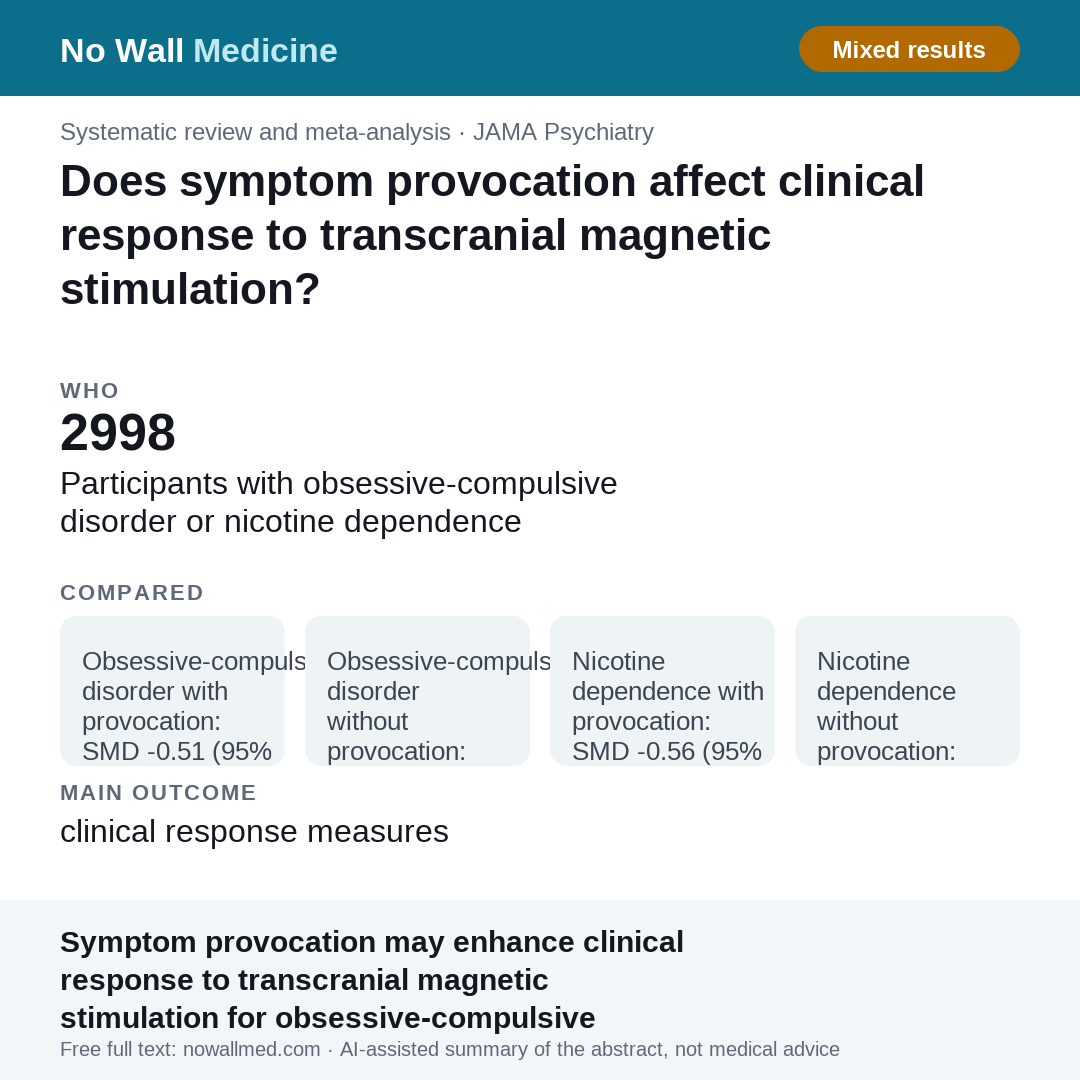
Does symptom provocation affect clinical response to transcranial magnetic stimulation?
Who
2998
Participants with obsessive-compulsive disorder or nicotine dependence
Compared
Obsessive-compulsive disorder with provocation: SMD -0.51 (95% CI, -0.96 to -0.07)
Obsessive-compulsive disorder without provocation: SMD -0.29 (95% CI, -0.40 to -0.17)
Nicotine dependence with provocation: SMD -0.56 (95% CI, -1.12 to 0)
Nicotine dependence without provocation: SMD -0.35 (95% CI, -0.74 to 0.04)
Main outcome
clinical response measures
Bottom line: Symptom provocation may enhance clinical response to transcranial magnetic stimulation for obsessive-compulsive disorder and nicotine dependence.
Limitation: Studies comparing TMS with and without provocation are critical to establish the causal effect of provocation.
JAMA Psychiatry · 2025-06-04Download image
Clinical question: Does symptom provocation affect clinical response to transcranial magnetic stimulation?
Why it matters: It is unknown whether the brain state, specifically through symptom provocation, affects how patients respond to transcranial magnetic stimulation.
Key points
- Researchers analyzed 63 studies involving 2998 participants to compare clinical responses to transcranial magnetic stimulation with and without symptom provocation.
- For obsessive-compulsive disorder, active stimulation was associated with better response than sham both with (SMD = -0.51) and without (SMD = -0.29) provocation.
- In nicotine dependence, active stimulation was associated with better response than sham with provocation (SMD = -0.56) but not without provocation (SMD = -0.35).
Headline and key points written with AI from the paper’s abstract, with every number checked against it. Read the paper before relying on them.
Was this summary helpful?
Subject terms
Cite this article
Bello D, Jones M, Gadiyar I, Artim L, Blyth SH, Brady RO. Symptom Provocation and Clinical Response to Transcranial Magnetic Stimulation: A Systematic Review and Meta-Analysis. JAMA Psychiatry. 2025. doi:10.1001/jamapsychiatry.2025.0792
Spotted a mistake? Suggest a correction
Top studies every Monday
The week’s key trials and guidelines in your specialties, plus any topics you follow. By email, free.
Get the weekly digest