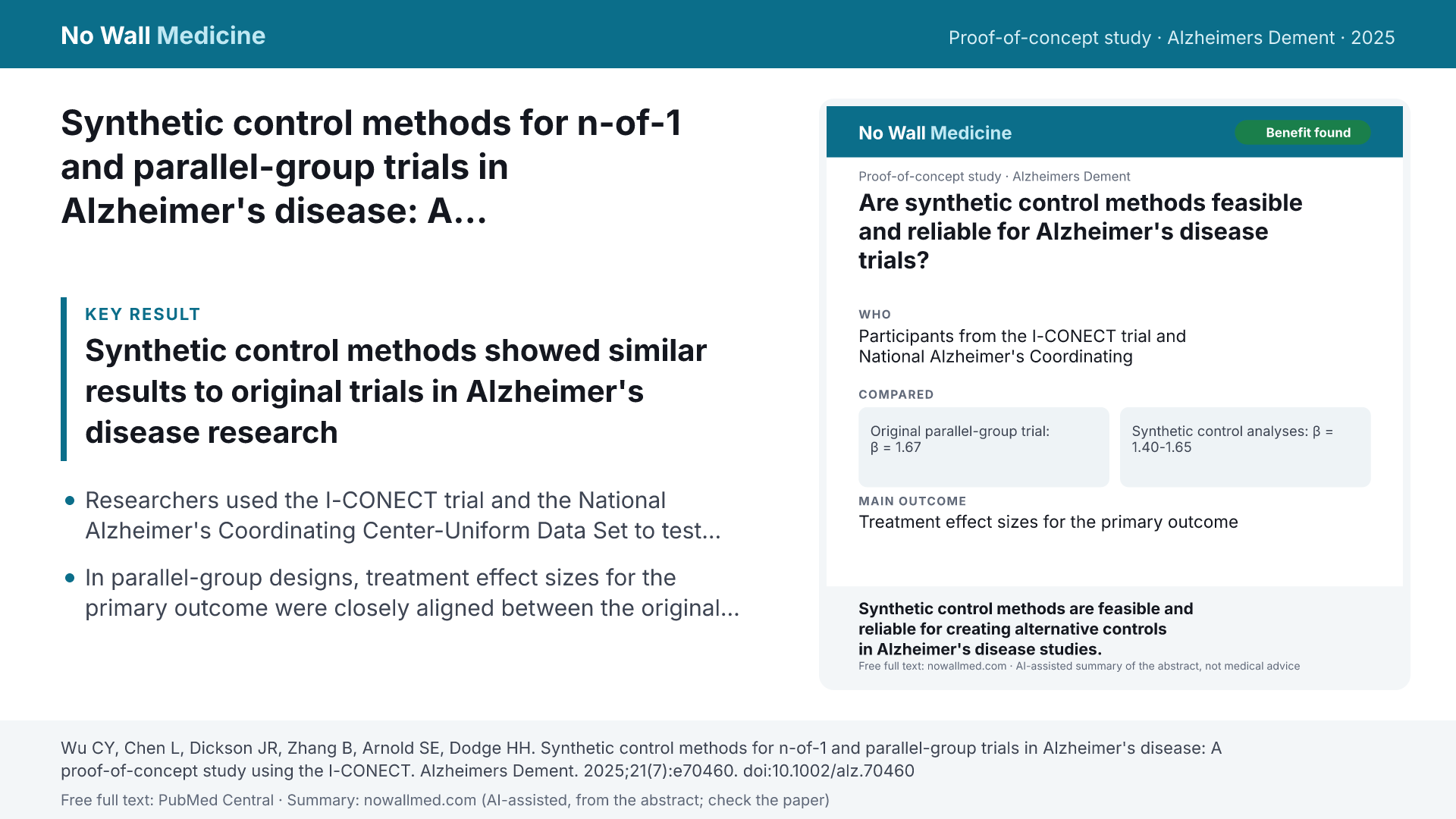
Synthetic control methods showed similar results to original trials in Alzheimer's disease research
Synthetic control methods for n-of-1 and parallel-group trials in Alzheimer's disease: A proof-of-concept study using the I-CONECT
Proof-of-concept studyBenefit found
Are synthetic control methods feasible and reliable for Alzheimer's disease trials?
Who
Participants from the I-CONECT trial and National Alzheimer's Coordinating Center-Uniform Data Set · Not specified
Compared
Original parallel-group trial: β = 1.67
Synthetic control analyses: β = 1.40-1.65
Main outcome
Treatment effect sizes for the primary outcome
Bottom line: Synthetic control methods are feasible and reliable for creating alternative controls in Alzheimer's disease studies.
Alzheimers Dement · 2025-07-07Download image
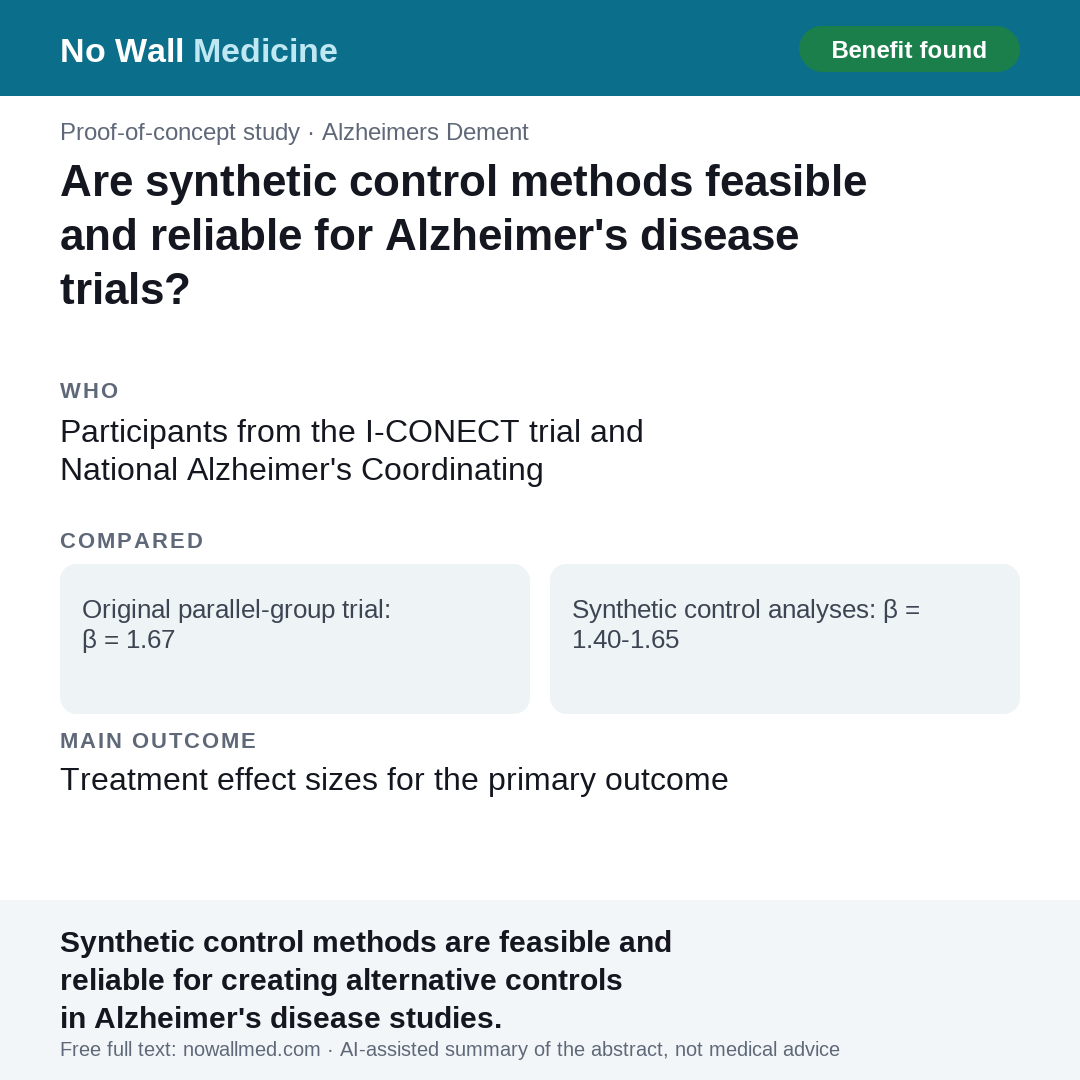
Clinical question: Are synthetic control methods feasible and reliable for Alzheimer's disease trials?
Why it matters: Enrolling participants as concurrent placebo controls in Alzheimer's disease trials can become increasingly difficult as new treatments are developed.
Key points
- Researchers used the I-CONECT trial and the National Alzheimer's Coordinating Center-Uniform Data Set to test two synthetic control methods: case mapping and case modeling.
- In parallel-group designs, treatment effect sizes for the primary outcome were closely aligned between the original trial (β = 1.67) and synthetic control analyses (β = 1.40-1.65).
- For n-of-1 designs, which involve single patients, the two methods showed high agreement in identifying treatment responders with a Kappa value of 0.75-0.82.
Headline and key points written with AI from the paper’s abstract, with every number checked against it. Read the paper before relying on them.
Was this summary helpful?
Subject terms
Cite this article
Wu CY, Chen L, Dickson JR, Zhang B, Arnold SE, Dodge HH. Synthetic control methods for n-of-1 and parallel-group trials in Alzheimer's disease: A proof-of-concept study using the I-CONECT. Alzheimers Dement. 2025. doi:10.1002/alz.70460
Spotted a mistake? Suggest a correction