Synthetic control methods for n-of-1 and parallel-group trials in Alzheimer's disease: A proof-of-concept study using the I-CONECT
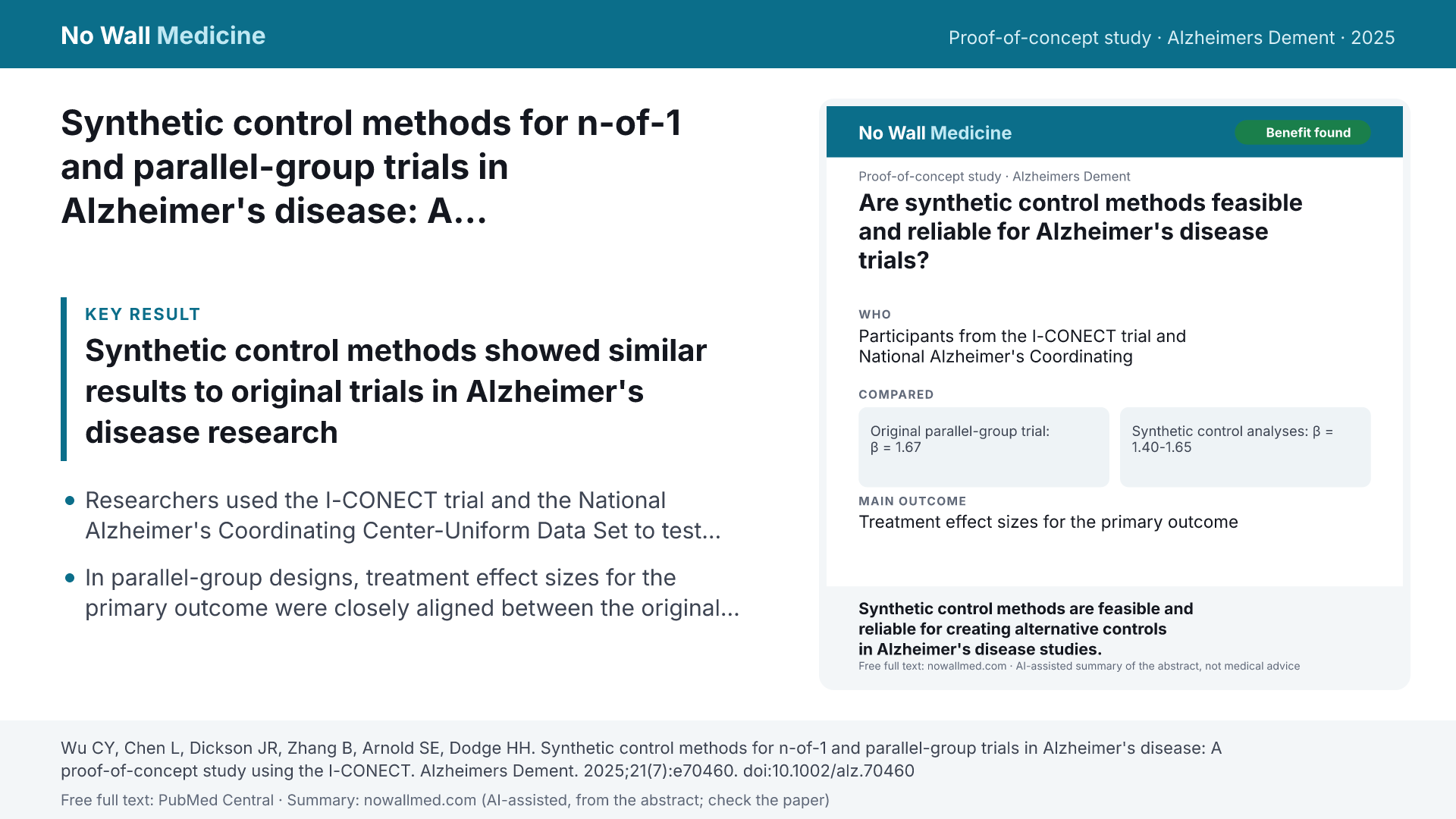
Key result: Synthetic control methods showed similar results to original trials in Alzheimer's disease research
Key points
- Researchers used the I-CONECT trial and the National Alzheimer's Coordinating Center-Uniform Data Set to test two synthetic control methods: case mapping and case modeling.
- In parallel-group designs, treatment effect sizes for the primary outcome were closely aligned between the original trial (β = 1.67) and synthetic control analyses (β = 1.40-1.65).
- For n-of-1 designs, which involve single patients, the two methods showed high agreement in identifying treatment responders with a Kappa value of 0.75-0.82.
Why it matters: Enrolling participants as concurrent placebo controls in Alzheimer's disease trials can become increasingly difficult as new treatments are developed.
Discussion prompts
- Would these patients look like yours? Who was left out?
- Is the main outcome one that matters to patients?
- Is the difference large enough to change what you do?
Cite: Wu CY, Chen L, Dickson JR, Zhang B, Arnold SE, Dodge HH. Synthetic control methods for n-of-1 and parallel-group trials in Alzheimer's disease: A proof-of-concept study using the I-CONECT. Alzheimers Dement. 2025;21(7):e70460. doi:10.1002/alz.70460
Free full text: PubMed Central · Summary and visual abstract: nowallmed.com/a/synthetic-control-methods-for-n-of-1-and-parallel-group-trials-in-ijzjky/ (AI-assisted from the abstract; check the paper before relying on it).