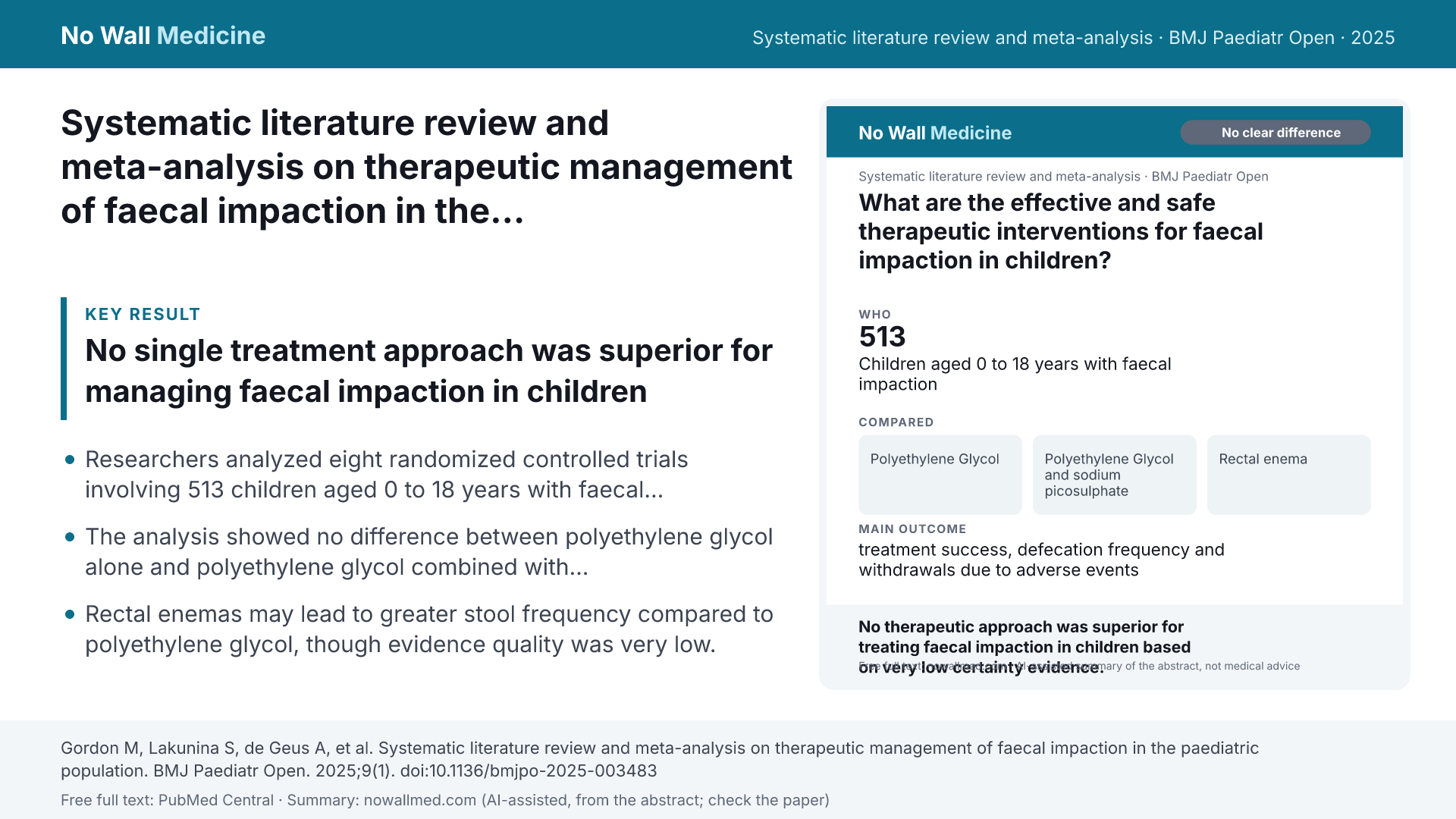
No single treatment approach was superior for managing faecal impaction in children
Systematic literature review and meta-analysis on therapeutic management of faecal impaction in the paediatric population
Systematic literature review and meta-analysisNo clear difference
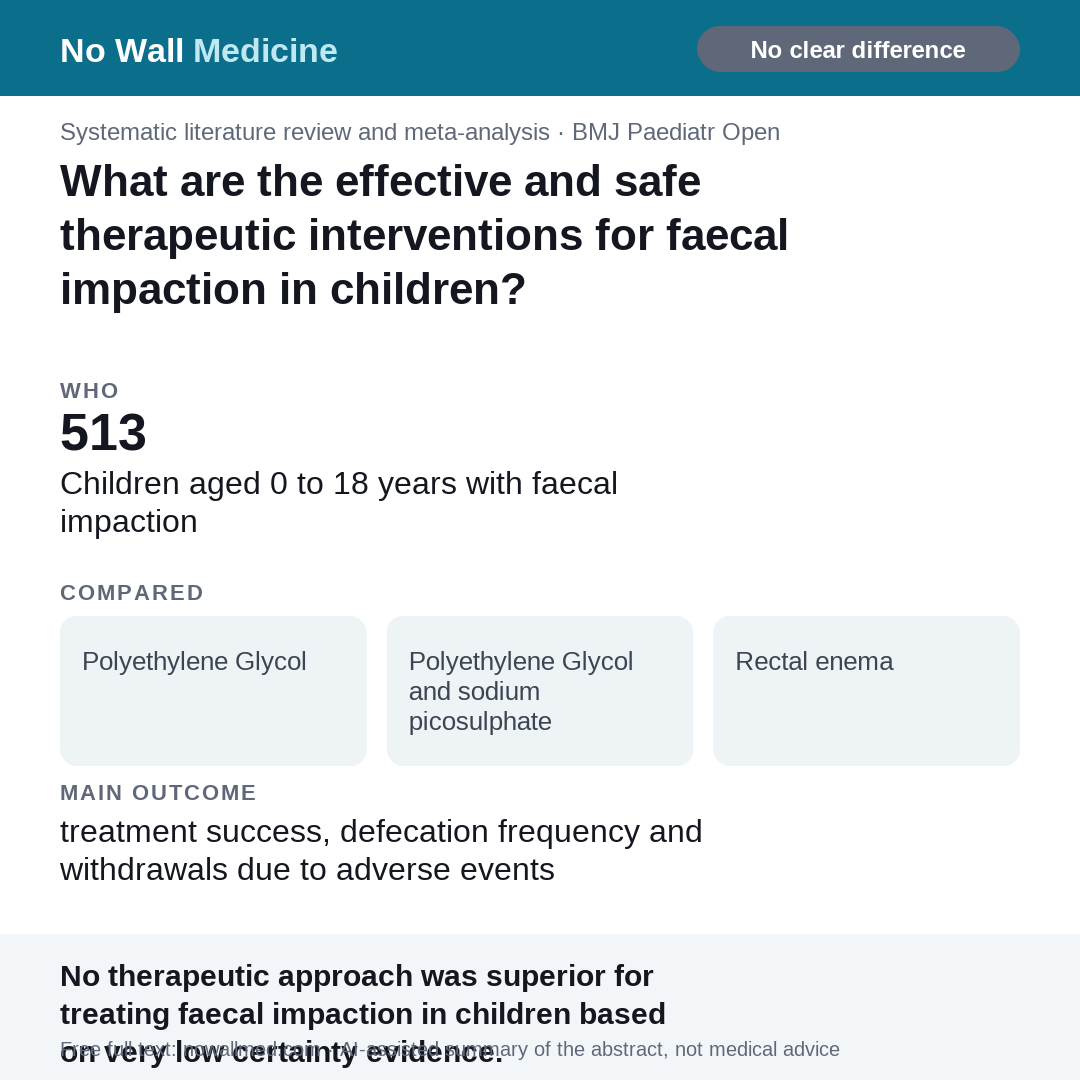
What are the effective and safe therapeutic interventions for faecal impaction in children?
Who
513
Children aged 0 to 18 years with faecal impaction
Compared
Polyethylene Glycol
Polyethylene Glycol and sodium picosulphate
Rectal enema
Main outcome
treatment success, defecation frequency and withdrawals due to adverse events
Bottom line: No therapeutic approach was superior for treating faecal impaction in children based on very low certainty evidence.
Limitation: Significant clinical heterogeneity and limited study numbers with very low certainty evidence.
BMJ Paediatr Open · 2025-06-22Download image
Clinical question: What are the effective and safe therapeutic interventions for faecal impaction in children?
Why it matters: There is currently no universally accepted or standardized protocol for managing faecal impaction in the pediatric population.
Key points
- Researchers analyzed eight randomized controlled trials involving 513 children aged 0 to 18 years with faecal impaction caused by functional constipation.
- The analysis showed no difference between polyethylene glycol alone and polyethylene glycol combined with sodium picosulphate, and no difference in success between polyethylene glycol and rectal enemas.
- Rectal enemas may lead to greater stool frequency compared to polyethylene glycol, though evidence quality was very low.
Limitation the authors note: The evidence was limited by significant clinical heterogeneity regarding patient factors, clinical factors, outcome measures, and limited study numbers.
Headline and key points written with AI from the paper’s abstract, with every number checked against it. Read the paper before relying on them.
Was this summary helpful?
Abstract
Background
To date, there is no universally accepted or standardised protocol for management of faecal impaction (FI) in paediatric population. If left untreated, it can lead to serious consequences for the health and well-being of the child. We set out to determine the effectiveness and safety of existing therapeutic interventions for FI in children and identify any gaps occurring in current research. Methods
We have performed a systematic literature review on treatment of FI in paediatric population in accordance with Preferred Reporting Items for Systematic Reviews and Meta-Analyses guidelines. We have included randomised controlled trials (RCTs) on all interventions for children (0-18 years old) with FI on background of functional constipation and excluded children with organic causes of FI. Our primary outcomes were treatment success, defecation frequency and withdrawals due to adverse events. We have performed a meta-analysis of the data. Results
Out of 13 341 records identified, only eight RCTs met our inclusion criteria with a total of 513 participants randomised. The diagnosis of functional constipation was mainly made using ROME III criteria. The diagnosis of FI varied from study to study. We identified several intervention groups based on our search. Our analysis has shown that there is no difference probably between PEG (Polyethylene Glycol).and PEG with sodium picosulphate, and there may be no difference between PEG and rectal enema for treatment success, but enema may lead to greater stool frequency. No other studies produced anything other than very low certainty evidence. Conclusions
No therapeutic approach was superior to others, with evidence limited by significant clinical heterogeneity related to varying patient and clinical factors, different outcome measures and limited study numbers. More high-quality research is needed to determine effective strategies for FI. Moreover, a consensus should be reached regarding the definition and diagnosis of FI as based on that a standardised approach to patient's care can be determined.
Abstract reproduced under the article’s CC BY NC licence.
Subject terms
Cite this article
Gordon M, Lakunina S, de Geus A, et al. Systematic literature review and meta-analysis on therapeutic management of faecal impaction in the paediatric population. BMJ Paediatr Open. 2025. doi:10.1136/bmjpo-2025-003483
Spotted a mistake? Suggest a correction