Review of transitional care for young people with rheumatic diseases shows limited quantitative evidence
Systematic literature review informing the EULAR points to consider for patient education in physical activity and self-management of pain during transitional care
Systematic literature reviewUnclear result
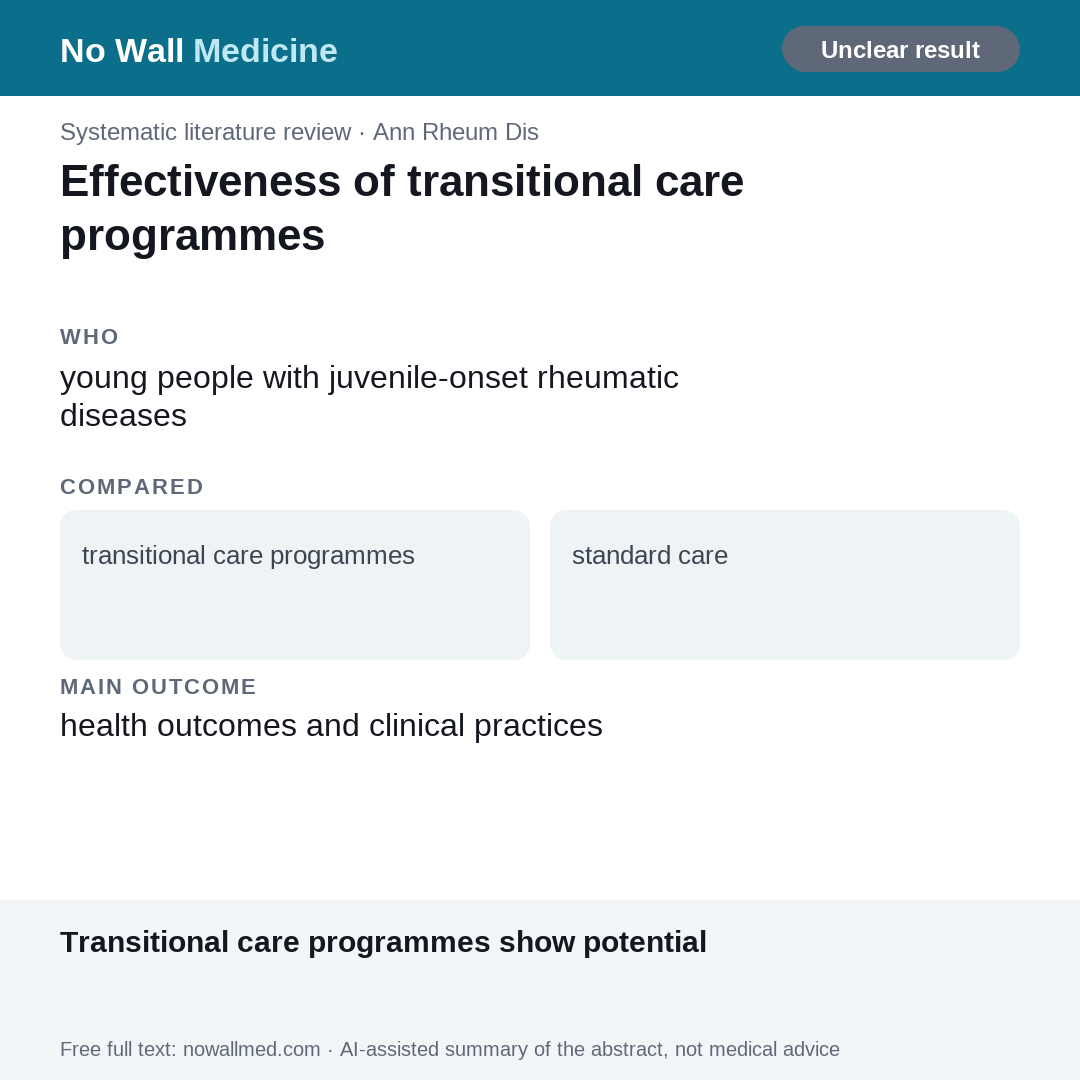
Effectiveness of transitional care programmes
Who
young people with juvenile-onset rheumatic diseases
Compared
transitional care programmes
standard care
Main outcome
health outcomes and clinical practices
Bottom line: Transitional care programmes show potential
Limitation: limited quantitative evidence
Ann Rheum Dis · 2025-02-11Download image
Why it matters: It is unclear which specific transitional care structures and implementation strategies effectively improve quantitative health outcomes for young people moving to adult rheumatology care.
Key points
- Researchers reviewed 31 studies to examine transitional care programs for young people with juvenile-onset rheumatic and musculoskeletal diseases.
- The 18 identified programs often used multidisciplinary teams and individualized plans, but quantitative evidence for their effectiveness remains limited.
- Young people and their families reported satisfaction with these programs, especially when receiving early support for self-management.
Limitation the authors note: Quantitative evidence supporting the effectiveness of these programs is limited, with few experimental studies confirming consistent benefits.
Headline and key points written with AI from the paper’s abstract, with every number checked against it. Read the paper before relying on them.
Topics
Cite this article
Courel-Ibáñez J, Prieto-Moreno R, Briones-Vozmediano E, Ariza-Vega P, Angevare S, Anton J. Systematic literature review informing the EULAR points to consider for patient education in physical activity and self-management of pain during transitional care. Ann Rheum Dis. 2025. doi:10.1016/j.ard.2025.01.017
Spotted a mistake? Suggest a correction
Top studies every Monday
The week’s key trials and guidelines in your specialties, by email. Free.
Get the weekly digest