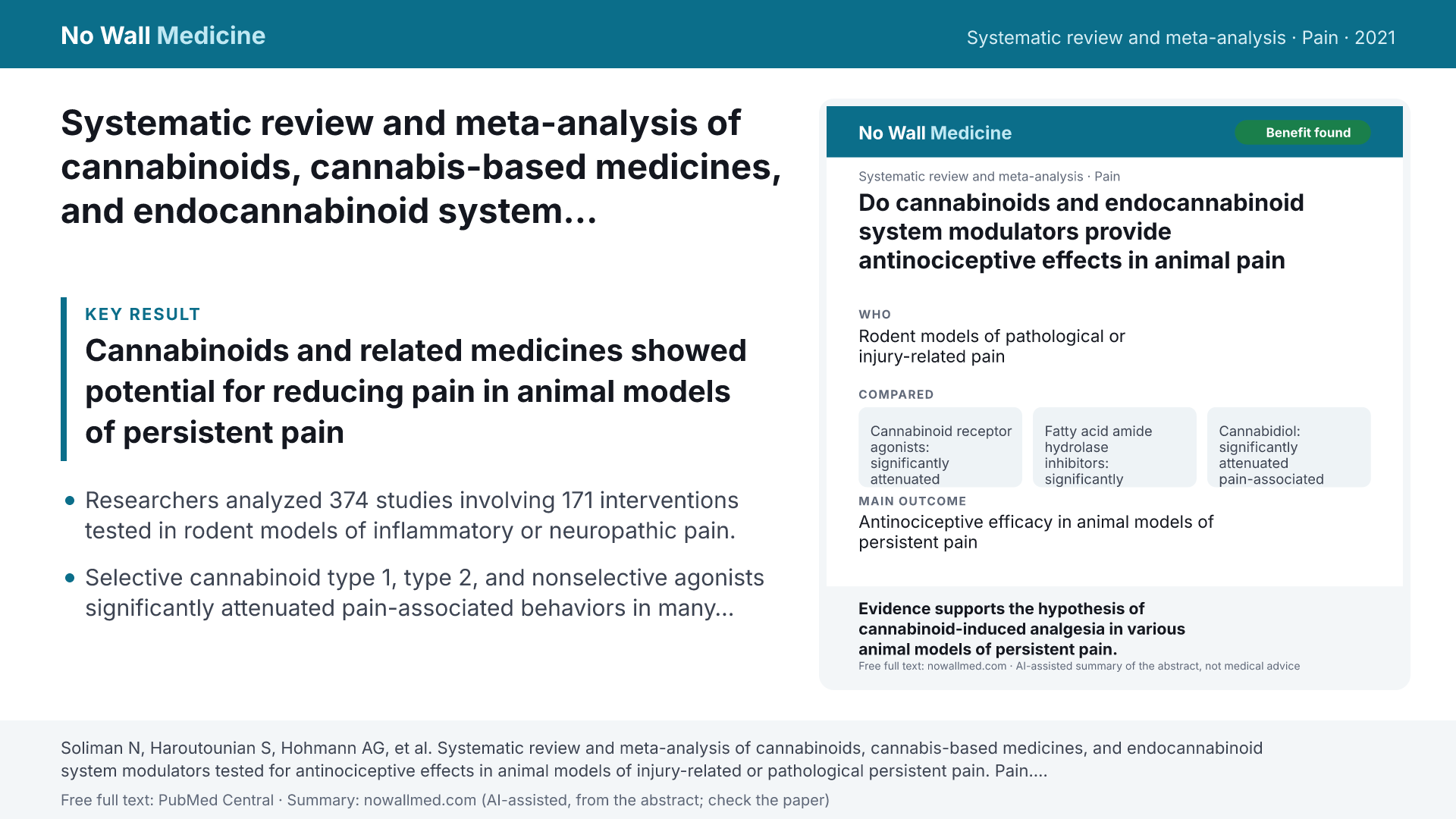
Cannabinoids and related medicines showed potential for reducing pain in animal models of persistent pain
Systematic review and meta-analysis of cannabinoids, cannabis-based medicines, and endocannabinoid system modulators tested for antinociceptive effects in animal models of injury-related or pathological persistent pain
Systematic review and meta-analysisBenefit found
Do cannabinoids and endocannabinoid system modulators provide antinociceptive effects in animal pain models?
Who
374
Rodent models of pathological or injury-related pain
Compared
Cannabinoid receptor agonists: significantly attenuated pain-associated behaviours
Fatty acid amide hydrolase inhibitors: significantly attenuated pain-associated behaviours in neuropathic pain models
Cannabidiol: significantly attenuated pain-associated behaviours in neuropathic pain models
Main outcome
Antinociceptive efficacy in animal models of persistent pain
Bottom line: Evidence supports the hypothesis of cannabinoid-induced analgesia in various animal models of persistent pain.
Limitation: Low reporting of criteria to reduce risk of bias and unclear risk of bias.
Pain · 2021-03-18Download image
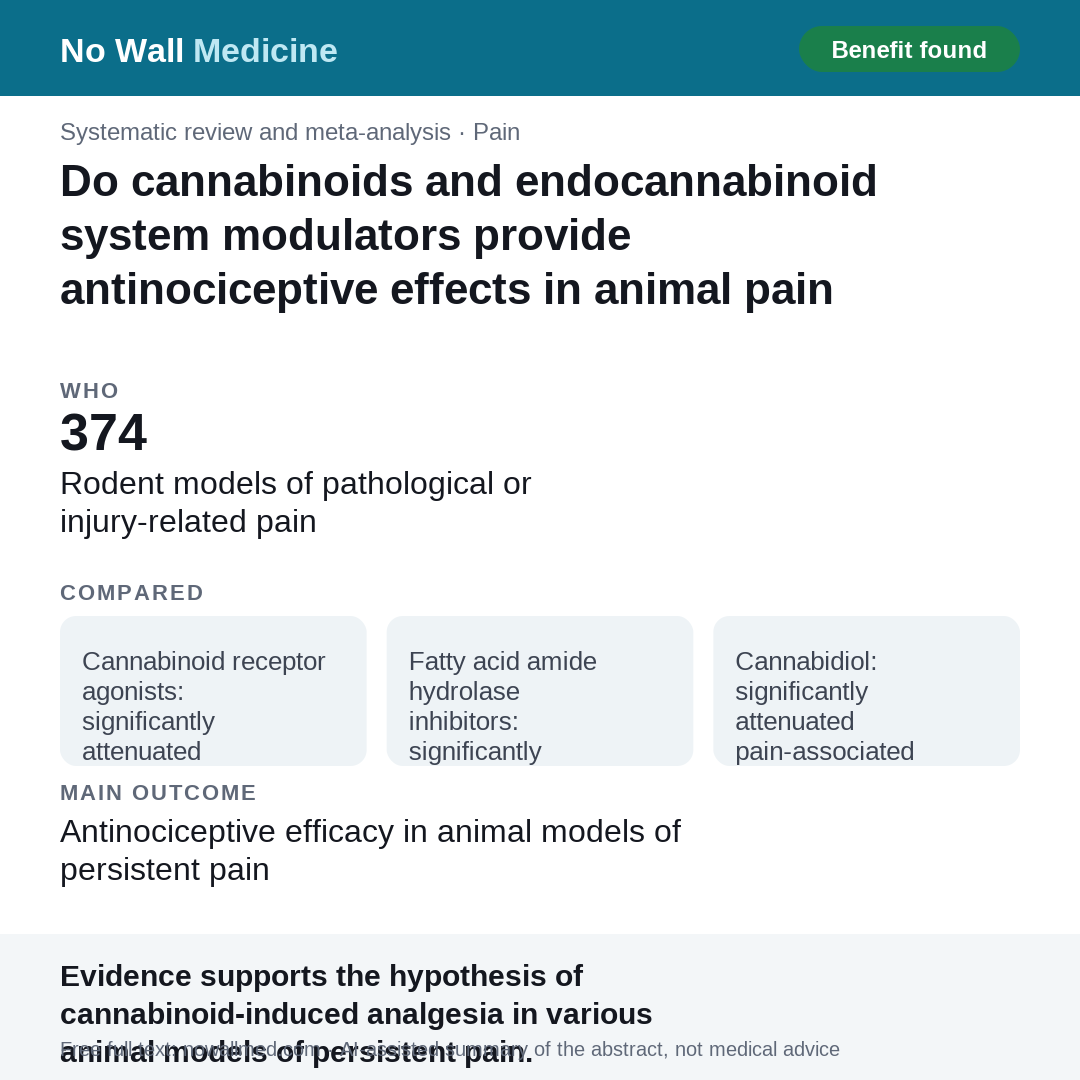
Clinical question: Do cannabinoids and endocannabinoid system modulators provide antinociceptive effects in animal pain models?
Why it matters: It was unclear how effective cannabinoids and endocannabinoid system modulators are at reducing pain-related behaviors in animal models of injury-related or pathological persistent pain.
Key points
- Researchers analyzed 374 studies involving 171 interventions tested in rodent models of inflammatory or neuropathic pain.
- Selective cannabinoid type 1, type 2, and nonselective agonists significantly attenuated pain-associated behaviors in many pain models.
- Fatty acid amide hydrolase inhibitors, monoacylglycerol lipase inhibitors, and cannabidiol significantly attenuated pain behaviors in neuropathic pain models.
Limitation the authors note: The studies had an unclear risk of bias because the reporting of criteria to reduce that risk was low.
Headline and key points written with AI from the paper’s abstract, with every number checked against it. Read the paper before relying on them.
Was this summary helpful?
Subject terms
Cite this article
Soliman N, Haroutounian S, Hohmann AG, Krane E, Liao J, Macleod M. Systematic review and meta-analysis of cannabinoids, cannabis-based medicines, and endocannabinoid system modulators tested for antinociceptive effects in animal models of injury-related or pathological persistent pain. Pain. 2021. doi:10.1097/j.pain.0000000000002269
Spotted a mistake? Suggest a correction