Interventions improved mental health symptoms for people affected by extreme weather events
Systematic review and meta-analysis of interventions for mental health in extreme weather events
Systematic review and meta-analysisBenefit found
Are interventions effective for mental health in people affected by extreme weather events?
Who
People affected by extreme weather events
Compared
Intervention
Control
Main outcome
Post-traumatic stress disorder, depression, anxiety, stress, functioning, and well-being
Result: standardised mean difference -2.92 (95% CI -4.53 to -1.31) for PTSD
Bottom line: Interventions significantly improve mental health symptoms following extreme weather events and should be integrated into disaster management plans.
BMJ Glob Health · 2026-05-28Download image
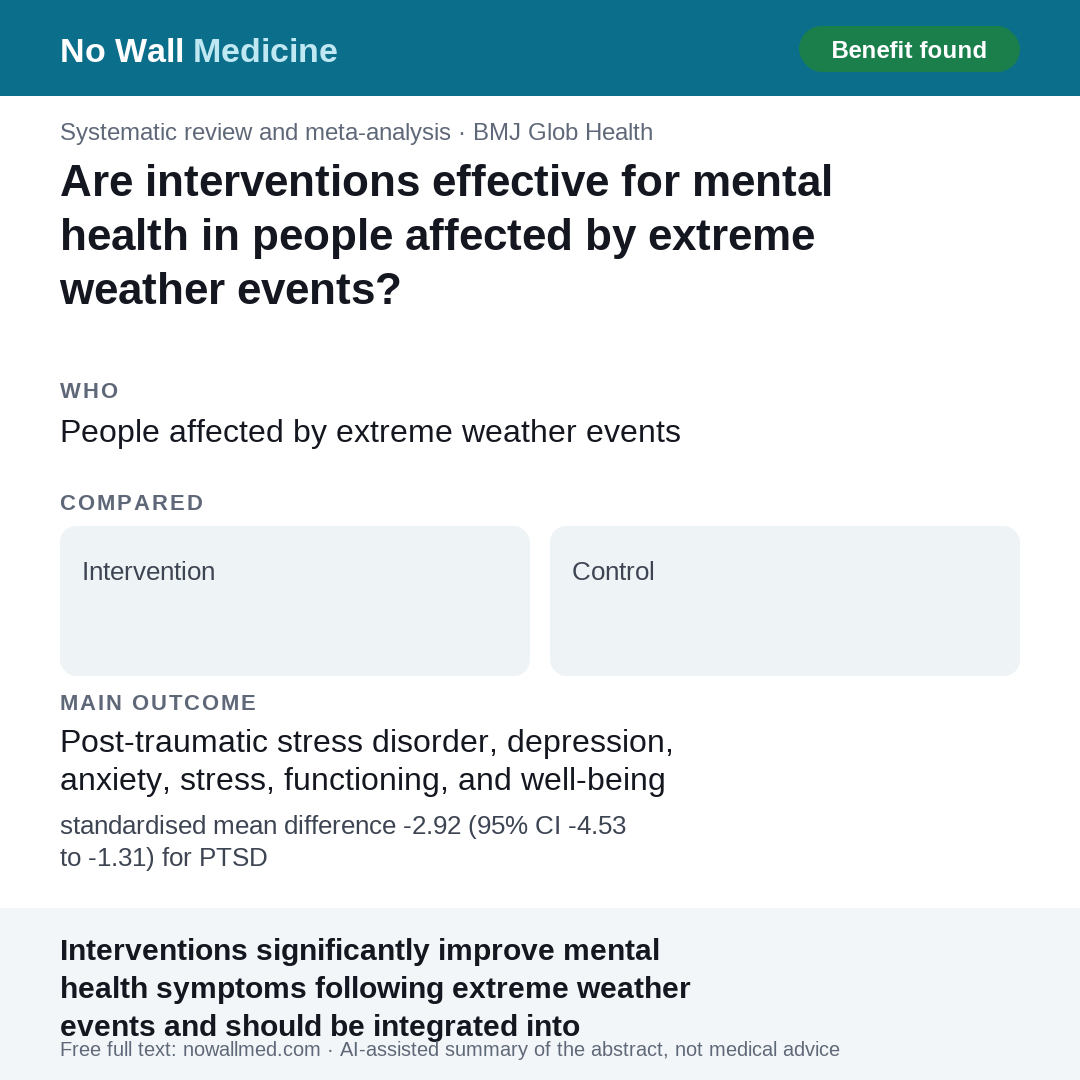
Clinical question: Are interventions effective for mental health in people affected by extreme weather events?
Why it matters: There is a need to identify effective interventions to mitigate the mental health impacts caused by climate change and extreme weather events.
Key points
- Researchers reviewed 33 studies including randomized controlled trials and before-after studies to evaluate mental health interventions following extreme weather events.
- Interventions led to significant decreases in post-traumatic stress disorder symptoms, depression, anxiety, and stress, while improving general functioning and well-being.
- Post-traumatic stress disorder symptoms decreased with a standardized mean difference of -2.92 in six intervention-control studies and -0.71 in five before-after studies.
Headline and key points written with AI from the paper’s abstract, with every number checked against it. Read the paper before relying on them.
Abstract
Introduction
Climate change leading to extreme weather events (EWEs) poses critical threat to human health, including mental well-being. As the effects of climate change are becoming more pronounced, there is a need to identify effective interventions to mitigate the mental health impacts. Methods
The aim of this review was to synthesise the existing literature on interventions to prevent and manage mental health symptoms in people affected by EWEs. We conducted a comprehensive literature search in MEDLINE, EBSCO CINAHL and Cochrane till 7 February 2024 and in Web of Science and EMBASE till 20 February 2024. Randomised controlled trials (RCTs), quasi-experimental studies and before-after study designs were included. Our search yielded 11 083 potentially relevant papers, which were screened by titles and full texts and 33 studies were finally included in the review. We recorded the study, participants, intervention, disaster and other relevant data on Excel in duplicate. We conducted a meta-analysis separately for intervention-control and before-after studies using Review Manager 5.4. The Cochrane Risk of Bias tool II was used to assess risk of bias in RCTs and the risk of bias in non-randomised studies of interventions tool for quasi-experimental and before-after designs. Main outcomes were symptoms of post-traumatic stress disorder (PTSD), depression, anxiety, stress, general functioning and well-being. Results
There was significant improvement in mental health symptoms following implementation of various interventions, leading to a decrease in PTSD symptoms (standardised mean difference (SMD) -2.92, 95% CI (-4.53 to -1.31), six intervention-control studies and SMD -0.71, 95% CI (-0.95 to -0.48), five before-after studies), depression symptoms (SMD -0.28, 95% CI (-0.53 to -0.03), three intervention-control studies and SMD -1.00, 95% CI (-1.41 to -0.59), 11 before-after studies), anxiety symptoms (SMD -0.38, 95% CI (-0.69 to -0.06), two studies and SMD -0.35, 95% CI (-0.47 to -0.23), eight before-after studies), stress symptoms (SMD -0.82, 95% CI (-1.10 to -0.53), two before-after studies), general functioning impairment (SMD -1.22, 95% CI (-1.73 to -0.70), three before-after studies) and an improvement in well-being (SMD 0.29, 95% CI (0.15 to 0.42), three intervention-control studies and SMD 0.67, 95% CI (0.25 to 1.09), two before-after studies). Conclusion
There are existing interventions to improve mental health after an EWE, and these should be integrated into all relevant disaster management plans.
Abstract reproduced under the article’s CC BY licence.
Topics
Cite this article
Das JK, Arshad Ali A, Jangda AT, Riaz N, Bhutta ZA. Systematic review and meta-analysis of interventions for mental health in extreme weather events. BMJ Glob Health. 2026. doi:10.1136/bmjgh-2025-020407
Spotted a mistake? Suggest a correction