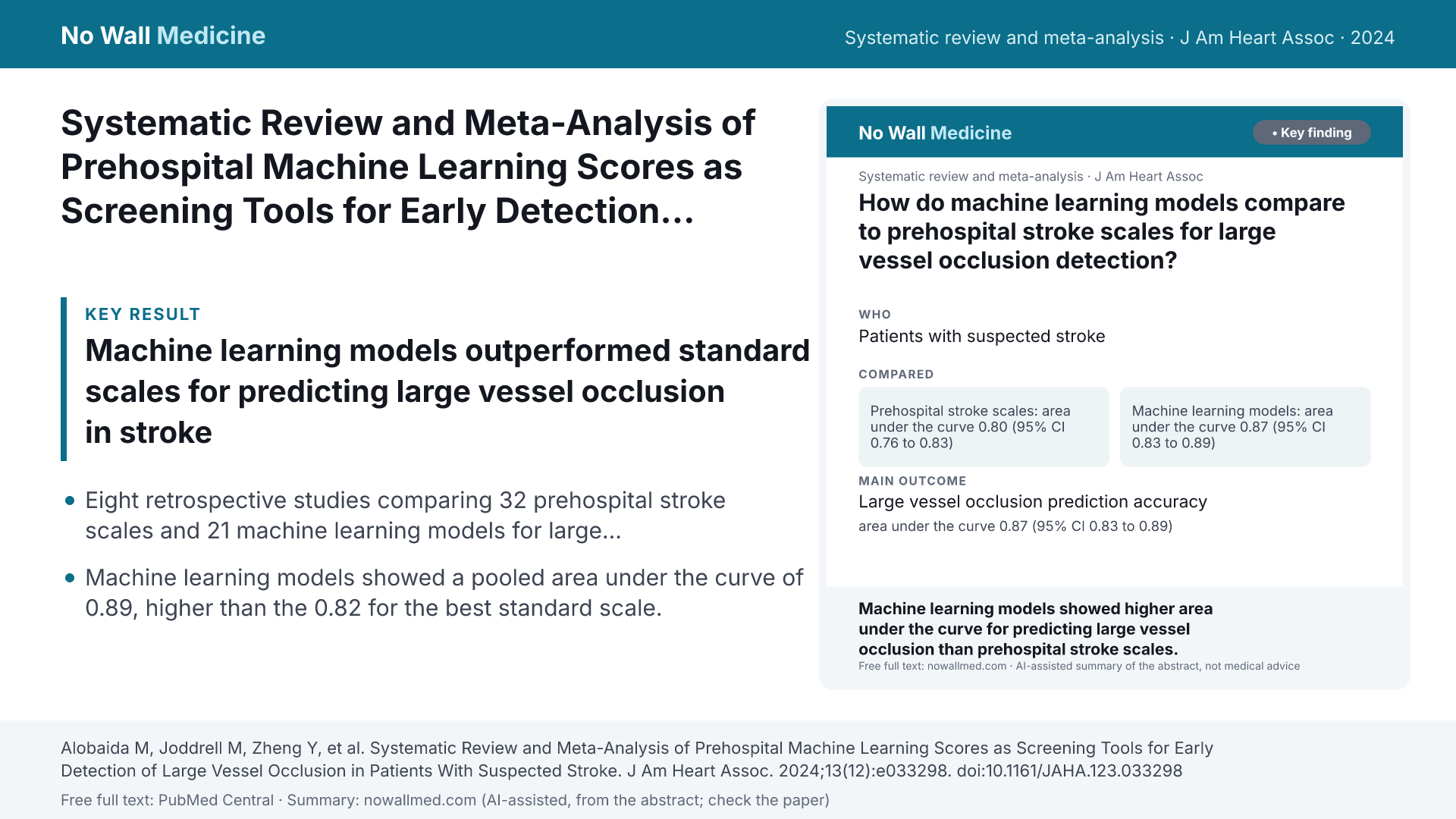
Machine learning models outperformed standard scales for predicting large vessel occlusion in stroke
Systematic Review and Meta-Analysis of Prehospital Machine Learning Scores as Screening Tools for Early Detection of Large Vessel Occlusion in Patients With Suspected Stroke
Systematic review and meta-analysisKey finding
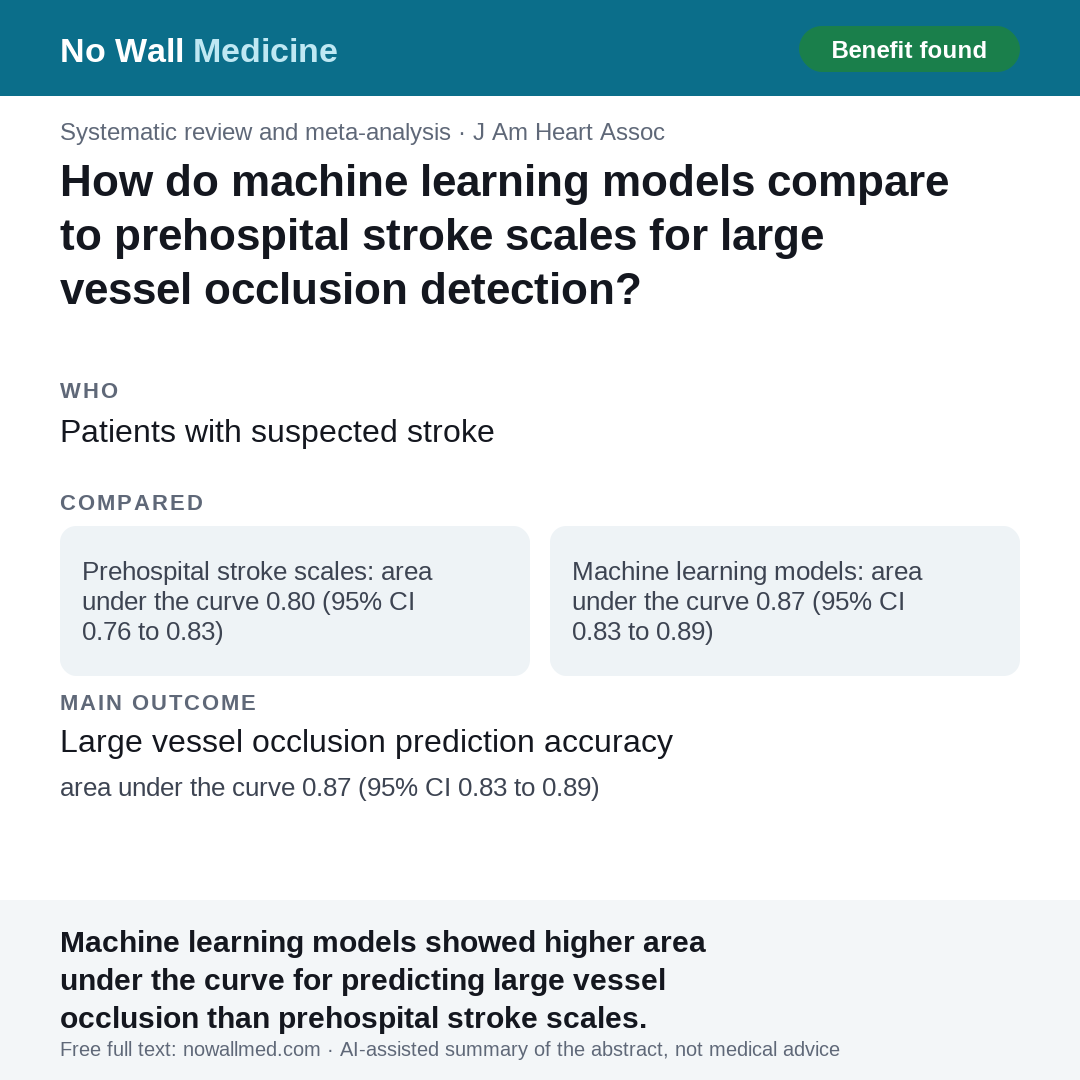
How do machine learning models compare to prehospital stroke scales for large vessel occlusion detection?
Who
Patients with suspected stroke
Compared
Prehospital stroke scales: area under the curve 0.80 (95% CI 0.76 to 0.83)
Machine learning models: area under the curve 0.87 (95% CI 0.83 to 0.89)
Main outcome
Large vessel occlusion prediction accuracy
Result: area under the curve 0.87 (95% CI 0.83 to 0.89)
Bottom line: Machine learning models showed higher area under the curve for predicting large vessel occlusion than prehospital stroke scales.
Limitation: Absence of prospective external validation, limited sample sizes, and lack of real-world performance data.
J Am Heart Assoc · 2024-06-14Download image
Clinical question: How do machine learning models compare to prehospital stroke scales for large vessel occlusion detection?
Key points
- Eight retrospective studies comparing 32 prehospital stroke scales and 21 machine learning models for large vessel occlusion were analyzed.
- Machine learning models showed a pooled area under the curve of 0.89, higher than the 0.82 for the best standard scale.
- The authors noted that real-world application is limited by the lack of prospective external validation and small sample sizes.
Limitation the authors note: The authors stated that application remains limited by the absence of prospective external validation, limited sample sizes, and lack of real-world performance data.
Headline and key points written with AI from the paper’s abstract, with every number checked against it. Read the paper before relying on them.
Was this summary helpful?
Subject terms
Headline, design, result, key points, caveat and citation as plain text.
Cite this article
Alobaida M, Joddrell M, Zheng Y, et al. Systematic Review and Meta-Analysis of Prehospital Machine Learning Scores as Screening Tools for Early Detection of Large Vessel Occlusion in Patients With Suspected Stroke. J Am Heart Assoc. 2024. doi:10.1161/JAHA.123.033298
Spotted a mistake? Suggest a correction