Artificial intelligence and machine learning show potential for movement prediction and patient assessment in robotic rehabilitation
Systematic review of AI/ML applications in multi-domain robotic rehabilitation: trends, gaps, and future directions
Systematic reviewBenefit found
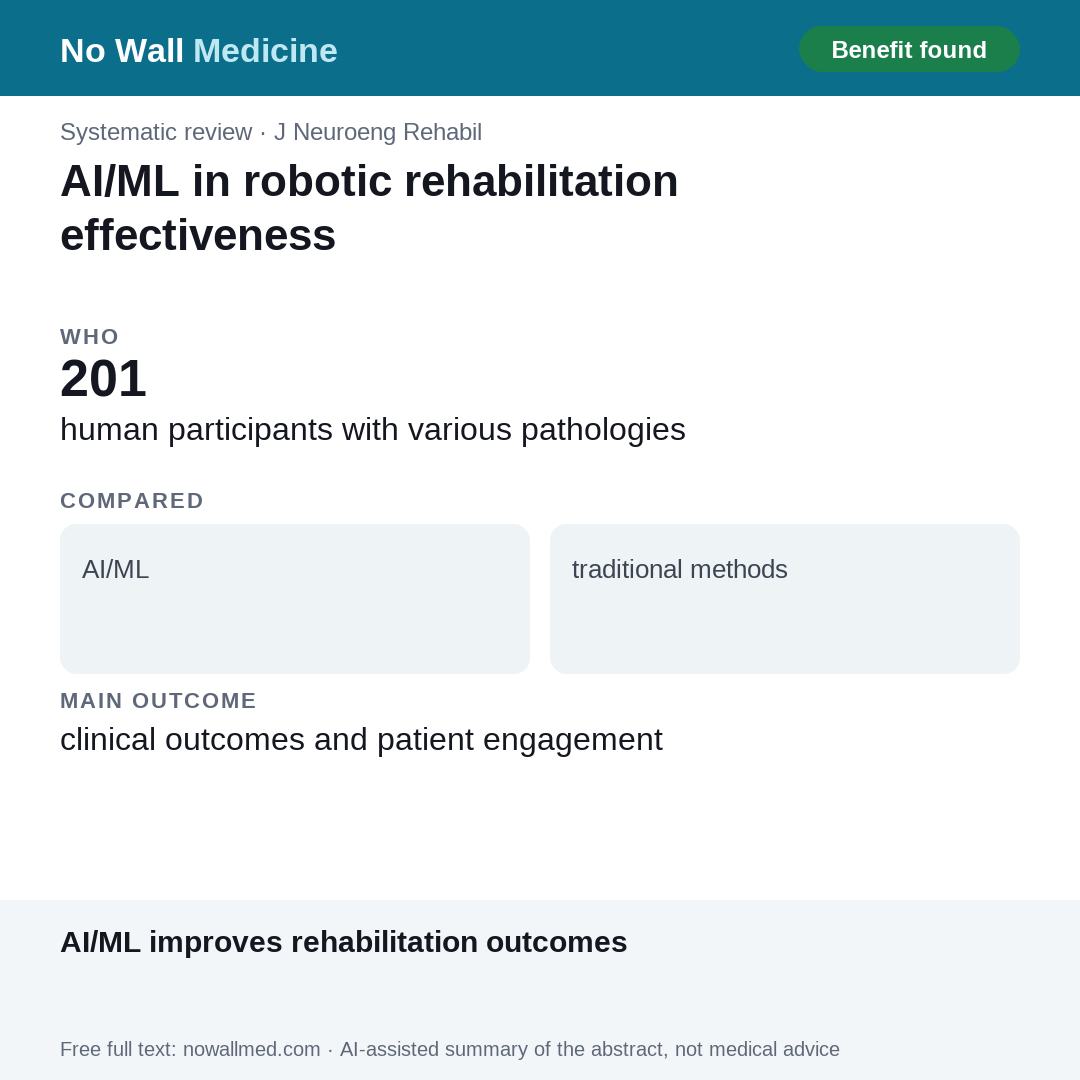
AI/ML in robotic rehabilitation effectiveness
Who
201
human participants with various pathologies
Compared
AI/ML
traditional methods
Main outcome
clinical outcomes and patient engagement
Bottom line: AI/ML improves rehabilitation outcomes
Limitation: explainability issues and poor generalization
J Neuroeng Rehabil · 2025-04-09Download image
Why it matters: The current landscape and impact of using artificial intelligence and machine learning in robotic rehabilitation across different pathologies and body districts are not fully summarized.
Key points
- Researchers performed a systematic review of 201 articles involving human participants to examine how artificial intelligence and machine learning are used in robotic rehabilitation.
- Machine learning was reported as highly effective for predicting movement intentions, assessing clinical outcomes, and detecting compensatory movements.
- The review identified potential issues regarding the explainability of these systems and their ability to generalize when applied in real-world settings.
Limitation the authors note: The authors identified potential pitfalls regarding explainability issues and poor generalization ability in real-world settings.
Headline and key points written with AI from the paper’s abstract, with every number checked against it. Read the paper before relying on them.
Was this summary helpful?
Subject terms
Cite this article
Nicora G, Pe S, Santangelo G, Billeci L, Aprile IG, Germanotta M. Systematic review of AI/ML applications in multi-domain robotic rehabilitation: trends, gaps, and future directions. J Neuroeng Rehabil. 2025. doi:10.1186/s12984-025-01605-z
Spotted a mistake? Suggest a correction
Top studies every Monday
The week’s key trials and guidelines in your specialties, plus any topics you follow. By email, free.
Get the weekly digest