Systematic review of deep learning image analyses for the diagnosis and monitoring of skin disease
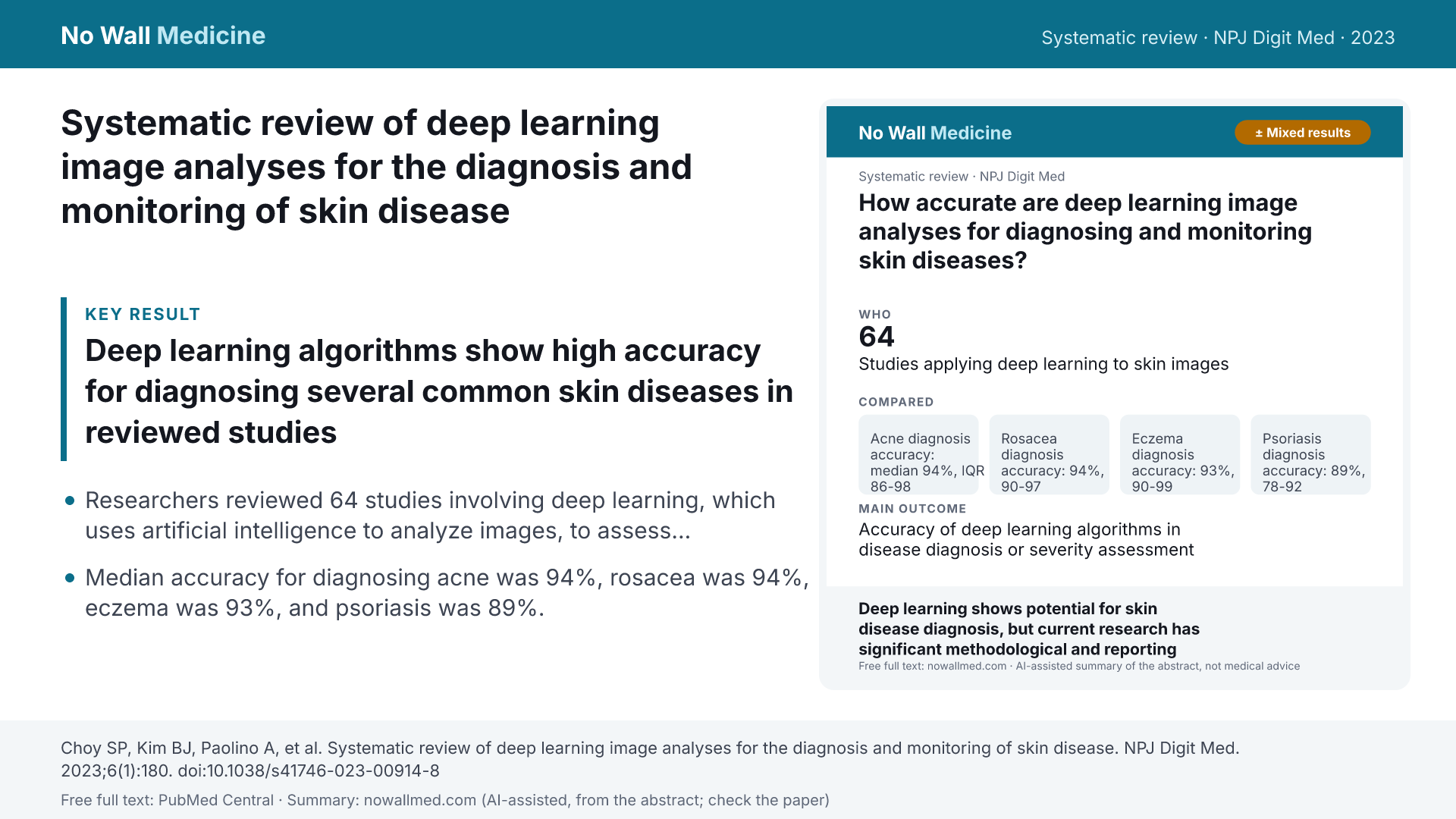
Key result: Deep learning algorithms show high accuracy for diagnosing several common skin diseases in reviewed studies
Systematic reviewMixed results
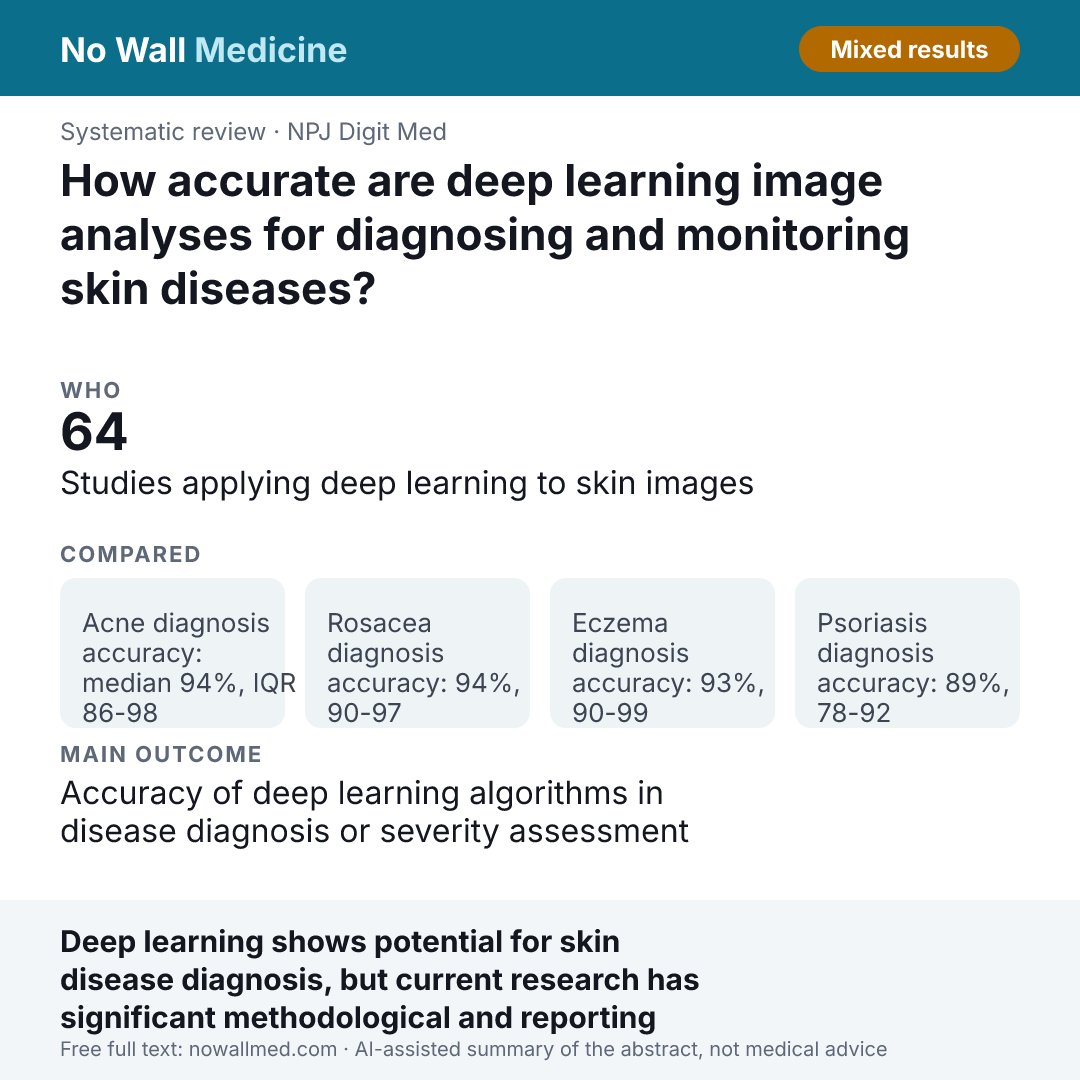
How accurate are deep learning image analyses for diagnosing and monitoring skin diseases?
Who
64
Studies applying deep learning to skin images
Compared
Acne diagnosis accuracy: median 94%, IQR 86-98
Rosacea diagnosis accuracy: 94%, 90-97
Eczema diagnosis accuracy: 93%, 90-99
Psoriasis diagnosis accuracy: 89%, 78-92
Main outcome
Accuracy of deep learning algorithms in disease diagnosis or severity assessment
Bottom line: Deep learning shows potential for skin disease diagnosis, but current research has significant methodological and reporting limitations.
Limitation: High risk-of-bias and high-level applicability concerns in most studies, with limited reporting on ethnicity or skin type.
NPJ Digit Med · 2023-09-27 · Save PNG
Key points
- Researchers reviewed 64 studies involving deep learning, which uses artificial intelligence to analyze images, to assess the accuracy of diagnosing and monitoring skin diseases.
- Median accuracy for diagnosing acne was 94%, rosacea was 94%, eczema was 93%, and psoriasis was 89%.
- Most studies had a high risk of bias, and only 12 of 64 studies reported the ethnicity or skin type of the participants.
Limitation the authors note: The authors stated that 59 (92%) studies had high risk-of-bias judgements and 62 (97%) had high-level applicability concerns.
Discussion prompts
- Would these patients look like yours? Who was left out?
- Is the main outcome one that matters to patients?
- Is the difference large enough to change what you do?
Cite: Choy SP, Kim BJ, Paolino A, et al. Systematic review of deep learning image analyses for the diagnosis and monitoring of skin disease. NPJ Digit Med. 2023;6(1):180. doi:10.1038/s41746-023-00914-8
Free full text: PubMed Central · Summary and visual abstract: nowallmed.com/a/systematic-review-of-deep-learning-image-analyses-for-the-diagnosis-1n0kih8/ (AI-assisted from the abstract; check the paper before relying on it).